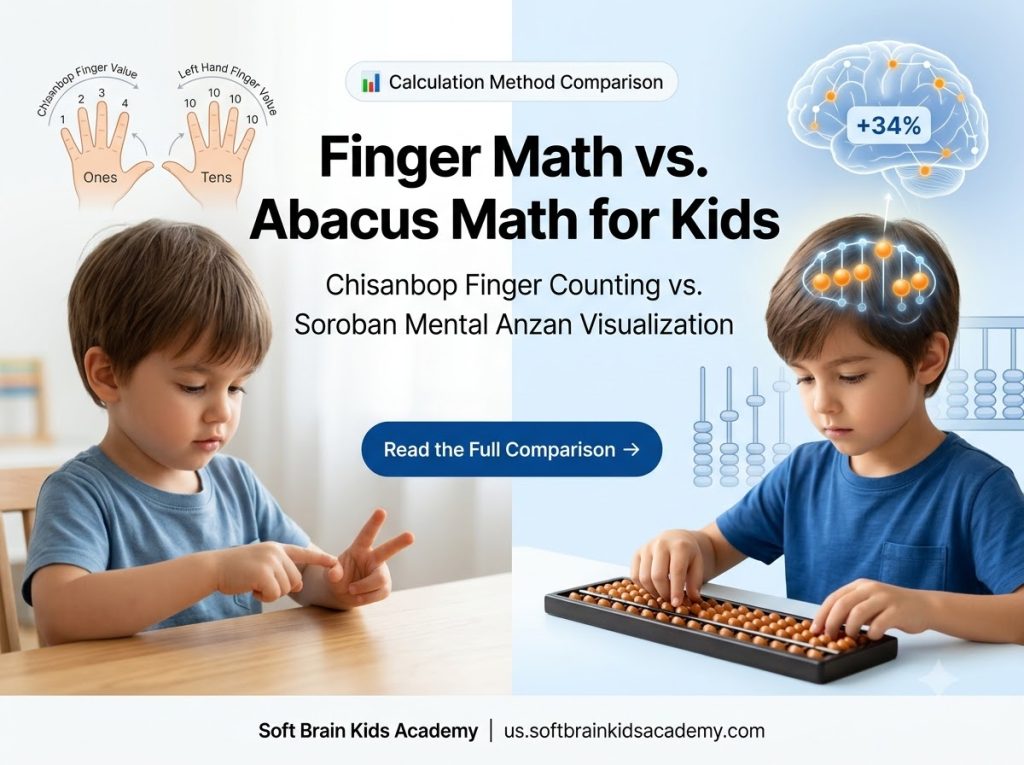

Finger Math vs. Abacus Math for Kids: 2026 Comparison & Guide
At a Glance: Finger Math vs. Abacus Math
Compare Finger Math (Chisanbop) vs. Abacus Math (Soroban) in this comprehensive 2026 guide. Analyze differences in calculation speed, multi-digit capacity, working memory expansion (+34%), and learn how to transition your child from finger counting to mental abacus Anzan mastery.
When young children begin their mathematical journey, their very first calculator is already attached to their hands — their ten fingers. Finger counting is a natural, neurobiologically grounded stage of child development. However, as children progress through elementary school, parents often ask: “Is finger counting enough, or should my child transition to structured Abacus math?”
To answer this question, it is essential to compare standard Finger Math — including structured systems like Korean Chisanbop — against the Soroban abacus for brain development system.
At SoftBrain Kids Academy, we view finger counting as an outstanding early bridge for preschoolers aged 4 to 5. However, to scale beyond 2-digit numbers, build working memory, and achieve multi-digit mental math fluency, transitioning to Soroban abacus Anzan is essential. Read our related guides on abacus for preschoolers and how to improve math speed for kids.

What is Finger Math (Chisanbop)? Strengths & Hard Limits
Finger Math encompasses both natural finger counting and structured systems like Chisanbop. In Chisanbop, the right hand represents ones (thumb = 5, fingers = 1 each; max 9) and the left hand represents tens (thumb = 50, fingers = 10 each; max 90). Pressing fingers against a tabletop allows a child to calculate up to 99.
Strengths: Always available, zero cost, builds early finger gnosia and fine motor coordination for ages 4 to 6.
Hard Limits: Cannot scale beyond 99, cannot perform multi-digit multiplication or division efficiently, and does not create an internal visual memory image once fingers are removed.
🚀 Upgrade Your Child’s Math Brain Beyond Finger Counting
Our live Soroban abacus classes teach children to calculate multi-digit numbers mentally in seconds. Book a free trial class.
Book Free Trial Class →What is Abacus Math (Soroban)? Infinite Scaling & Anzan Visualization
Soroban Abacus Math uses a 1:4 wooden bead frame representing place values (ones, tens, hundreds, thousands, millions). Abacus math scales infinitely to multi-digit addition, subtraction, multiplication, division, decimals, and square roots. Most importantly, as children progress, they move to mental Anzan — visualizing the abacus frame in their mind’s eye to compute complex arithmetic without physical tools. Read our guide on how abacus works step-by-step.
Neuroscience Comparison: Motor Pressing vs. Bilateral Brain Activation
Neuroimaging studies reveal a dramatic cognitive difference between finger math and mental abacus Anzan:
- Finger Math Neural Path: Engages the motor cortex and sensory-motor strip. Excellent for basic early counting, but does not stimulate spatial memory rotation.
- Abacus Mental Anzan Neural Path: Stimulates both the left logical cortex AND right visual-spatial parietal cortex simultaneously. This bilateral dual-brain activation expands visual working memory span by 34% and permanently strengthens corpus callosum white-matter tract connectivity. Explore abacus learning benefits for brain.
Finger Math vs. Abacus Math Master Comparison Table
| Feature | Finger Math (Chisanbop) | Abacus Math (Soroban Anzan) |
|---|---|---|
| Calculation Capacity Limit | Max 99 (2-digit numbers) | Infinite (multi-digit, decimals, roots) |
| Working Memory Impact | Basic motor memory | +34% visual-spatial working memory expansion |
| Calculation Speed | Moderate (limited by finger pressing) | ⚡⚡⚡⚡⚡ (Competition Anzan speed) |
| Ideal Age Range | Ages 4–6 (Preschool / Early K) | Ages 5–14 (Elementary & Middle School) |
The Ideal Progression: When & How to Transition Your Child
Follow this natural 3-stage progression to maximize your child’s cognitive development:
- Stage 1 (Ages 4–5): Encourage natural finger counting and skip-counting games to establish basic number sense.
- Stage 2 (Ages 5–7): Transition to a physical Soroban abacus. Learn single-digit bead complement rules. Read best age to learn abacus.
- Stage 3 (Ages 7–14): Master mental Anzan visualization for multi-digit multiplication and division speed.
Step-by-Step Parent Guide: Transitioning from Finger Counting to Abacus
Transitioning a child from simple finger counting to Soroban abacus math is a smooth, rewarding process when managed with care. Here is a step-by-step roadmap for parents:
Step 1 — Validate Finger Counting (Don’t Ban Fingers): Never tell a young child that finger counting is ‘wrong’ or ‘childish.’ Research in pediatric neuroscience shows finger counting (finger gnosia) is a vital bridge. Validate their effort while introducing the abacus frame as an exciting ‘super-calculator tool.’
Step 2 — Map Fingers to Abacus Beads (The 1:4 Rule): Show your child how the abacus mirrors their hand. The upper bead represents 5 (just like the thumb in Chisanbop finger math), while the four lower beads represent 1 each (just like the four fingers). This direct visual analogy makes the transition instantaneous.
Step 3 — 5-Minute Daily Physical Bead Drills: Practice sliding beads for 5 minutes daily. Start with simple single-digit addition (1 + 2, 3 + 1, 5 + 2). As bead movement becomes automatic, the child naturally stops reaching for their fingers because moving abacus beads is faster and more tactile.
Step 4 — Introduce Mental Anzan Visualization: Ask your child to close their eyes and ‘see’ the wooden beads moving inside their head. Start with single-digit additions, then progress to 2-digit numbers. Within 8 to 12 weeks, your child will calculate multi-digit arithmetic in their head without touching their fingers or a physical abacus!
Read our comprehensive parent guides on abacus addition and subtraction rules, abacus training at home, and math fluency activities for kids.
🏆 Transition Your Child to Mental Abacus Anzan Today
Book a free trial class at SoftBrain Kids Academy. Watch your child move from finger counting to multi-digit mental speed.
Book Free Trial Class →