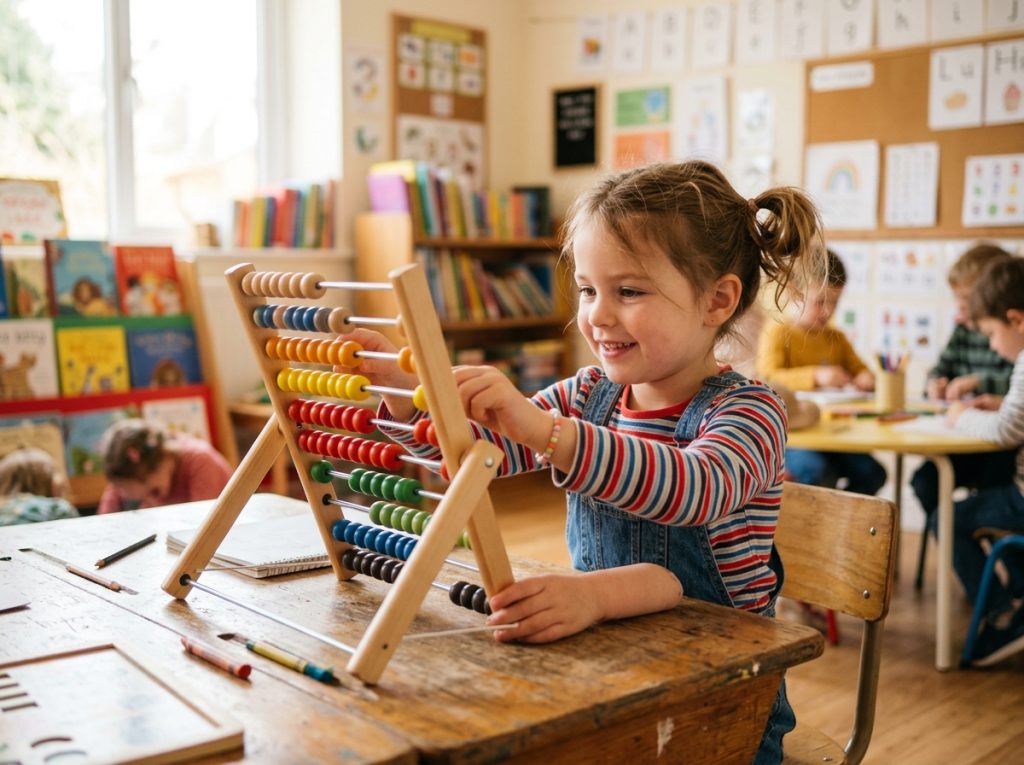

Abacus Math for 2nd Grade: Essential Parent Guide to Mental Math & Concentration
TL;DR Direct Answer: Abacus math for 2nd grade (ages 7–8) develops early numerical fluency by training children to visualize physical bead movements in their brain’s right hemisphere. This visual-spatial method allows 2nd graders to compute 2-digit and 3-digit mental addition in under 3 seconds, directly supporting Common Core place value standards (CCSS 2.NBT) and eliminating early math anxiety.
Quick Summary — Abacus Math for 2nd Graders
Second grade (ages 7 to 8) represents the golden neurodevelopmental window for starting abacus math training. In 2nd grade, children transition from single-digit counting to double-digit addition, subtraction, place value, and regrouping. Abacus math for 2nd grade builds a physical bead-based mental model in the brain’s right hemisphere, allowing students to perform 2-digit and 3-digit mental addition in under 3 seconds without relying on finger counting.
Second grade is a pivotal year in elementary math education. As students step out of 1st-grade simple counting into 2nd-grade double-digit addition, regrouping (carrying and borrowing), and word problems, many experience their first encounter with math anxiety. When parents search for effective interventions, abacus math for 2nd grade emerges as the single most effective tool for building permanent numerical fluency.
Rather than relying on abstract numbers on a worksheet, abacus training turns arithmetic into a visual and tactile game. Children physically touch and slide beads on a Japanese soroban frame, linking abstract place value concepts (ones, tens, hundreds) to tangible physical movements. Within 6 months of live online abacus classes, 2nd graders transition from physical bead sliding to Anzan (mental visualization), computing rapid calculations faster than a handheld calculator.
| Key Insight | 2nd Grade Developmental Reality |
|---|---|
| Neuroplasticity Window | Ages 7–8 exhibit maximum growth in visual working memory. Bead mental images form 3x faster than in older children. |
| Ending Finger Counting | 2nd graders who count on fingers hit a wall when adding numbers > 20. Abacus replaces fingers with 4-rod visual memory. |
| Place Value Mastery | Soroban rods represent Ones, Tens, and Hundreds. 2nd graders physically see regrouping (‘Small Friend’ & ‘Big Friend’ rules). |
| Attention Span Extension | Tactile bead manipulation increases focused attention span from 8 minutes to 25 minutes during math tasks. |
| Confidence & Speed | 2nd graders complete 2-digit mental addition in under 3 seconds, eliminating classroom math anxiety. |
1. What is Abacus Math for 2nd Grade? (Definition & Core Concept)
Abacus math for 2nd grade is a visual-spatial calculation methodology that utilizes a 17-rod Japanese Soroban abacus board to teach 7 and 8-year-old children place value, multi-digit addition, subtraction, and mental arithmetic.
Unlike traditional 2nd-grade classroom math that relies on paper pencil algorithms or line counting, abacus training translates numbers into physical bead configurations. Each vertical rod represents a decimal place value (Ones, Tens, Hundreds, Thousands). By physically sliding upper beads (value of 5) and lower beads (value of 1), 2nd-grade students internalize mathematical relationships tactilely and visually before transitioning to Anzan (mental bead imagery).
2. Why 2nd Grade is the Perfect Age to Learn Abacus
Developmental psychologists refer to ages 7 and 8 as the “concrete operational transition.” At this stage, 2nd graders possess the fine motor skills to slide small soroban beads accurately, while their brains are rapidly forming visual-spatial neural pathways.
If a child starts abacus too early (e.g., age 4), motor coordination can be frustrating. If they start too late (e.g., age 11), their left-brain verbal memory habits are already entrenched, making right-brain bead visualization harder to adopt. 2nd grade is the sweet spot.
Neuroimaging studies demonstrate that when 2nd-grade children perform abacus mental math, both hemispheres of the brain are activated simultaneously. The left hemisphere handles the logical rules of arithmetic, while the right hemisphere visualizes the movement of beads on a mental screen. This bilateral brain activation builds superior working memory capacity that benefits all academic subjects.
3. How Abacus Aligns with 2nd Grade Common Core Math
US elementary schools follow Common Core standards that place immense focus on Number & Operations in Base Ten (CCSS.MATH.CONTENT.2.NBT). Here is how abacus training maps directly to 2nd-grade classroom expectations:
| 2nd Grade Common Core Standard | School Classroom Expectation | Abacus Math Equivalent Skill |
|---|---|---|
| CCSS.MATH.CONTENT.2.NBT.A.1 | Understand 3-digit numbers represent amounts of hundreds, tens, and ones. | Setting digits on vertical Soroban rods (Rods C, B, A = 100s, 10s, 1s). |
| CCSS.MATH.CONTENT.2.NBT.B.5 | Fluently add and subtract within 100 using strategies based on place value. | Applying ‘Small Friends’ (+4 = +5 -1) and ‘Big Friends’ (+9 = +10 -1) formulas. |
| CCSS.MATH.CONTENT.2.NBT.B.8 | Mentally add 10 or 100 to a given number 100–900. | Flicking upper bead (val: 5/50/500) and lower beads instantly during Anzan drills. |
| CCSS.MATH.CONTENT.2.NBT.B.9 | Explain why addition and subtraction strategies work using place value properties. | Explaining bead movement logic when regrouping across rods. |
4. 2nd Grade Abacus Learning Milestones (Level 1 to 3)
When a 2nd grader joins SoftBrain Kids Academy, they progress through structured 3-month milestones:
Level 1: Direct Operations (Months 1–3)
Mastering 1-digit and simple 2-digit addition without carryover. Building physical finger speed (thumb for lower beads, index for upper bead).
Level 2: Regrouping Formulas (Months 4–6)
Learning ‘Small Friend’ (base 5) and ‘Big Friend’ (base 10) bead combinations. Solving long sums of five 2-digit numbers in under 10 seconds.
5. Abacus vs. Standard School Worksheets: Comparison Table
| Feature | 🧮 Abacus Math Training | 📝 Standard Written Worksheets |
|---|---|---|
| Learning Mode | Tactile & Visual Bead Imagery | Rote Symbol Memorization & Pencil Drills |
| Calculation Speed | 2 to 3 seconds per 2-digit sum | 15 to 30 seconds per problem |
| Brain Activation | Bilateral (Right visual + Left logical) | Unilateral Left Brain dominant |
| Math Anxiety Impact | Eliminates fear through visual success | Often triggers timed test anxiety |
6. Recommended Daily 15-Minute Practice Schedule
Consistency is the secret to 2nd-grade abacus mastery. Rather than a single 2-hour cram session once a week, follow this 15-minute daily home routine:
| Time Slot | Activity | Parent Role |
|---|---|---|
| Minutes 0–3 | Physical Abacus Warm-Up (Flicking lower & upper beads 1–100) | Ensure correct finger technique (thumb up, index down). |
| Minutes 4–10 | Targeted Worksheet / Digital App Drills (2-digit addition) | Monitor quiet focus space without interrupting. |
| Minutes 11–15 | Anzan Flash Mental Math (Visualizing imaginary beads) | Call out 3 numbers out loud for mental calculation. |
7. Common Misconceptions About 2nd Grade Abacus
- Myth 1: Abacus relies on a physical calculator.
Fact: The physical soroban frame is only used for the first 3 months. Afterwards, 2nd graders calculate entirely in their mind’s eye using imaginary beads (Anzan). - Myth 2: Abacus conflicts with school math methods.
Fact: Abacus does not alter math logic. It accelerates internal arithmetic processing speed so students complete school scratchwork in seconds. - Myth 3: Abacus is only for gifted math prodigies.
Fact: Abacus is a developmental tool that helps average or struggling 2nd graders build confidence and overcome math anxiety.
Boost Your 2nd Grader’s Math Speed Today
Book a FREE 1-on-1 trial class for your 7 or 8-year-old with SoftBrain’s certified elementary abacus coaches.