
Abacus Math for 2nd Grade: Why 7-Year-Olds Master Mental Math 3x Faster
TL;DR Direct Answer: Enrolling in abacus math for 2nd grade gives 7-year-old students a powerful cognitive advantage. Second grade is the ideal developmental age because children have mastered basic digit writing but have not yet developed rigid finger-counting dependencies. Through tactile Soroban bead movements, 2nd graders learn to visualize place value, solving 2-digit and 3-digit mental addition in under 3 seconds.
Quick Summary — Abacus Math for 2nd Grade Students
Second grade marks a crucial leap in US elementary mathematics. Curriculum standards move rapidly from single-digit counting to 3-digit place value, regrouping, and word problems. Introducing abacus math for 2nd grade bridges abstract paper math with concrete spatial beads, building permanent calculation speed, photographic memory, and razor-sharp concentration.
| Learning Area | 🏫 Standard 2nd Grade School Expectation | 🧮 2nd Grade Abacus Math Achievement |
|---|---|---|
| Addition & Subtraction | 2-digit regrouping on paper using scratch lines | 3-digit mental addition in under 3 seconds without paper |
| Place Value Intuition | Identifies ones, tens, and hundreds digits on worksheets | Physical rod visualization of values up to 999,999 |
| Calculation Speed | Solves 10 basic math facts per minute with finger tapping | Solves 40+ mental math equations per minute |
| Focus & Attention Span | 10 to 15 minutes of quiet worksheet desk focus | 30 to 45 minutes of sustained visual concentration |
1. Why 2nd Grade is the Golden Window for Abacus Math
Educational neuroscientists highlight 2nd grade (ages 7 to 8) as the ultimate sweet spot for starting abacus math for 2nd grade. At age 7, a child’s brain exhibits peak synaptic plasticity in the parietal cortex—the region responsible for visual-spatial processing and mathematical quantity representation.
In 1st grade, children are still developing basic fine motor pencil grip and reading comprehension. By 3rd grade, inefficient calculation habits like counting on fingers or tapping pencils become deeply ingrained muscle memory. Second grade presents the perfect developmental window: 7-year-olds have the motor dexterity to flick small Soroban beads accurately while remaining open to new visual calculation strategies.
When children practice abacus math for 2nd grade at SoftBrain Kids Academy, they learn to translate written numbers into physical bead coordinates. This dual touch-and-see feedback loop builds intuitive number sense that stays with them throughout middle school algebra and high school calculus.
| Cognitive Skill | How Abacus Training Develops It | Real-World Academic Result |
|---|---|---|
| Photographic Memory | Child holds a 4-rod bead image mentally (Anzan) | Faster reading comprehension & vocabulary retention |
| Bilateral Brain Activation | Thumb & index finger bead manipulation across rods | Equal stimulation of spatial and logical brain hemispheres |
| Subitizing Ability | Instantly recognizes quantity without counting beads 1-by-1 | Eliminates finger counting and exam stress panic |
| Spatial Working Memory | Tracks carried numbers as bead positions on rods | Higher performance in STEM geometry and science diagrams |
2. How Abacus Math Transforms 2nd Grade Math Skills
The core hurdle in 2nd grade school math is multi-digit addition and subtraction with regrouping (carrying and borrowing). On paper, children are taught abstract rules like “drop the 4, carry the 1.” To a 7-year-old, these abstract pencil rules often feel arbitrary and confusing, leading to frequent calculation errors.
Abacus math for 2nd grade solves this by making place value tangible. A standard Japanese Soroban abacus features vertical rods divided by a horizontal beam:
- Lower Rods (Earth Beads): Each of the 4 lower beads has a value of 1. Pushing beads up toward the beam adds value; pulling them down subtracts value.
- Upper Rods (Heaven Beads): The single upper bead on each rod has a value of 5. Pulling it down toward the beam adds 5.
- Vertical Rod Place Value: The rightmost rod represents Ones ($10^0$), the second rod represents Tens ($10^1$), the third represents Hundreds ($10^2$), and so on.
When adding $47 + 38$, a 2nd grader does not memorize carrying rules. Instead, they apply ‘Big Friends’ formula rules (e.g. $+8 = -2 + 10$), physically sliding beads on the Tens and Ones rods. Within 12 weeks of live online coaching, students move from the physical abacus frame to mental Anzan, visualizing imaginary beads moving in their mind’s eye at lightning speed.
| Abacus Level | Focus Topic & Formula Rules | Mental Math Outcome |
|---|---|---|
| Level 1 (Foundation) | Direct addition & subtraction (1 to 4 beads) | Single-digit mental sums in under 1 second |
| Level 2 (Small Friends) | 5-combinations ($+4 = +5 – 1$, $+3 = +5 – 2$) | 2-digit mental addition without paper scratchpad |
| Level 3 (Big Friends) | 10-combinations ($+9 = -1 + 10$, $+8 = -2 + 10$) | Multi-digit addition & subtraction with regrouping |
| Level 4 (Advanced Anzan) | Speed flash mental drills & introductory multiplication | 3-digit mental addition in under 3 seconds |
3. Eliminating Math Anxiety & Building Lifelong Confidence
Math anxiety among elementary students in the US has risen sharply over the past decade. Timed arithmetic quizzes in 2nd grade often cause young children to freeze, leading to negative self-talk like “I’m just not good at math.”
Abacus math for 2nd grade rebuilds emotional security around numbers. Because the abacus is a physical kinetic tool, children view calculation as a game rather than an intimidating test. When a mistake occurs, the beads clearly show where the error happened, allowing the student to adjust bead placement without shame.
As 2nd graders master mental Anzan, they experience a profound psychological shift. Being able to compute $358 + 429$ mentally in front of peers or teachers instills genuine academic confidence that carries over into reading, science, and public speaking.
| Day | Activity Type | Duration | Goal |
|---|---|---|---|
| Saturday / Sunday | Live 1-on-1 Zoom Class with Certified Coach | 60 Minutes | Learn new formula rules & receive camera feedback |
| Monday & Tuesday | Gamified Micro-App Bead Drills | 10–15 Minutes | Reinforce speed & finger muscle memory |
| Wednesday & Thursday | Mental Anzan Flash Card Practice | 10–15 Minutes | Build visual bead image projection in mind’s eye |
| Friday | Rest & Fun Math Game Day | Off | Allow brain neuroplastic consolidation |
4. The SoftBrain Advantage: Live 1-on-1 Online Coaching for 2nd Graders
Not all online abacus programs are created equal. Pre-recorded video courses or large group Zoom sessions often fail for 2nd graders because young children need continuous real-time feedback on finger technique.
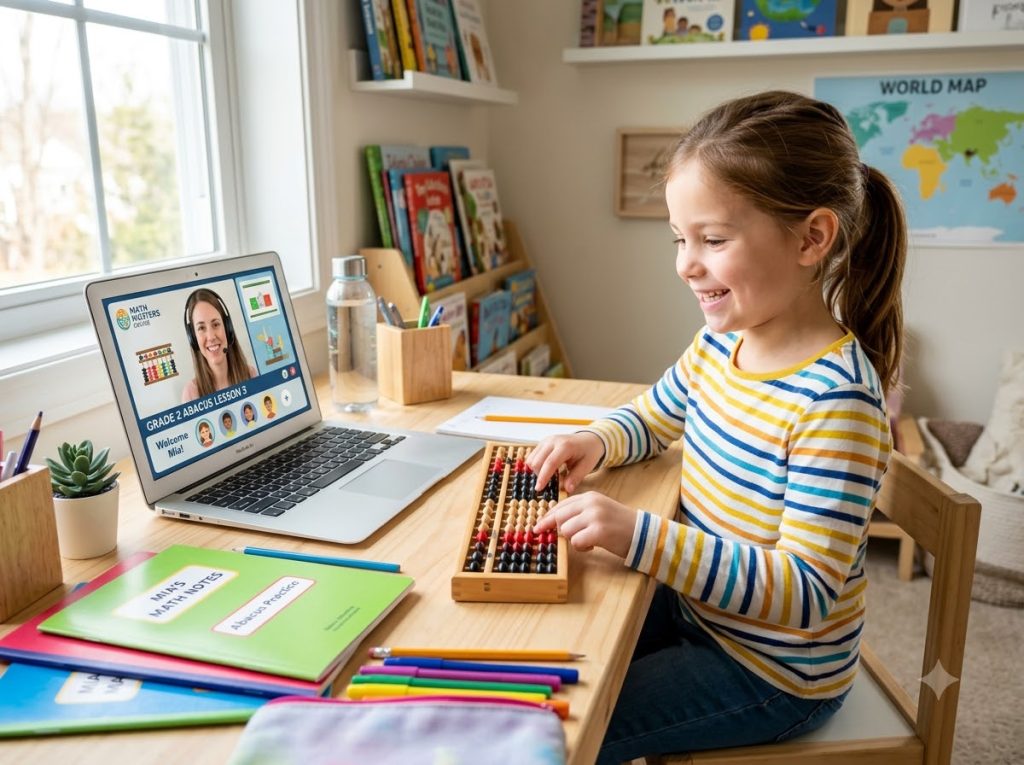
At SoftBrain Kids Academy, our abacus math for 2nd grade curriculum combines live 1-on-1 private coaching with cutting-edge digital app tools:
- Certified Live Coaches: Experienced instructors observe your child’s hands via webcam, correcting thumb and index finger movements in real time.
- Gamified App Platform: 10-minute daily home practice modules with instant digital scoring and fun rewards keep 7-year-olds motivated.
- Free Physical Abacus Kit: Shipped directly to your home upon enrollment, ensuring your 2nd grader gets authentic tactile Soroban practice.
| Program Feature | 🧮 SoftBrain Online Abacus for 2nd Grade | 🏬 Commercial Math Centers (Kumon/Mathnasium) |
|---|---|---|
| Instructional Method | Live 1-on-1 Coaching + Visual Anzan | Rote paper worksheets or self-guided desks |
| Calculation Speed Growth | 3x Faster Mental Processing in 90 Days | Gradual paper drill progression |
| Monthly Tuition Cost | $60 – $95 / month | $150 – $250 / month |
| Parent Commute Stress | Zero (Learn comfortably at home) | 2 driving trips per week in traffic |
Give Your 2nd Grader a 3x Mental Math Advantage
Book a FREE 1-on-1 live demo class with SoftBrain’s certified abacus coaches and receive a free Soroban abacus kit upon enrollment.