
15 Proven Benefits of Abacus for Kids: A Science-Backed Parent’s Guide (2026)
Quick Summary — Benefits of Abacus for Kids
Abacus training is an evidence-based whole-brain development program. By transitioning from a physical abacus to mental bead visualization, children build visual-spatial pathways that lead to 15+ cognitive benefits, including 60%+ faster calculation speeds, enhanced working memory capacity, photographic memory, and visual concentration limits.
If you are a parent looking to help your child succeed academically, you have probably considered enrolling them in extracurricular programs. In a world full of digital calculators, learning an ancient math frame might seem old-fashioned. However, pediatric neuroscience shows that the benefits of abacus for kids go far beyond learning arithmetic. It serves as an active brain development program that strengthens how children process numbers, focus on tasks, and recall information under pressure.
At SoftBrain Kids Academy, our certified developmental trainers have watched thousands of students upgrade their focus, calculation speed, and confidence. In this science-backed parent’s guide, we detail the 15 primary benefits of abacus for kids, explore the brain science behind mental imagery, and look at how to pick the right program for your child.
1. What is Abacus Training?
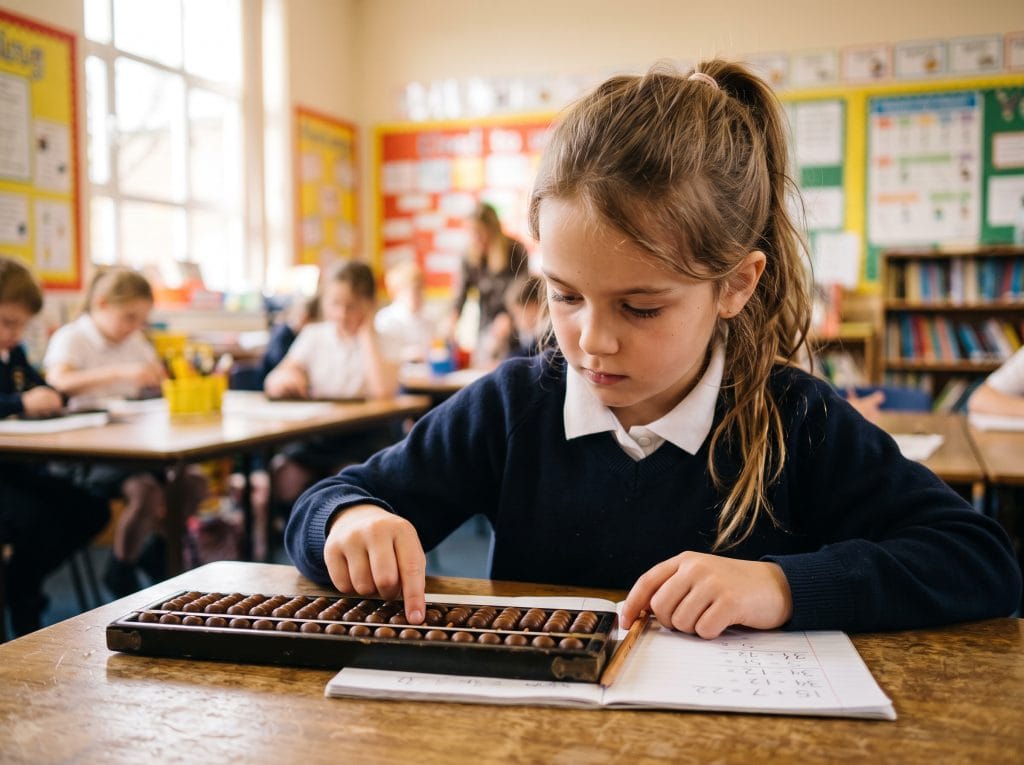
An abacus is a manual calculation framework composed of rows of sliding beads set on vertical wires. By moving these beads with a system of finger movements, users represent numbers and execute arithmetic.
Modern abacus training, however, is not just about using a physical tool. It uses a structured three-phase development cycle:
- Tactile Phase: Kids learn calculations by sliding beads on a physical wooden or plastic abacus, aligning their motor skills with numerical values.
- Visualization Phase: Kids begin removing the physical frame and learn to visualize the abacus grid clearly inside their head.
- Mental Abacus Mastery: Kids execute high-speed mental calculations by visualising bead shifts in their mind’s eye, requiring no physical instruments.
2. 15 Proven Benefits of Abacus for Kids
Structured abacus classes online develop diverse mental systems. Below are the 15 primary benefits validated by developmental psychology and child research studies.
1. Double the Calculation Speed
By representing numbers as spatial bead shapes, kids skip the slow verbal translation step. Mental abacus users process math formulas 2x faster than peers using written formulas, helping them complete math exams quickly. This is one of the most obvious benefits of abacus for kids when they demonstrate arithmetic speeds.
2. Stronger Visual Working Memory
Mental math requires kids to hold visual layouts of abacus beads in their head while calculating. This visual memory training is a powerful cognitive workout that expands working memory limits.
3. Measurably Better Classroom Focus
Calculating mentally on a virtual abacus frame requires complete focus. Distractions instantly drop the mental image, forcing children to practice filtering out noise to get the correct answer. The benefits of abacus for kids include building a high attention ceiling.
4. Balanced Brain Hemispheres
Standard calculations utilize the logical left brain. Mental abacus forces kids to visualize bead patterns (right brain) and apply math formulas (left brain) simultaneously, building stronger connections between both hemispheres.
5. Higher Photographic Memory Potential
Students practice translating numbers into bead snapshots instantly. This constant visualization practice builds photographic memory skills, helping kids recall diagrams, spelling, and facts.
6. Greater Spatial Reasoning Skills
Mental calculations are processed as spatial movements in the brain’s parietal lobe. This strengthens visual-spatial skills that are highly beneficial for STEM subjects, geometry, and coding.
7. Reduced Math Anxiety
Math anxiety typically stems from a fear of abstract numbers. The abacus turns math into a hands-on, visual game, replacing confusion with clear bead patterns. By seeing the direct benefits of abacus for kids, children feel more capable and self-reliant.
8. Higher Auditory Processing Accuracy
During abacus practice, trainers read numbers aloud at high speeds. Students listen closely, translate the spoken words into bead layouts, and calculate, which builds sharp auditory focus.
9. Faster Brain Processing Speed
With regular practice, visual calculations become automatic. The neural pathways handling math work faster, improving overall information processing speeds.
10. Deep Number Sense
Instead of memorizing rules, students understand place value, carrying, and borrowing visually on the abacus frame. This builds a strong math foundation for advanced studies.
11. Better Fine Motor Skills
Quickly moving small beads using specific finger patterns develops fine motor skills. This tactile feedback stimulates the motor cortex, benefiting overall brain activity.
12. Intuitive Arithmetic Logic
The structure of the soroban abacus (using groups of 5 and 10) teaches kids to break down numbers logically. This structural understanding makes learning division and decimals much easier.
13. Greater Self-Esteem
Succeeding in mental math builds confidence. Standing out in class by solving complex math equations mentally shows kids they can conquer difficult subjects.
14. Improved Academic Endurance
Mental abacus training is rigorous and requires sustained effort. Overcoming challenging levels teaches kids grit, helping them stay determined when facing tough school projects.
15. Lifelong Cognitive Resilience
The structural brain upgrades built during childhood stay with them. Neuroscientific research suggests early brain-training builds cognitive reserves that support analytical thinking for life.
| Cognitive Area | Traditional Teaching (Left-Brain Only) | Mental Abacus Model (Whole-Brain) |
|---|---|---|
| Math Processing | Translating words to abstract numbers | Direct visual bead visualization |
| Calculation Speeds | Vocalizing math steps internally (slow) | Instant spatial layout shifts (fast) |
| Memory System | Short-term rote memory retention | Photographic working memory |
| Focus Style | Vulnerable to screen distraction | Active concentration discipline |
3. The Neuroscience of Mental Beads Visualization
What happens inside a child’s brain during mental abacus calculation? Clinical neuroimaging research provides fascinating answers.
Standard mathematics relies heavily on verbal systems in the left hemisphere (specifically Broca’s and Wernicke’s areas). This is why kids calculate by reciting rules internally (e.g., “7 times 8 is…”). This auditory step acts as a bottleneck.
In contrast, studies published by the National Institutes of Health (NIH) reveal that mental abacus calculation shifts math processing to the prefrontal cortex and parietal lobes, which govern visual-spatial logic.
🔬 Neuroimaging Research Highlight
fMRI brain scans show that mental abacus users show strong activation in the bilateral superior parietal lobule, which handles spatial mapping. By translating abstract logic into spatial bead positions, kids bypass slow verbal pathways and unlock faster calculations.
This whole-brain engagement is why the benefits of abacus for kids extend far beyond math exams. By building spatial pathways, kids strengthen executive functions that improve performance in science, reading, and logical reasoning.
4. Abacus vs. Calculator: Cognitive Differences
In an era where every smartphone has a calculator, some parents ask: “Why should my child spend hours learning to calculate on an abacus?”
The answer lies in the difference between active and passive processing. Using a calculator is a passive task. The user inputs digits, the machine processes the math, and outputs the result. The user’s brain learns nothing and registers no developmental growth.
The abacus, however, requires active mental involvement:
- With a calculator: The device performs the thinking. The child’s mind is passive.
- With an abacus: The child’s mind performs the calculation while the abacus serves as a visual map. This active processing builds neural connections that make kids smarter.
Relying on digital tools too early can lead to calculation anxiety and low number sense. Abacus training builds strong, self-reliant math systems.
5. The Best Age to Start Abacus Classes
While abacus math classes online can benefit students of all ages, there is a developmental window where it is most effective.
During this developmental phase, the brain exhibits high neural plasticity. The pathways governing visual-spatial learning are highly adaptable. Once children pass age 15, visual memory circuits become less flexible, making it harder to master mental bead visualization.
If your child is in preschool or elementary school (grades K-6), this is the ideal window to build these cognitive advantages.
6. Choosing Between Online and Offline Courses
Should you enroll your child in local physical training centers or look for online classes? Let’s compare their structures:
| Feature | Traditional In-Person Center | SoftBrain Online Program |
|---|---|---|
| Class Size | 15–25 students per teacher | Micro-groups (4–8 kids max) |
| Scheduling | Rigid times, travel required | Flexible online scheduling |
| Trainers | Limited local selection | Certified global experts |
| Tools / Portal | Standard textbooks only | Digital portal & math simulator |
Many parents worry online courses lack personal engagement. We solve this at SoftBrain Kids Academy. We limit our online abacus math classes to micro-groups of 4 to 8 students led by a live, certified teacher. This ensures every child receives the feedback they need to master beads calculation.
Give Your Child the Abacus Advantage Today
Book a FREE cognitive assessment and live demo class. See how our certified instructors use mental abacus techniques to improve child memory and concentration.