
Best Age to Learn Abacus: Complete Parent Guide (2026)
At a Glance: Best Age to Learn Abacus
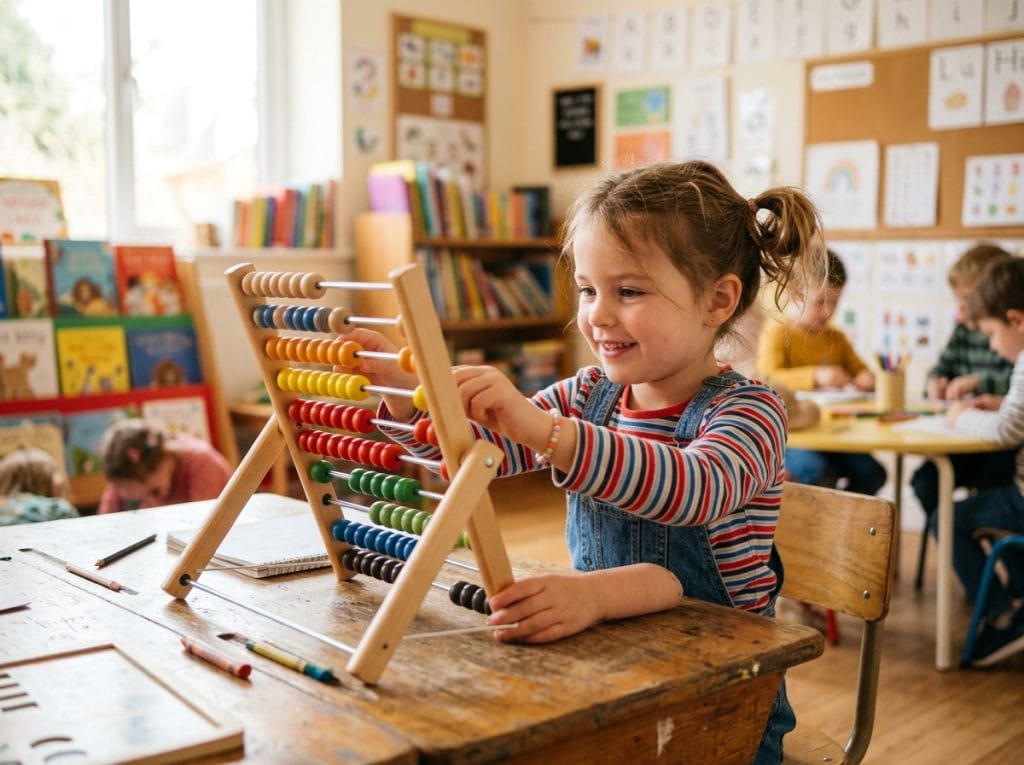
The best age to learn abacus is between 4 and 7 years old — the golden window of brain plasticity. Children who start during this period develop mental visualization skills up to 3x faster than those who begin later. However, structured abacus programs deliver significant cognitive benefits for children up to age 14.
“When should my child start abacus?” is the most common question parents ask when they first discover abacus-based mental math training. The answer matters because the best age to learn abacus directly affects how quickly your child develops mental calculation abilities, concentration skills, and bilateral brain activation. Start too early and the child lacks the motor skills. Start too late and the peak neuroplasticity window narrows.
At SoftBrain Kids Academy, we have trained thousands of children across multiple age groups and have observed firsthand how starting age impacts learning speed and long-term outcomes. In this comprehensive guide, we break down the ideal starting age, readiness indicators, what to expect at each stage, and why it is never truly “too late” to start.

1. The Golden Window: Why Ages 4–7 Are the Best Age to Learn Abacus
The best age to learn abacus is between 4 and 7 years old because this is when the brain’s neuroplasticity — its ability to form and strengthen neural connections — is at its absolute peak. According to research from Harvard’s Center on the Developing Child, more than 1 million new neural connections form every second during early childhood.
This means that a 5-year-old learning to visualize abacus bead positions in their mind builds those neural pathways 2–3 times faster than a 12-year-old learning the same skill. The brain literally wires itself around the activity during this developmental window.
Three specific factors make this window ideal for abacus training:
- Peak Brain Plasticity: Neural pathways for visualization and spatial reasoning are forming rapidly and can be shaped by targeted training
- No Math Anxiety Yet: Children aged 4–7 have not yet developed the negative associations with math that affect older students
- Motor Skill Readiness: By age 5, most children have the fine motor control to manipulate abacus beads confidently
- Foundation Building: Starting early allows children to develop “number sense” before they encounter formal school math
This is also why structured programs like those offered at SoftBrain Kids Academy begin enrollment at age 4. The earlier a child starts, the more natural mental calculation becomes — eventually, it feels as effortless as reading.
Furthermore, cognitive scientists have noted that children who engage in structured tactile learning early on are much less likely to view mathematics as an intimidating set of dry rules. Instead, they interact with quantities visually, which translates into long-term academic ease. This developmental shift serves as a powerful shield against downstream academic struggles in middle and high school settings.
By establishing this foundation during the golden years of neural mapping, children construct a cognitive safety net. They do not just memorize arithmetic equations; they learn to perceive relationships between quantities. This organic perception builds an intuitive numbers network that forms the core of mathematical literacy.
2. Five Signs Your Child Is Ready for Abacus Training
While age provides a general guideline, readiness matters more than birthday. Every child develops at their own pace. Rather than waiting for a specific age, look for these five behavioral indicators that your child is ready to begin:
✅ Sign 1: Number Recognition (1–10)
Your child can identify and name numbers from 1 to 10 consistently. They do not need to count to 100 — basic number awareness is sufficient to start bead manipulation.
✅ Sign 2: Focused Attention (10–15 Minutes)
Your child can sit and focus on a single guided activity — drawing, building blocks, listening to a story — for 10 to 15 minutes without getting up or losing interest. This attention span is essential for structured learning.
✅ Sign 3: Follows Two-Step Instructions
Your child can follow sequential instructions like “Pick up the red block and put it on the table.” This ability to process ordered steps is the foundation for understanding bead movement sequences.
✅ Sign 4: Fine Motor Control
Your child can hold a pencil, use scissors, or stack small objects. These motor skills transfer directly to sliding abacus beads with precision.
✅ Sign 5: Curiosity About Numbers
Your child naturally counts objects — stairs, toys, snacks — or asks questions like “how many?” This organic curiosity signals readiness for structured number training.
Rule of thumb: If your child shows 3 out of 5 signs, they are ready. You do not need to wait for all five. At this stage, keeping lessons play-based prevents burnout and nurtures a child’s natural curiosity about how calculations flow.
If a child has not yet met these readiness guidelines, forcing structured classes can backfire. It is far better to cultivate number sense through organic everyday routines, such as counting steps or sorting toys by color, until their attention spans and fine motor skills catch up naturally.
3. Best Age to Learn Abacus: Complete Age-by-Age Breakdown
Here is what abacus training looks like at every age, so you can set the right expectations regardless of when your child starts:
| Age Range | Stage | What They Learn | Expected Progress |
|---|---|---|---|
| 4–5 years ⭐ | Foundation | Number recognition, bead manipulation, simple addition/subtraction with physical abacus | Levels 1–2 in first year |
| 6–7 years ⭐ | Acceleration | Mental visualization begins, 2–3 digit addition/subtraction, speed drills start | Mental math by end of year 1 |
| 8–10 years | Catch-up | Faster through physical phase (already knows arithmetic), moves to visualization sooner | Can match younger starters within 18 months |
| 11–14 years | Advanced | Focus on mental abacus for exam prep, competition math, processing speed improvement | Significant cognitive gains in 6–12 months |
As the table shows, the best age to learn abacus depends on your goals. For maximum long-term cognitive development, ages 4–7 are ideal. For competition preparation and academic performance, ages 8–12 deliver fast, targeted results. Learn more about the cognitive advantages in our detailed guide on benefits of abacus for kids.
Is Your Child in the Golden Window?
SoftBrain Kids Academy offers age-appropriate abacus programs for children 4–16. Live 1-on-1 classes with certified trainers. US-friendly scheduling. 14-day money-back guarantee.
Book a Free Demo Class →4. Is It Too Late? Abacus for Older Kids (8–14)
It is never too late to start abacus training. While ages 4–7 represent the optimal window, children aged 8–14 gain unique advantages that younger learners do not have:
- Faster Physical Phase: Older children already understand addition, subtraction, and multiplication. They breeze through the initial bead-manipulation levels that take younger kids months.
- Better Self-Discipline: Older children can practice independently and maintain focus for longer sessions, accelerating their progress.
- Exam Application: The processing speed and mental calculation skills transfer directly to standardized tests like the SAT, math olympiads, and Common Core assessments.
- Concentration Benefits: The deep focus required for mental abacus is particularly beneficial for pre-teens who struggle with attention and distraction from screens.
Neuroimaging studies published by the National Institutes of Health (NIH) show that even older children who start abacus training develop increased gray matter density in the frontal-parietal cortex — the brain regions responsible for working memory and attention. The best age to learn abacus may be 4–7, but the benefits extend well into the teenage years.

If your child is also interested in alternative math approaches, explore our comparison of Vedic math vs abacus to understand which program fits best by age. For supplementary cognitive training activities, see our guide to brain exercises for kids.
Older kids bring a distinct level of focus to mental mathematics. Because their cognitive structures are already developed, they can grasp complex visual rules with far less repetition. The primary challenge for older kids is overcoming any pre-existing math anxiety; once that hurdle is cleared, their progress through the levels can be exceptionally rapid.
5. How to Choose the Right Abacus Program by Age
Not all abacus programs are created equal. When evaluating programs, consider these age-specific factors:
For Ages 4–7 (Beginners)
- Look for play-based, game-oriented programs — not drill-heavy approaches
- Small class sizes (1-on-1 or max 4 students) so the instructor can observe bead handling
- Short sessions (30–45 minutes) to match the child’s attention span
- Certified instructors experienced with early childhood learners
For Ages 8–12 (Intermediate)
- Programs that move quickly from physical abacus to mental visualization
- Speed challenge and competition components to maintain engagement
- Integration with school curriculum (Common Core alignment)
- Parent dashboard with progress tracking and practice assignments
For Ages 13+ (Advanced)
- Focus on exam preparation applications (SAT, ACT, math olympiad)
- Advanced mental calculation techniques (5+ digit operations)
- Flexible scheduling to accommodate school and extracurricular commitments
The best programs adapt their teaching approach based on the student’s age and starting level. At SoftBrain Kids Academy, every student receives a personalized learning path based on their age, skill level, and learning goals.
Ultimately, structured and interactive support guarantees a child’s success. Traditional classroom settings often fail to adapt to individual student paces, creating frustration. In contrast, 1-on-1 online instruction ensures your child receives real-time validation and error correction during vital stages of bead mapping. This personalized feedback mechanism speeds up progress and secures foundational skills before advanced, multi-digit operations are introduced.
Find the Right Program for Your Child’s Age
Whether your child is 4 or 14, SoftBrain has an age-appropriate abacus and brain development program. Try a free class and see the difference structured cognitive training makes.
Explore Programs by Age →