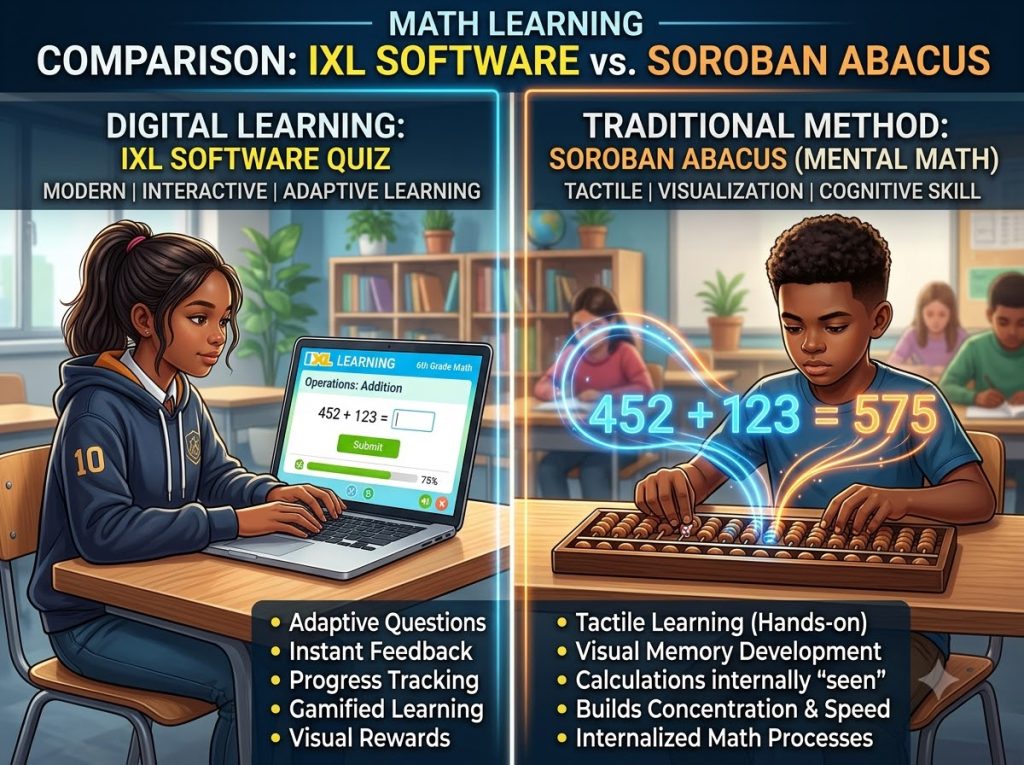

IXL Learning vs. Abacus Math: Which Math Method Builds True Fluency?
TL;DR Direct Answer: When evaluating IXL vs abacus math programs for US students, IXL functions as a digital assessment platform that tests whether a student knows state curriculum standards. In contrast, Abacus math is a brain-development methodology that equips children with the internal visual calculation engine needed to compute 3-digit equations mentally in seconds without pencil scratchpad work or multiple-choice guessing.
Quick Comparison — IXL Learning vs. Abacus Math
Parents evaluating IXL vs abacus are often deciding between a self-guided online question bank and an interactive cognitive skill program. IXL Learning provides thousands of state-aligned questions to test if a child understands current school topics. Abacus Math trains the brain’s right hemisphere to picture physical bead movements, giving children the internal calculation engine to solve those questions in seconds.
| Comparison Metric | 📱 IXL Learning | 🧮 Soroban Abacus Mental Math |
|---|---|---|
| Primary Function | Curriculum skill testing & quiz drill platform | Mental calculation engine & right-brain growth |
| Instructional Support | Self-guided text explanations after wrong answers | Live certified coach providing real-time 1-on-1 feedback |
| Calculation Speed Impact | Minimal speed growth (relies on pencil/scratchpad) | 3-digit addition & multiplication in under 3 seconds |
| Screen Time Impact | 100% passive screen time (mouse clicks/typing) | Tactile physical soroban beads + mental imagery |
| Math Anxiety Risk | High (SmartScore drops drastically on 1 wrong answer) | Low (Builds confidence with physical bead feedback) |
1. What is IXL Learning? (Features, Pedagogy & Limitations)
IXL Learning is a massive digital educational software platform widely adopted by US public and private schools. Covering mathematics, language arts, science, and social studies from grades Pre-K through 12, IXL aligns directly with state educational standards, Common Core, and standardized testing benchmarks.
The core mechanism of IXL is its infinite question generator organized by micro-skills (such as Grade 3: Add two 3-digit numbers with regrouping). Students work independently, answering questions on a computer or tablet until they reach a target score.
However, when evaluating IXL vs abacus, parents must realize that IXL is fundamentally an assessment platform, not a teaching system. IXL tests whether a child knows how to solve a problem, but it does not teach the underlying mental execution techniques. When a student makes a mistake, IXL shows a static text explanation. For elementary children (ages 6 to 10), reading dense online explanations without a teacher often leads to frustration rather than conceptual understanding.
Furthermore, IXL relies heavily on the controversial SmartScore algorithm. If a student gets 9 questions right and reaches a score of 92, but makes one careless arithmetic typo on question 10, SmartScore drops them back down to 78. This heavy penalty loop frequently triggers severe math anxiety, tears, and resistance to home practice.
| Feature | 📱 IXL Learning | 🧮 Abacus Mental Math (SoftBrain) |
|---|---|---|
| Target Age Group | Grades Pre-K through 12th | Ages 5 to 13 (Optimal window: K to 5th) |
| Pedagogical Approach | Question-and-answer drill testing | Tactile bead manipulation to mental visualization |
| Teacher Interaction | None (Self-guided automated software) | Live 1-on-1 or small group certified coaching |
| Student Motivation System | SmartScore algorithm (0–100 score) | Positive milestone levels & physical/app rewards |
| Effect on Math Anxiety | High risk (Penalizes mistakes severely) | Eliminates anxiety through visual mastery |
2. How Abacus Math Operates as a Mental Engine
Unlike digital question banks, Soroban Abacus Math is a whole-brain development methodology. Originating in East Asia and perfected over centuries, the 17-rod Japanese Soroban converts abstract mathematical concepts into concrete physical objects.
When a student learns abacus math at SoftBrain Kids Academy, they move physical wooden beads using dedicated thumb and index finger movements. Lower beads represent units of 1, while upper beads represent units of 5. As the child moves beads along rods, they touch place values directly—building an intuitive understanding of ones, tens, hundreds, and thousands.
As students advance to Anzan (Mental Visualization), they transition from the physical frame to an internal mental abacus. When presented with a complex problem like $458 + 379$, an abacus-trained child does not tap fingers or write scratchpad steps. They project a virtual abacus in their mind’s eye, flicking mental beads in less than 2 seconds flat.
Real Problem Walkthrough: $458 + 379$ (IXL vs. Abacus)
📱 IXL Learning Method
- Child looks at screen prompt on computer.
- Takes pencil and scratch paper on desk.
- Writes down $8 + 9 = 17$, writes 7, carries 1.
- Writes down $1 + 5 + 7 = 13$, writes 3, carries 1.
- Writes down $1 + 4 + 3 = 8$.
- Types ‘837’ into IXL text box using keyboard.
- Total Execution Time: 35–50 Seconds
🧮 SoftBrain Mental Abacus Method
- Child closes eyes or looks up slightly.
- Projects imaginary 3-rod abacus mentally.
- Adds 3 to Hundreds rod: $+3 = +5 – 2$.
- Adds 7 to Tens rod: $+7 = -3 + 10$.
- Adds 9 to Ones rod: $+9 = -1 + 10$.
- Reads mental bead picture: 837 instantly out loud.
- Total Execution Time: 1.8 Seconds
| Brain Function | 📱 IXL Learning Impact | 🧮 Abacus Mental Math Impact |
|---|---|---|
| Working Memory Activation | Low (Relies on external paper writing) | Extremely High (Holds 4+ digit bead pictures) |
| Spatial Reasoning (Parietal Lobe) | Minimal spatial stimulation | Maximal stimulation via 3D bead visualization |
| Attention & Concentration Span | Short bursts before clicking next prompt | 30 to 45 minutes of laser-focused mental flow |
| Fine-Motor Tactile Feedback | Flat glass screen tapping / mouse clicks | Physical wooden bead movement with thumb/index finger |
3. Financial ROI & Parent Value Breakdown: IXL vs. Abacus
When comparing the cost of IXL vs abacus classes, parents must look at what is included in tuition:
- IXL Subscription: Costs ~$9.95 to $19.95 per month for self-guided software access. While low cost, it requires parents to sit next to the child to monitor practice, explain wrong answers, and manage homework arguments.
- SoftBrain Live Online Abacus: Costs $60 to $95 per month for small group live Zoom classes with a certified coach (or $120–$180/mo for private 1-on-1). Monthly tuition includes weekly live coaching, a physical Soroban abacus kit shipped to your home, gamified practice app access, and zero parent grading effort.
| Resource Metric | 📱 IXL Self-Guided Software | 🧮 SoftBrain Live Online Abacus |
|---|---|---|
| Monthly Investment | $9.95 – $19.95 / month | $60 – $95 / month (Group) | $120 – $180 (1-on-1) |
| Parent Supervision Time | 3 to 5 Hours per week (Sitting next to child) | Zero Hours (Live coach teaches & grades) |
| Physical Kit Included | None (Digital screen only) | Free 17-Rod Soroban Kit Shipped to US Address |
4. The Ideal Hybrid Solution: Using IXL and Abacus Together
Rather than viewing IXL vs abacus as a strict binary choice, forward-thinking US parents often combine both tools strategically:
Use Abacus Math as the Core Brain Engine to build raw mental calculation speed, concentration, and spatial memory. Then, use IXL as a School Standard Verifier for 15 minutes a week to ensure your child is familiar with state test formatting and word problem wording.
| Evaluation Category | 📱 IXL Learning | 🧮 SoftBrain Abacus Coaching |
|---|---|---|
| Calculation Speed Growth | Low | 3x Faster Mental Arithmetic |
| Live Expert Coach | No | Yes (Certified Live Zoom Tutors) |
Give Your Child a Real Mental Math Engine
Stop relying on multiple-choice quiz guessing. Build 3x mental math speed with a FREE 1-on-1 trial class from SoftBrain Kids Academy.