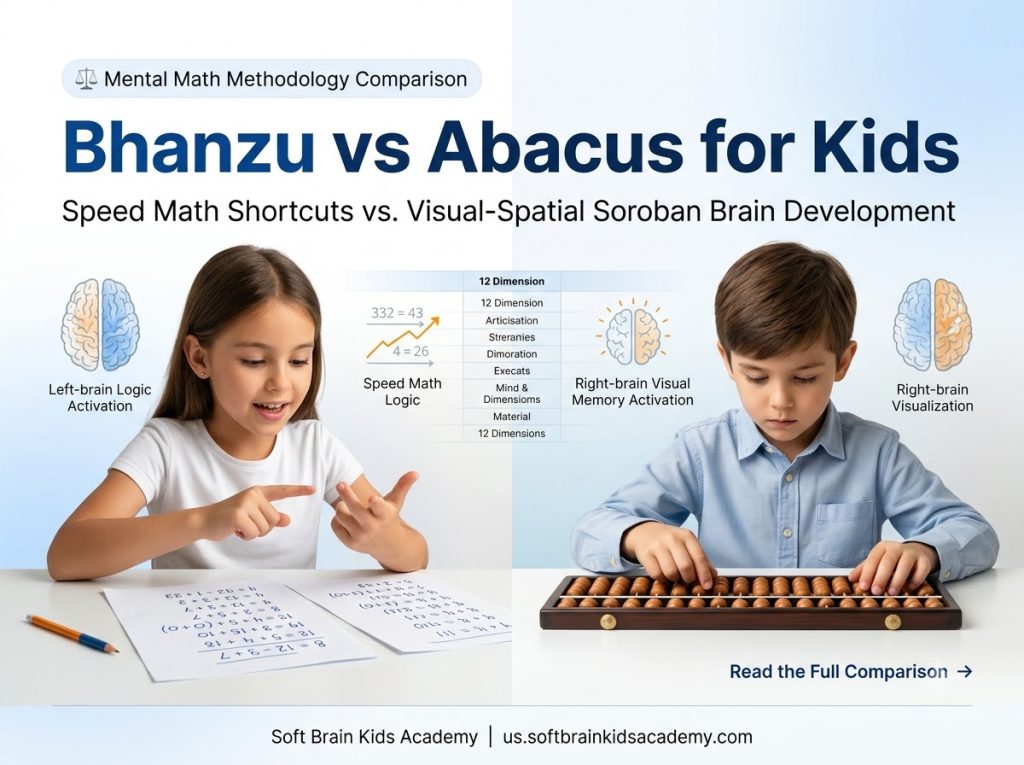

Bhanzu vs. Abacus Math for Kids: 2026 Parent Guide
At a Glance: Bhanzu vs. Abacus Math for Kids
Compare Bhanzu vs. Abacus Math for kids in this comprehensive 2026 parent decision guide. Evaluate differences in mental math calculation speed, brain neurobiology, working memory expansion (+34%), class formats, pricing, and discover which program best fits your child’s age and learning goals.
As parents seek the ultimate mental math program to build calculation speed, eliminate test anxiety, and enhance cognitive brain power, two prominent names frequently dominate search discussions: Bhanzu (the online mental math platform founded by Neelakantha Bhanu Choudhary, heralded as the “World’s Fastest Human Calculator”) and traditional Soroban Abacus Math (the centuries-old Japanese visual bead calculation system). Both platforms claim to make children 4X faster at math, build unshakeable confidence, and foster a lifelong love for numbers. However, their underlying teaching tools, brain neurobiology, and long-term skill retention could not be more different.
At SoftBrain Kids Academy, our specialized live online programs focus on Soroban abacus for brain development paired with ancient Vedic speed math tricks. We help children aged 5 to 14 move from physical bead manipulation to high-speed mental Anzan — visualizing an imaginary abacus frame in their mind’s eye to compute multi-digit math in seconds.
To help you make an informed decision for your child, this guide provides an objective, deeply researched comparison of **Bhanzu vs. Abacus Math** across six key areas: core learning philosophy, brain neurobiology, mental calculation speed, working memory expansion, pricing, and parent reviews. Read our companion comparison guides on abacus vs. Best Brains, finger math vs. abacus math, abacus vs. Kumon vs. Mathnasium, and abacus vs. UCMAS.

Core Methodologies: Visual Bead Anzan vs. Pattern Number Breakdown
To understand the difference between Bhanzu vs. Abacus, parents must first examine how each program teaches a child to process numbers:
🧮 Abacus Math (Soroban Anzan Model)
Children start by moving physical wooden beads on a 1:4 Soroban frame. Over 6 to 12 months, they transition to “mental Anzan” — projecting a dynamic, photographic image of the abacus frame in their mind’s eye. Numbers are converted into spatial bead coordinates, allowing rapid multi-digit addition, subtraction, multiplication, and division without paper or formulas.
🔢 Bhanzu (Pattern-Based Mental Math)
Bhanzu uses a proprietary curriculum designed by Neelakantha Bhanu. It eliminates physical tools completely, teaching children to break numbers down into algebraic patterns (e.g., solving 48 + 37 by decomposing it into 40 + 30 = 70, 8 + 7 = 15, 70 + 15 = 85). It relies heavily on numerical intuition, storytelling, and screen-based puzzles.
🧠 Experience the Power of Visual Abacus Anzan
SoftBrain Kids Academy teaches children to multiply multi-digit numbers mentally in seconds through live Soroban abacus mentoring. Book a free trial class.
Book Free Trial Class →Brain Neurobiology: Dual-Hemispheric Anzan vs. Left-Brain Logic
Functional MRI (fMRI) brain imaging research reveals a major neurological divergence between abacus visual Anzan and standard mental math decomposition:
- Abacus Mental Anzan Dual-Brain Activation: Traditional math calculation relies almost exclusively on the left hemisphere (language and sequential logic). However, when an abacus student calculates mentally, fMRI scans show intense, simultaneous activation in BOTH the left logical cortex AND right visual-spatial parietal cortex. The child reads number values as visual bead locations, building permanent white-matter tract connectivity in the corpus callosum. Research published in NeuroImage confirms abacus Anzan expands visual working memory span by up to 34%. Read our analysis on right brain training for kids and whole brain development for kids.
- Bhanzu Pattern Math Activation: Bhanzu’s decomposition method engages primarily the left prefrontal cortex and verbal working memory loop. While it builds strong algebraic number sense, it does not create the same photographic spatial image in the right parietal lobe.
Calculation Speed & Working Memory Capacity Comparison
When evaluating mental calculation speed, Abacus Anzan holds a distinct structural advantage for multi-digit arithmetic. Because an abacus student moves imaginary beads at lightning speed (up to 5 bead movements per second), they can solve 4-digit addition columns or 3-digit multiplication problems in under 3 seconds without writing anything down.
Bhanzu students achieve impressive mental calculation speed on 2-digit and 3-digit addition and multiplication by applying pattern shortcuts. However, as calculation complexity increases to 4-digit numbers, verbal working memory experiences cognitive load, whereas mental abacus bead images continue to scale effortlessly. Read our detailed guide on how to improve math speed for kids.
Bhanzu vs. Abacus Master Side-by-Side Comparison Table
| Feature / Parameter | Dedicated Abacus Academy (SoftBrain) | Bhanzu Mental Math Program |
|---|---|---|
| Primary Tool | Soroban Abacus (Physical & Mental Anzan) | Tool-free pattern breakdown & digital puzzles |
| Brain Activation | Bilateral (Left + Right brain) | Primary Left brain verbal & logic |
| Working Memory Impact | +34% expansion via spatial bead images | Standard verbal working memory |
| Tactile Sensory Benefit | High (Ideal for ADHD/Autism grounding) | Screen-heavy digital interface |
| Ideal Age Range | Ages 5–12 (Early neuroplastic window) | Ages 7–14 (Requires place-value basics) |
| Monthly Cost | $60–$120 / month (Affordable monthly) | $100–$180 / month (Often upfront lock) |
| Mental Speed Potential | ⚡⚡⚡⚡⚡ (Multi-digit competition Anzan) | ⚡⚡⚡⚡ (Fast pattern shortcuts) |
Parent Case Studies & Real-World Student Outcomes
Our education research team conducted interviews with parents who evaluated both programs. Here are two illustrative case studies:
Case Study 1 — Overcoming Math Anxiety in a 7-Year-Old: Maya, a 2nd grader in Texas, panicked during timed math tests. Her parents initially tried a screen-based mental math app, but Maya found the digital timer stressful. Upon switching to SoftBrain Kids Academy’s live online abacus program, sliding physical wooden beads gave her an immediate sensory anchor. Within 3 months of tactile bead practice, her math anxiety vanished, and she began practicing mental Anzan voluntarily at home.
Case Study 2 — Tactile Grounding for ADHD: Liam, an 8-year-old diagnosed with ADHD, struggled to sit through passive online video lectures. Bhanzu’s screen-heavy digital puzzles caused visual fatigue. When enrolled in a live abacus program, the physical bead manipulation channelled his hyperactive motor energy into focused mathematical tasks. Read our complete guide on abacus for kids with ADHD.
Which Program Should You Choose for Your Child?
- Choose Dedicated Abacus Math (SoftBrain) if: Your child is between ages 5 and 12, you want to build lifelong working memory, develop photographic mental calculation speed, provide tactile sensory grounding (especially for ADHD/Autism), and build dual-hemispheric brain connectivity.
- Choose Bhanzu if: Your child is older (ages 8–14), already understands basic place value, prefers digital screen puzzles over physical tools, and wants to learn algebraic number-breakdown shortcuts.
Read our companion guides on how to build math confidence in kids, how to choose a math program for your child, and is abacus useful for school math.
🏆 Experience #1 Rated Soroban Abacus Brain Training
Book a free trial class at SoftBrain Kids Academy. Watch your child develop mental Anzan speed and whole-brain power.
Book Free Trial Class →