
Right Brain Training for Kids: 8 Science-Backed Activities (2026)
At a Glance: Right Brain Training for Kids
Right brain training for kids focuses on developing visual-spatial intelligence, photographic memory, intuition, and creativity. Introduced early (ages 0–7), it creates bilateral neural connectivity that enhances academic learning, focus, and rapid information processing.
Most traditional educational systems focus almost exclusively on left-brain skills — linear logic, repetitive drills, and memorizing facts. However, neuroscientists emphasize that early childhood is dominated by right-brain growth. Parents searching for right brain training for kids want to foster holistic, whole-brain development that pairs creative visualization with mathematical speed.
At SoftBrain Kids Academy, our whole-brain activation curriculum combines visual abacus bead mentalization, spatial reasoning, and speed calculation. In this guide, we break down the neuroscience, benefits, and 8 best home activities for right brain training.

1. The Science of Right-Brain vs. Whole-Brain Development
The human brain is divided into two hemispheres connected by the corpus callosum. While popular myths describe people as strictly “right-brained” or “left-brained,” modern cognitive neuroscience shows that peak performance requires seamless communication between both sides.
- Left Hemisphere: Processes text, symbols, sequential steps, verbal instructions, and formal arithmetic rules.
- Right Hemisphere: Processes visual imagery, spatial layout, photographic memory, emotional cues, and intuitive pattern matching.
From birth to age 7, the right brain develops rapidly, making young children highly receptive to visual memory games and spatial imagery. Incorporating right brain training for kids during this period ensures that when formal school math and literacy begin, the child can process information using both hemispheres simultaneously. Learn more in our guide on the best age to learn abacus.
Research published in peer-reviewed neuroscience journals reveals that children who engage in right-brain visual memory exercises retain information up to 3x longer than those relying purely on verbal repetition. By training the right brain early, children learn to absorb concepts as vivid mental pictures rather than isolated text rules.
2. Brain Stimulation Comparison: Screen Time vs Flashcards vs Abacus
Not all childhood activities stimulate the right hemisphere equally. The table below compares common daily activities across memory retention, spatial engagement, and whole-brain activation:
| Activity | Primary Hemisphere | Working Memory Impact | Long-Term Academic Benefit |
|---|---|---|---|
| Passive Tablet Screen Time | Passive Visual (Low depth) | Negative / Shortened attention span | Low |
| Rapid Image Flashcards | Right Hemisphere (Photographic) | Moderate | Moderate (Subconscious recognition) |
| Tangrams & Spatial Puzzles | Right Hemisphere (Spatial) | High | High (Geometry & architectural intuition) |
| Mental Abacus Visualization | Whole-Brain (Corpus Callosum Bridge) | Very High (+40% capacity) | Exceptional (Math speed, focus, STEM success) |
3. 8 Best Right Brain Training Activities for Kids
Here are 8 simple, highly effective right-brain activities parents can introduce at home:
Activity 1: Mental Abacus Bead Visualization
The child visualizes soroban abacus beads in their mind, sliding them mentally to perform arithmetic. This exercises visual-spatial memory and prefrontal cortex circuits. Read more about abacus for brain development and the benefits of abacus for kids.
Activity 2: “What’s Missing?” Memory Tray Game
Place 6 to 10 household objects on a tray. Let your child view them for 10 seconds, cover the tray, remove one item secretly, and ask them to name the missing item. This trains photographic recall and focused visual observation.
Activity 3: Rapid Image Flashcards
Show image cards at a pace of 1 second per card. High-speed visual input stimulates right-brain subconscious image retention before the left brain can analyze with words.
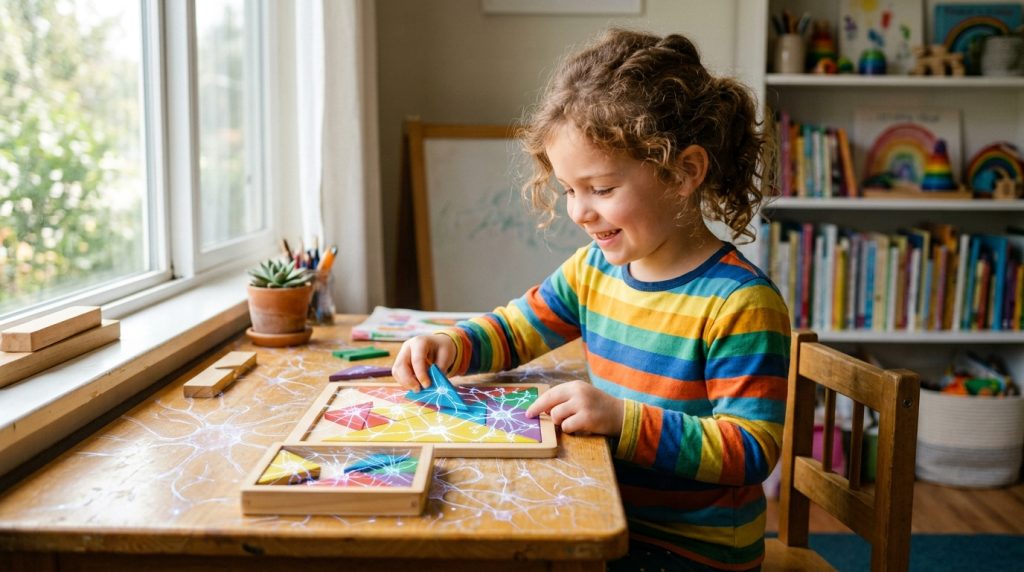
Activity 4: Tangrams & Geometric Spatial Puzzles
Solving 7-piece tangram shape puzzles builds spatial rotation and non-verbal reasoning skills. Children learn to decompose complex geometric shapes mentally into smaller triangles and quadrilaterals.
Activity 5: Guided Visualization Stories
Read a vivid story with your child’s eyes closed. Ask them to describe the colors, sights, and feelings in their “mind’s eye” to strengthen internal visual imagery and emotional intelligence.
Activity 6: Mandala Matching & Symmetry Completion
Provide half of a detailed mandala pattern and ask the child to draw or color the mirror image, building bilateral spatial awareness and fine motor coordination.
Activity 7: Mental Math Pattern Games
Use visual mental math shortcuts like those in Vedic math tricks, mental math for kids, and how to improve math speed for kids.
Activity 8: Cross-Lateral Movement & Bilateral Brain Exercises
Activities like touching left elbow to right knee encourage neural communication across the corpus callosum. See our full guide on brain exercises for kids.
Unlock Whole-Brain Development for Your Child
SoftBrain Kids Academy offers live 1-on-1 Abacus & Vedic Math courses designed for maximum cognitive stimulation. Certified instructors. Flexible scheduling.
Book a Free Demo Class →4. Why Mental Abacus Is the Ultimate Right-Brain Tool
While art and puzzles stimulate the right brain, Mental Abacus training is unique because it bridges left-brain arithmetic with right-brain spatial imagery. The student translates abstract numbers into bead patterns (right brain) while applying calculation formulas (left brain). Learn more in our comparison of Vedic Math vs Abacus or explore Abacus vs Kumon vs Mathnasium.
When a child performs mental abacus calculation, fMRI brain scans show intense bilateral activation across both the prefrontal cortex and parietal lobes. This dual-hemisphere engagement is what transforms basic counting into lifelong photographic memory and speed calculation capabilities.
5. A 10-Minute Home Right-Brain Workout Routine
Consistency is far more important than duration. Spend just 10 minutes each afternoon following this simple 3-step right-brain workout:
- Min 0–3: Rapid Image Warm-up — Flash 10 image cards quickly at 1 second per card.
- Min 3–7: Mental Abacus Visualization — Practice 5 mental abacus additions with eyes closed.
- Min 7–10: Spatial Puzzle Challenge — Solve 1 Tangram pattern or play the ‘What’s Missing?’ tray game.
Start Your Child’s Cognitive Journey Today
Discover how SoftBrain Kids Academy’s whole-brain curriculum builds focus, speed, and memory. Book your free 1-on-1 trial class.
Try a Free Demo Class →