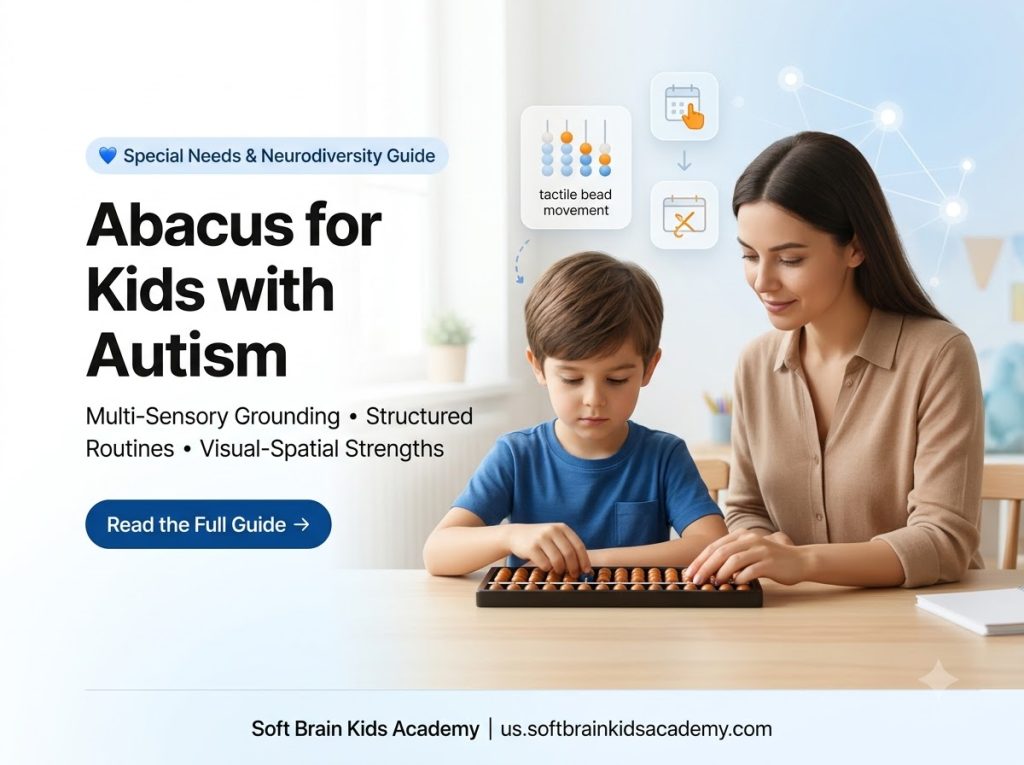

Abacus for Kids with Autism: Multi-Sensory Math Benefits & Guide (2026)
At a Glance: Abacus for Kids with Autism
Discover why abacus for kids with autism is one of the most effective multi-sensory educational tools. Learn how Soroban abacus bead movement provides tactile sensory grounding, creates structured predictable routines, leverages visual-spatial strengths, and builds executive function in ASD learners.
For children on the Autism Spectrum (ASD), traditional classroom math instruction can present significant sensory and cognitive barriers. Abstract numbers printed on paper, ambiguous word problem language, and noisy classroom environments often trigger sensory overload and frustration. Yet many autistic children possess extraordinary visual-spatial processing abilities, deep pattern recognition skills, and an affinity for structured, predictable systems. The challenge is not mathematical capability — it is finding an instructional medium that speaks their cognitive language.
The Soroban abacus is uniquely suited for ASD learners. By translating abstract numbers into physical, tactile wooden beads sliding along structured rods, abacus for kids with autism provides a concrete sensory bridge between touch, sight, and mathematical logic.
At SoftBrain Kids Academy, our live online instructors are trained to support neurodiverse learners. Our small-group and 1-on-1 virtual sessions combine Soroban abacus for brain development with calm, structured routines that build unshakeable confidence. Read our companion guide on abacus for kids with ADHD to see how our neurodiverse programs adapt to different learning profiles.

5 Key Reasons Why Abacus Training Works for Autistic Children
1. Concrete Physical Representation of Numbers
Autistic children often struggle with ambiguity and abstract verbal explanations. On a Soroban abacus, numbers are not abstract symbols — they are physical wooden beads. The number 5 is physically one upper bead lowered to the beam. This 100% concrete representation aligns with the visual-tactile thinking style of ASD learners.
2. Predictable, Orderly System (Systemizing Mindset)
Renowned psychologist Dr. Simon Baron-Cohen established that autistic individuals possess a high “systemizing drive” — a deep affinity for predictable, rule-governed systems. The Soroban abacus is a flawless mathematical system where every movement follows clear, immutable rules. There are no exceptions or ambiguous word traps.
3. Calming Tactile & Proprioceptive Feedback
The physical action of sliding smooth wooden beads provides soothing tactile and proprioceptive sensory input. For many autistic children, bead movement acts as a focused, productive “stimming” alternative that reduces anxiety while performing calculations.
4. Bypasses Auditory Processing Delays
Many ASD students experience auditory processing delays in noisy classrooms. Abacus math is overwhelmingly visual and tactile. A non-verbal or quiet child can demonstrate complex addition, multiplication, and square root calculations by setting beads on the frame without needing to speak.
5. Leverages Right-Brain Visual-Spatial Strengths
Neuroimaging shows that Soroban mental Anzan activates the right parietal cortex, which governs visual-spatial rotation. Autistic children who naturally think in pictures excel at visualizing the mental abacus frame. Explore our guide on right brain training for kids.
💙 Specialized Support for Your Neurodiverse Learner
Our gentle, structured live abacus classes adapt to your child’s sensory & pacing needs. Book a free 1-on-1 trial session.
Book Free Trial Class →Tactile Grounding & Proprioceptive Input in Bead Sliding
Sensory processing differences are a core characteristic of Autism Spectrum Disorder. When an autistic child experiences sensory overload, their nervous system enters a heightened state of stress. Physical manipulatives like the Soroban abacus provide controlled, rhythmic tactile input through the fingertips. The satisfying click of wooden beads against the beam offers proprioceptive feedback that helps ground the child’s attention. Read our articles on how abacus works step-by-step and abacus for preschoolers.
How Abacus Builds Executive Function & Working Memory in ASD
Executive function challenges — including task initiation, working memory, and impulse control — are common in ASD. Abacus practice serves as a structured gym for executive function. Solving a problem like 47 + 38 on an abacus requires the child to hold the tens and ones rod values in working memory, execute the complement rule (+10 − 2 on the ones rod), and update the tens rod. This sequential step-by-step process builds dorsolateral prefrontal cortex connectivity. Read our guide on how to improve memory in kids.
Abacus for Autism vs. Abacus for ADHD: Key Instructional Differences
| Instructional Parameter | Abacus for Autism (ASD) | Abacus for ADHD |
|---|---|---|
| Primary Focus | Predictable routine, sensory grounding, visual logic | Rapid speed sprints, novelty, channeling energy |
| Lesson Structure | Consistent 5-step visual schedule every session | Fast 2-minute activity rotations with frequent rewards |
| Sensory Environment | Quiet room, smooth wooden frame, low vocal volume | Upbeat music, movement breaks, high energy |
Home Adaptation Guide: Creating a Sensory-Friendly Abacus Practice Space
To help your autistic child thrive with abacus practice at home:
- 1. Choose the Right Abacus: Select a high-quality Japanese Soroban with smooth wooden beads that move quietly without harsh metallic clicking sounds.
- 2. Use a Visual Schedule: Display a 4-picture visual schedule (1. Setup, 2. Bead Practice, 3. Drawing, 4. Finished).
- 3. Keep Sessions Short & Consistent: Practice for 5 to 10 minutes at the exact same time every day. Predictability builds comfort.
- 4. Allow Non-Verbal Proof: Let your child show their answer by setting beads on the frame rather than insisting on spoken numbers. Read our guide on building math confidence in kids.
💙 Experience Gentle, Patient Abacus Mentoring
Book a free trial session at SoftBrain Kids Academy. Discover how our structured abacus program supports autistic learners.
Book Free Trial Class →