
After School Math Programs for Kids: Complete Parent Guide (2026)
At a Glance: After School Math Programs for Kids
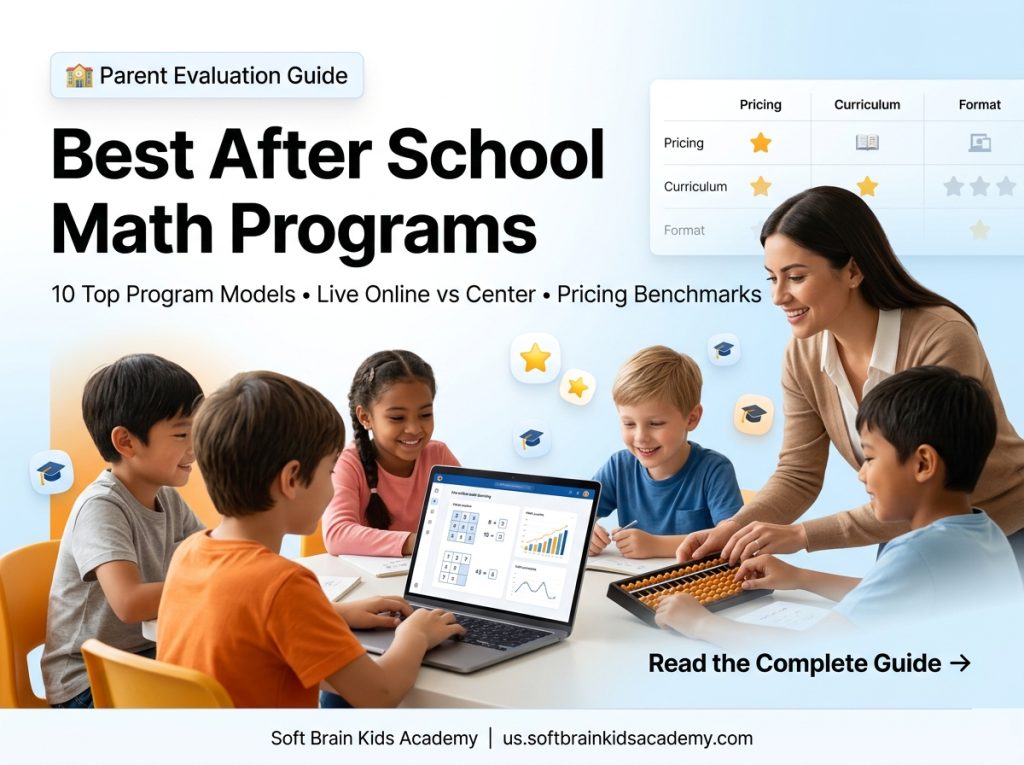
Navigate the landscape of after school math programs for kids. Compare 10 leading providers — including SoftBrain Kids Academy, Kumon, Mathnasium, RSM, Think Academy, Cuemath, Beast Academy, and AoPS. Features a 5-point evaluation framework, online vs. physical center trade-offs, pricing benchmarks, and ROI analysis.
Selecting the right after school math programs for kids is one of the most consequential decisions a parent can make for their child’s academic future. In today’s competitive educational environment, relying solely on standard elementary school instruction is often insufficient. Whether your child is struggling with basic arithmetic, experiencing math anxiety, or seeking advanced enrichment and competition challenges, an effective after-school program provides the targeted instruction that transforms performance.
At SoftBrain Kids Academy, we believe after-school math should build both mental arithmetic speed and deep conceptual confidence. By combining physical Soroban abacus mental Anzan training with Vedic math algebraic shortcuts, our live online classes provide an unbeatable dual-brain foundation. Read our guide on how to choose a math program for your child for a personalized evaluation checklist.
In this complete guide, we evaluate the 10 top after-school math providers, compare live online vs. physical center formats, establish a 5-point decision framework, analyze real monthly costs, and share strategies to prevent student fatigue. For related comparison reading, explore abacus vs Kumon vs Mathnasium, RSM vs abacus for kids, and math enrichment programs for gifted kids.

Why After-School Math Instruction Is Essential Today
Standard elementary school math instruction faces structural constraints: class sizes of 25 to 30 students, rigid pacing schedules tied to state testing, and limited time for individual student support. As a result, two distinct groups of students suffer:
1. Struggling Learners (The Gap Trap)
If a child misses a foundational concept in 2nd grade (like number bonds or place value), subsequent topics like multi-digit subtraction and long division become increasingly confusing. Without structured after-school support, minor gaps accumulate into severe math anxiety.
2. Advanced & Gifted Learners (The Boredom Trap)
Gifted students who master grade-level concepts instantly become bored and disengaged during repetitive classroom drills. Without high-level enrichment, they fail to develop the problem-solving stamina and study discipline required for advanced STEM disciplines.
The 5-Point Parent Evaluation Framework
When evaluating **after school math programs for kids**, assess these 5 critical parameters:
| Parameter | What to Look For | Red Flags to Avoid |
|---|---|---|
| 1. Class Size & Attention | Small groups (4 to 6 students) or dedicated 1-on-1 tutoring | Large crowded centers where 1 tutor monitors 15+ kids on worksheets |
| 2. Core Methodology | Multi-sensory tactile tools (Soroban abacus), visual modeling, Vedic pattern logic | Endless repetitive worksheet drilling with zero conceptual explanation |
| 3. Instructor Quality | Certified math specialists trained specifically in child psychology & methodology | High-school student graders working for minimum wage |
| 4. Homework Load | 10 to 15 minutes of daily practice reinforcing class lessons | Overwhelming 45-minute daily worksheet stacks causing evening family fights |
| 5. Progress Tracking | Regular diagnostic level tests, speed metrics, and parent report dashboards | Vague feedback with zero quantitative milestone tracking |
10 Top After-School Math Programs Evaluated
Here is a comprehensive summary of the 10 leading after-school math providers:
1. SoftBrain Kids Academy
Format: Live Online Small Groups (4–6 students) | Ages: 5–14
Unique dual-brain program combining Soroban abacus mental Anzan (right-brain visual-spatial memory) with Vedic math shortcuts (left-brain algebraic logic). Builds extreme calculation speed, concentration, and 90+ Rank Math performance.
2. Russian School of Mathematics (RSM)
Format: Physical Centers & Online | Ages: K–12
Classical European curriculum focused on deep algebraic reasoning, proof writing, and multi-step word problems. Outstanding academic depth for advanced students. Read: RSM vs abacus for kids.
3. Mathnasium
Format: Physical Centers & Online | Ages: K–12
Customized learning plans designed to fill foundational gaps and support school homework. Great for struggling students seeking confidence. Read: abacus vs Mathnasium.
4. Kumon
Format: Physical Centers & Worksheets | Ages: Pre-K–12
Self-paced daily paper worksheet drilling focused on speed and accuracy. Excellent for discipline; lacks interactive conceptual instruction. Read: abacus vs Kumon.
5. Think Academy
Format: Live Online Small Groups | Ages: K–8
Interactive tech-focused competition prep targeting Math Kangaroo and AMC 8 exams with gamified online learning dashboards.
6. Cuemath
Format: Live 1-on-1 Online | Ages: K–10
Personalized 1-on-1 online tutoring aligning visual puzzle worksheets with school curriculum standards.
7. Beast Academy / AoPS
Format: Self-Paced Books & Online | Ages: Grades 2–12
Comic-book styled rigorous math books and online problem-solving tracks designed for self-motivated gifted students.
Discover the SoftBrain Advantage for Your Child
Book a free live trial class to see how small-group online Soroban abacus instruction transforms calculation speed and focus.
Book Your Free Trial Class →Live Online vs. Physical Learning Center: Trade-Off Matrix
Should you choose a local physical center or a live online program? Examine the key trade-offs:
| Evaluation Dimension | Live Small-Group Online (e.g. SoftBrain) | Physical Learning Center (e.g. RSM / Kumon) |
|---|---|---|
| Convenience & Time | ⭐ High — zero commute time; child learns safely from home | Low — requires 30–60 minute driving and waiting time twice per week |
| Parent Visibility | ⭐ High — parents can quietly observe lesson quality and child participation | Low — child goes behind closed classroom doors; feedback is periodic |
| Class Size Ratio | ⭐ Excellent — 4 to 6 students per instructor guarantees focus | Variable — physical classrooms often hold 12 to 20 students per teacher |
| Monthly Cost | ⭐ Moderate ($120 – $220/mo) — no physical facility overhead | Higher ($200 – $400/mo) — includes facility and franchise fees |
Pricing & Cost Benchmark Table
Use this price comparison benchmark table when budgeting for after-school math instruction:
| Program | Monthly Price Range | Weekly Time Commitment | Free Trial / Diagnostic? |
|---|---|---|---|
| SoftBrain Kids Academy | $120 – $220 / month | 1 hr live class + 10m daily practice | Yes — Free Live Diagnostic Class |
| Kumon | $140 – $200 / month | 2 center visits + 30m daily worksheets | Placement test included |
| Mathnasium | $250 – $400 / month | 2 to 3 center visits per week | Free Initial Assessment |
| RSM (Russian Math) | $250 – $420 / month | 2 hrs classroom + 2 hrs homework | Evaluation test required |
| Think Academy | $180 – $350 / month | 1.5 hrs live class + app homework | Free Diagnostic Test |
Remedial Tutoring vs. Enrichment: Which Does Your Child Need?
Before choosing a program, determine whether your child needs **remedial catch-up support** or **enrichment depth**:
- Choose Remedial Tutoring (e.g. Mathnasium, Wyzant) if: Your child is failing current school math tests, missing basic grade-level facts, experiencing acute homework breakdowns, or falling behind after missing school.
- Choose Enrichment (e.g. SoftBrain, RSM, AoPS) if: Your child gets A’s in school math without effort, asks deep questions about how numbers work, expresses interest in competition math, or wants to develop extraordinary mental calculation speed and brain focus.
For detailed comparison of specific alternative options, read online vs offline abacus classes and best Vedic math classes for kids.
Preventing Math Burnout & Scheduling Best Practices
To ensure your child maintains enthusiasm for after-school math, implement these 3 scheduling rules:
1. The 15-Minute Daily Limit for Home Practice
Keep daily practice sessions strictly under 15 minutes. Short, energetic daily sessions build neural habits without creating homework dread.
2. Schedule Math BEFORE Screen Entertainment
Establish a consistent routine: after-school snack → 10 minutes of abacus practice → free playtime/screens. This eliminates daily negotiation fights.
3. Celebrate Growth & Effort over Scores
Praise your child’s persistence and strategy selection rather than raw test scores. This fosters a growth mindset that protects against perfectionism.
Frequently Asked Questions
What are the best after school math programs for kids?
Are online after school math programs as effective as in-person centers?
How much do after school math programs for kids cost on average?
How do I know if my child needs an after school math program?
How many hours per week should a child spend on after school math?
What is the difference between remedial math tutoring and math enrichment?
Give Your Child the Gift of Lifelong Math Confidence
Book a free live 1-on-1 diagnostic class with SoftBrain Kids Academy to experience the power of small-group Soroban abacus training.
Book Your Free Trial Class →