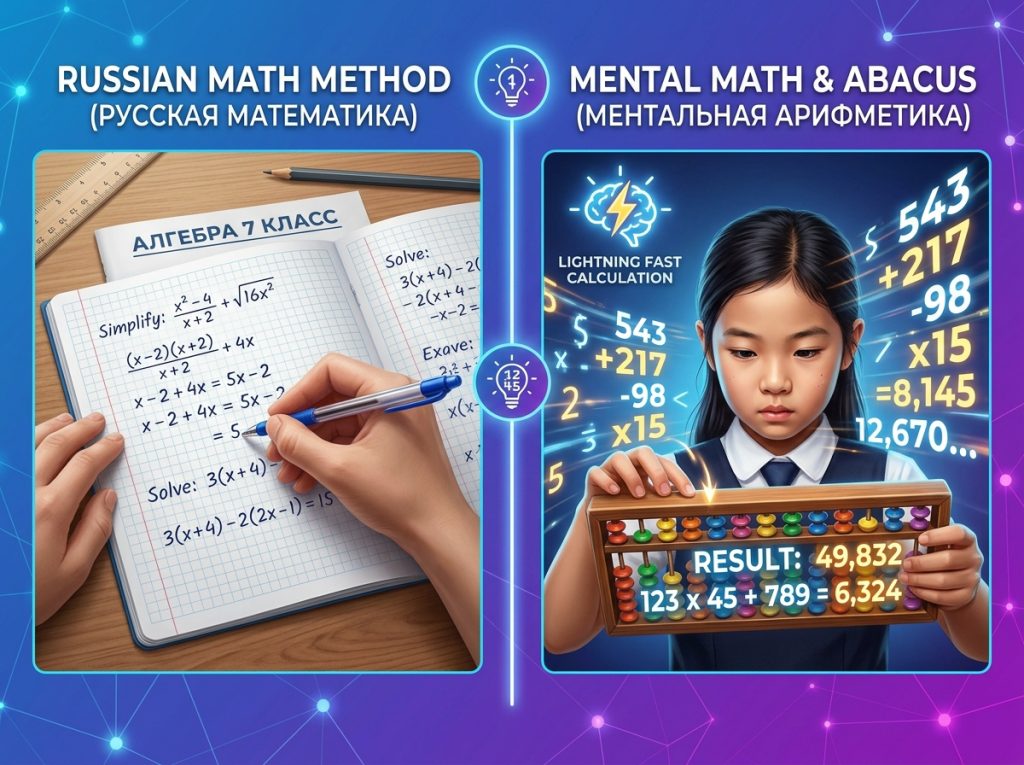

RSM vs Abacus for Kids: Russian School of Math Comparison Guide (2026)
At a Glance: RSM vs Abacus for Kids
Compare RSM vs abacus for kids. Russian School of Mathematics focuses on academic rigor, algebra proofs, and heavy homework. Abacus focuses on tactile mental math, working memory expansion, and rapid calculation. Learn which program fits your child’s age and goals.
When US parents evaluate after-school math enrichment, two prominent options dominate discussions: the Russian School of Mathematics (RSM) and Abacus mental math programs. Choosing between RSM vs abacus for kids requires understanding their vastly different educational philosophies.
At SoftBrain Kids Academy, we believe in building strong foundational calculation speed and working memory first. In this 2026 head-to-head comparison, we analyze RSM and Abacus across 7 key dimensions: curriculum focus, homework burden, age appropriateness, tuition costs, and long-term results. Also compare abacus vs Kumon vs Mathnasium and abacus vs Kumon.

1. What is Russian School of Math (RSM)?
RSM is a structured after-school program rooted in the Soviet math tradition. It prioritizes deep conceptual understanding, algebra readiness from early elementary grades, and rigorous multi-step word problems. Classes are typically 1.5 to 2 hours per week with significant weekly homework assignments.
2. What is Abacus Mental Math?
Abacus mental math is a brain development system that teaches children to perform high-speed calculations by manipulating beads on a Soroban frame, eventually transitioning to mental visualization (“Anzan”). It trains working memory, focus, and visual-spatial processing. Read benefits of abacus for kids and best age to learn abacus.

3. 7-Point Head-to-Head Comparison Table
| Feature | Russian School of Math (RSM) | Abacus Mental Math |
|---|---|---|
| Primary Goal | Advanced academic math & algebra proofs | Cognitive development & calculation speed |
| Optimal Starting Age | Grades 2 to 8 (Ages 7–14) | Pre-K to Grade 5 (Ages 4–10) |
| Weekly Homework Load | Heavy (2–4 hours weekly) | Light (10–15 mins daily practice) |
| Teaching Medium | Classroom lecture, paper problem sets | Tactile soroban frame + mental visualization |
| Annual Cost Range (US) | $2,000 – $3,500+ / year | $700 – $1,400 / year |
| Math Anxiety Impact | Can increase anxiety if child falls behind | Reduces anxiety via gamified success |
Build Calculation Mastery Without RSM Homework Stress
Try SoftBrain Kids Academy’s live online abacus classes. Build rapid calculation speed and focus with just 15 minutes of daily practice.
Book Free Demo Session →4. Which Program Is Best for Your Child?
Use this decision framework:
- Choose Abacus if: Your child is between ages 4 and 9, needs better focus, struggles with calculation speed, or experiences math anxiety.
- Choose RSM if: Your child is in 4th grade or higher, loves complex logic puzzles, wants to prepare for proof-based math, and can manage heavy homework.
- The Hybrid Strategy: Many families do Abacus from ages 5 to 9 to build speed, then transition to RSM or Vedic math for competitive exams. Also compare abacus vs Mathnasium.
5. Frequently Asked Questions
What is the main difference between RSM and Abacus for kids?
Which program is better for younger elementary students (ages 4-8)?
Can a child enroll in both RSM and Abacus?
How do RSM and Abacus compare in tuition fees?
Which is better for math competitions like AMC 8 and MATHCOUNTS?
Comparing RSM vs abacus for kids empowers you to pick the right program for your child’s personality and academic goals. Explore our full blog library or learn about abacus vs Vedic math for kids.