
Abacus for Brain Development: Science-Backed Benefits (2026)
At a Glance: Abacus for Brain Development
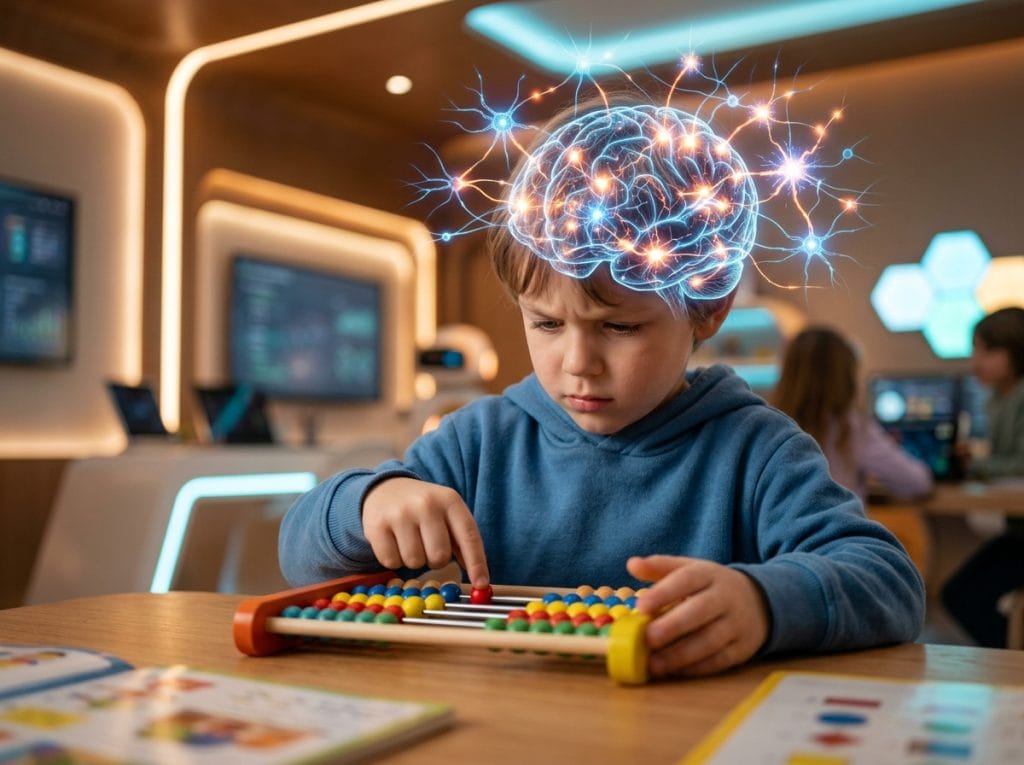
Using an abacus for brain development activates both brain hemispheres simultaneously — the left for logic and the right for visualization. NIH-published fMRI studies show measurable increases in gray matter density, working memory, and processing speed in children who train consistently for 6+ months.
Parents often ask: “Is abacus just about math?” The answer is no — and the science proves it. Using an abacus for brain development is one of the most well-researched cognitive training methods available for children. Unlike flashcard apps or math worksheets that exercise only the analytical left brain, abacus training simultaneously activates both hemispheres through a unique combination of physical manipulation, visualization, and calculation. This dual-hemisphere engagement is crucial for early brain building, as it lays down structural connectivity between sensory, visual, and analytical processing loops in young children.
At SoftBrain Kids Academy, our abacus program is designed not just to teach math — but to build the neural architecture that supports all learning. In this article, we will walk through exactly what happens in your child’s brain during abacus training, what the peer-reviewed research says, and how to maximize the cognitive benefits. We will explore how visual calculations can help reduce school stress and give your child an edge in STEM subjects.

1. How Abacus for Brain Development Actually Works
Abacus for brain development works through a three-stage progression that systematically trains increasingly complex cognitive abilities:
Stage 1: Physical Abacus (Months 1–6)
Children learn to manipulate physical beads to represent numbers and perform calculations. This stage activates motor cortex (hand movement), visual cortex (bead tracking), and prefrontal cortex (following step sequences). The hands and eyes work together, building hand-eye coordination and spatial awareness. By physically moving beads up and down, children learn that numbers correspond to physical spatial objects, establishing a core visual understanding of arithmetic scale.
Stage 2: Semi-Mental Abacus (Months 6–12)
Children begin to visualize the abacus mentally while still using finger movements. This is where the brain development magic happens: the child must hold a mental image of bead positions while simultaneously performing calculations. This exercises working memory — the cognitive workspace used for reasoning — more intensely than almost any other childhood activity. The finger movements act as a physical anchor for the spatial visualization occurring inside their head, preparing them for the advanced pure mental stage.
Stage 3: Pure Mental Abacus (Year 2+)
Advanced students perform all calculations by visualizing the abacus entirely in their mind — no physical tool, no finger movement. At this stage, the child is essentially running a spatial simulation in their head while performing logical operations. fMRI scans show that this activates the right superior parietal lobule (spatial processing), left inferior frontal gyrus (logical sequencing), and bilateral fusiform gyrus (visual imagery) simultaneously. Children learn to slide mental beads at lightning speeds, solving complex multi-digit calculations in seconds.
This bilateral activation — both hemispheres working together — is what makes abacus for brain development uniquely effective compared to other math training methods. To understand more about the practical benefits, see our guide to benefits of abacus for kids.
By establishing this foundation during early childhood, students establish stable neural pathways. Rather than relying on simple memorized scripts, kids manipulate values dynamically, building spatial maps of arithmetic systems that benefit them far beyond math class.
2. What the Research Says: NIH Studies on Abacus for Brain Development
The cognitive benefits of abacus for brain development are not anecdotal — they are documented in peer-reviewed neuroscience research. Here are the key findings:
| Study / Source | Finding | Brain Region Affected |
|---|---|---|
| NIH/PubMed Review | Increased gray matter density in abacus-trained children | Frontal-parietal cortex |
| Neural Plasticity (2017) | Bilateral brain activation during mental calculation | Both hemispheres (L+R) |
| Frontiers in Psychology | Improved working memory capacity and processing speed | Prefrontal cortex |
| Biomedicine Online (2022) | Enhanced visual-spatial processing in AMC-trained children | Occipital-temporal regions |
The key takeaway: abacus for brain development produces measurable, structural changes in the brain — not just temporary performance improvements. These changes persist even after training ends, because the neural pathways formed during childhood become permanent parts of the brain’s architecture.
Furthermore, research shows that children trained in mental abacus have larger visual memory capacities. This helps them retain complex layouts and structural hierarchies. The improved connectivity between visual and motor processing loops makes general logical training far easier as schoolwork grows more abstract.
Give Your Child the Brain Development Advantage
SoftBrain’s abacus program is designed for cognitive development first, math speed second. Live 1-on-1 classes with certified trainers. US-friendly scheduling.
Book a Free Demo Class →3. Six Cognitive Skills Improved by Abacus for Brain Development
Here are the six specific cognitive abilities that abacus training strengthens, and why each matters for your child’s academic and personal growth:
1. Working Memory
Mental abacus requires holding multiple bead positions in mind while performing operations. This directly exercises working memory — the same cognitive resource used for reading comprehension, following multi-step directions, and problem-solving across all subjects. Expanding this temporary holding zone allows children to follow complex instructions without getting lost.
2. Processing Speed
Timed speed drills in abacus training increase the brain’s information processing rate. Children who train regularly process numerical information 2–3x faster than untrained peers, which translates to faster test completion and more confident academic performance. Over time, tasks that once felt slow and frustrating become second nature.
3. Sustained Attention
Completing multi-digit mental calculations requires unbroken concentration for 30–60 seconds per problem. This trains sustained attention — the ability to focus without distraction — which is one of the most valuable cognitive skills in the modern screen-saturated environment. By practicing this concentration weekly, children learn to shield their focus from external distractions.
4. Visual-Spatial Reasoning
Visualizing bead positions on a mental abacus develops the same spatial reasoning skills used in geometry, engineering, architecture, and computer science. Children who train develop superior ability to mentally rotate objects and understand spatial relationships, preparing them for advanced science and engineering coursework.
5. Bilateral Brain Coordination
The unique combination of logical operations (left brain) and visual imagery (right brain) trains both hemispheres to work together. This coordination supports creative problem-solving — the ability to combine analytical and intuitive thinking. A child learns to analyze details while maintaining a holistic perspective on the overall structure.
6. Numerical Fluency
Beyond raw calculation speed, abacus-trained children develop deep “number sense” — an intuitive understanding of quantities, magnitudes, and relationships. Research from the National Council of Teachers of Mathematics identifies number sense as the strongest predictor of long-term math achievement. When children feel comfortable with numbers, their fear vanishes and they actively participate in learning.

For complementary cognitive training activities, explore our guide to brain exercises for kids.
4. Abacus vs Other Brain Training Methods
| Method | Brain Areas | Transfer to Academics | Research Level |
|---|---|---|---|
| Abacus Training ⭐ | Both hemispheres (motor + visual + logical) | High — math, reading, focus | Strong (NIH studies) |
| Brain Training Apps | Primarily left hemisphere | Low — limited transfer | Mixed/Weak |
| Music Lessons | Auditory + motor cortex | Moderate — language, timing | Strong |
| Chess | Prefrontal + spatial | Moderate — planning, strategy | Moderate |
| Vedic Math | Primarily left hemisphere (algebraic) | High — math speed, exams | Moderate |
As the comparison shows, abacus for brain development stands out because of its bilateral brain activation and strong academic transfer. Many parents combine abacus with vedic math for comprehensive cognitive and speed development. Learn about the ideal starting age in our best age to learn abacus guide.
5. How to Maximize Brain Development Benefits
To get the most brain development value from abacus training, follow these evidence-based guidelines:
- Start in the Golden Window (Ages 4–7): Neuroplasticity peaks during early childhood, so starting early maximizes the brain-building effect
- Consistent Weekly Practice: 2–3 sessions per week of 30–45 minutes is more effective than one long session. Consistency matters more than intensity
- Progress Through All Three Stages: The biggest brain development gains come during the mental abacus stage. Do not stop at the physical bead stage
- Choose Live Instruction Over Apps: A trained instructor can observe technique, correct errors, and push the child to the next level at the right pace. Apps cannot do this
- Combine with Complementary Activities: Add brain exercises, reading, and physical activity for comprehensive cognitive development
- Commit to 2–3 Years: Structural brain changes require sustained training. Short-term programs produce temporary improvements; long-term programs produce permanent neural architecture changes
Using an abacus for brain development is an investment in your child’s cognitive future. The neural pathways formed during childhood become the foundation for academic success, career performance, and lifelong cognitive health. Programs like SoftBrain Kids Academy provide the structured, progressive training needed to unlock these benefits.
Sustained focus is key to structural plasticity. When kids learn to visualize bead frames, they practice concentration drills that naturally expand attention spans, helping them stay calm and organized during stressful exams. This forms an exceptional baseline for secondary school subjects. Over time, they don’t just calculate faster; they approach all learning challenges with an organized mind.
By establishing this regular routine early on, children develop a proactive approach to solving problems. They do not give up when faced with complex tasks. Instead, they apply spatial templates to break problems down into manageable components. This structured problem-solving style serves them well throughout their entire academic and professional lives. By learning to face complex multi-digit calculations without hesitation, they build a habit of academic courage and grit that is highly valuable in high school, college, and modern technical careers.
Build Your Child’s Brain — Not Just Math Skills
SoftBrain’s abacus program focuses on cognitive development. See measurable improvements in memory, focus, and processing speed within 3 months.
Start With a Free Class →