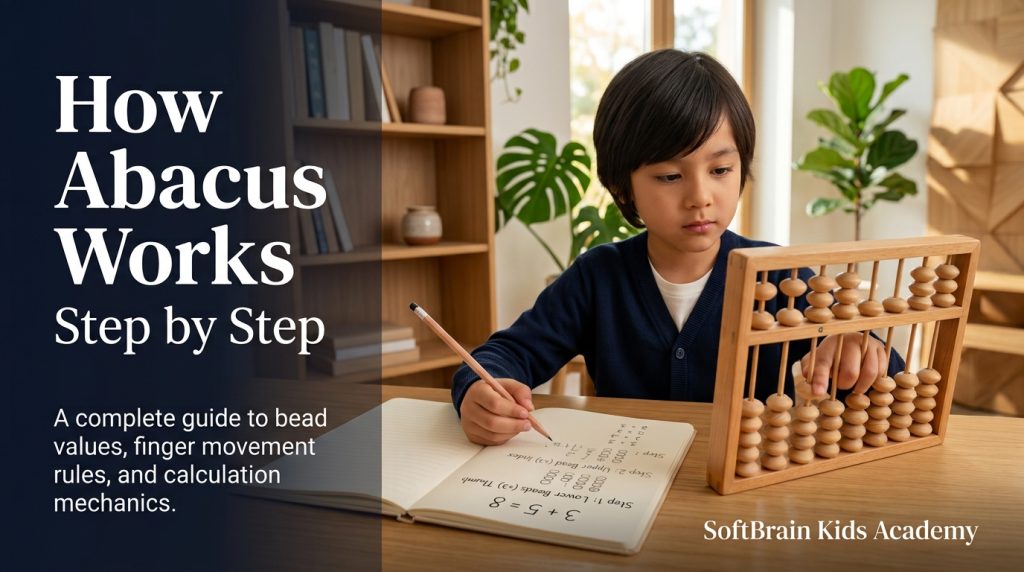

How Abacus Works Step by Step: Complete Mechanics & Guide (2026)
At a Glance: How Abacus Works Step by Step
Understanding how abacus works step by step transforms abstract numbers into physical, tactile beads. Built on a base-10 place value system with upper beads (worth 5) and lower beads (worth 1), the Japanese Soroban abacus allows students to perform rapid addition, subtraction, multiplication, and mental calculation from left to right.
To someone watching an abacus expert for the first time, the speed of bead movements looks almost like magic. But underneath the rapid motions lies an elegant, highly structured mathematical engine. Learning how abacus works step by step demystifies the tool and shows parents how physical bead manipulation builds whole-brain intelligence.
At SoftBrain Kids Academy, we introduce children to the mechanics of the 17-rod Japanese Soroban. In this comprehensive guide, we walk through abacus anatomy, bead values, place columns, standardized finger techniques, and worked calculation examples.

1. Physical Anatomy of the Soroban Abacus
The modern Japanese Soroban consists of four main structural components:
- Outer Rectangular Frame: Keeps vertical rods aligned and provides balance.
- Central Reckoning Beam (Bar): The horizontal bar dividing upper and lower beads. Golden Rule: A bead only counts toward a column’s value when moved toward the central beam.
- Upper “Heaven” Bead (Value = 5): Located above the central beam on each rod. There is exactly 1 upper bead per rod.
- Lower “Earth” Beads (Value = 1 each): Located below the central beam. There are 4 lower beads per rod, giving each column a maximum capacity of 9 (5 + 1 + 1 + 1 + 1).
Read our detailed breakdown of abacus math levels explained to see how bead mechanics scale across 8 curriculum levels.
2. Quick Reference Table: Bead Values & Finger Movements
| Bead Group | Count Per Rod | Value Per Bead | Action to Add (+) | Action to Subtract (-) |
|---|---|---|---|---|
| Lower Earth Beads | 4 beads | 1 | Push UP with Right Thumb | Pull DOWN with Right Index |
| Upper Heaven Bead | 1 bead | 5 | Pull DOWN with Right Index | Push UP with Right Index |
3. Understanding Place Values (Ones, Tens, Hundreds)
Each vertical rod represents a power of 10 in standard base-10 place value notation:
- Unit Rod (Ones Place): Typically marked with a white dot on the reckoning beam. Represents 1 to 9.
- Tens Rod (1st Rod Left of Unit): Represents 10, 20… up to 90.
- Hundreds Rod (2nd Rod Left of Unit): Represents 100 to 900.
- Thousands & Decimals: Moving further left increases place value by 10x; moving right from the unit rod represents tenths (.1) and hundredths (.01).
Learn more about how place value visualization supports early childhood math in how to teach abacus to kindergarteners and is abacus useful for school math.
4. Strict Finger Technique Rules (Thumb vs. Index Finger)
Speed in abacus math depends on muscle memory. Instructors enforce two strict finger movement rules:
- Rule 1 (Right Thumb): Used ONLY to push lower Earth beads UP toward the central beam (adding 1, 2, 3, or 4).
- Rule 2 (Right Index Finger): Used for ALL other movements: pulling lower beads DOWN (subtracting), pulling the upper 5-bead DOWN (adding 5), and pushing the upper 5-bead UP (subtracting 5).
Developing correct finger habits prevents hand fatigue and allows students to execute formulas in milliseconds. Check our guide on abacus addition and subtraction rules.
Master Abacus Mechanics with Live 1-on-1 Training
SoftBrain Kids Academy provides live 1-on-1 online abacus lessons to ensure proper finger technique and calculation speed. Book a free demo class today!
Book a Free Demo Class →5. Step-by-Step Worked Examples (Addition & Subtraction)
Example 1: Setting 7 on the Abacus
Step 1: Start at neutral position (0 beads touching beam).
Step 2: Pull upper 5-bead DOWN with right index finger (Value = 5).
Step 3: Push 2 lower beads UP with right thumb (Value = 5 + 2 = 7).
Example 2: Simple Addition (3 + 5 = 8)
Step 1: Push 3 lower beads UP with right thumb (Value = 3).
Step 2: Pull upper 5-bead DOWN with right index finger.
Step 3: Read result on rod: 1 upper bead (5) + 3 lower beads (3) = 8.
6. How Physical Bead Movement Converts to Mental Math (Anzan)
The ultimate power of learning how abacus works step by step is the transition to Mental Abacus (Anzan). After 6 to 12 months of physical bead manipulation, students form a vivid image of the abacus in their right brain hemisphere.
When given a math problem, students move their fingers slightly in the air to shift imaginary beads in their mind’s eye. This dual activation promotes abacus for brain development and right brain training for kids. Explore how abacus training helps eliminate math anxiety in kids and boosts math speed for kids.
Transform Your Child’s Math Skills Today
Learn abacus calculation mechanics from certified 1-on-1 instructors at SoftBrain Kids Academy. Claim your free demo class!
Try a Free Demo Class →