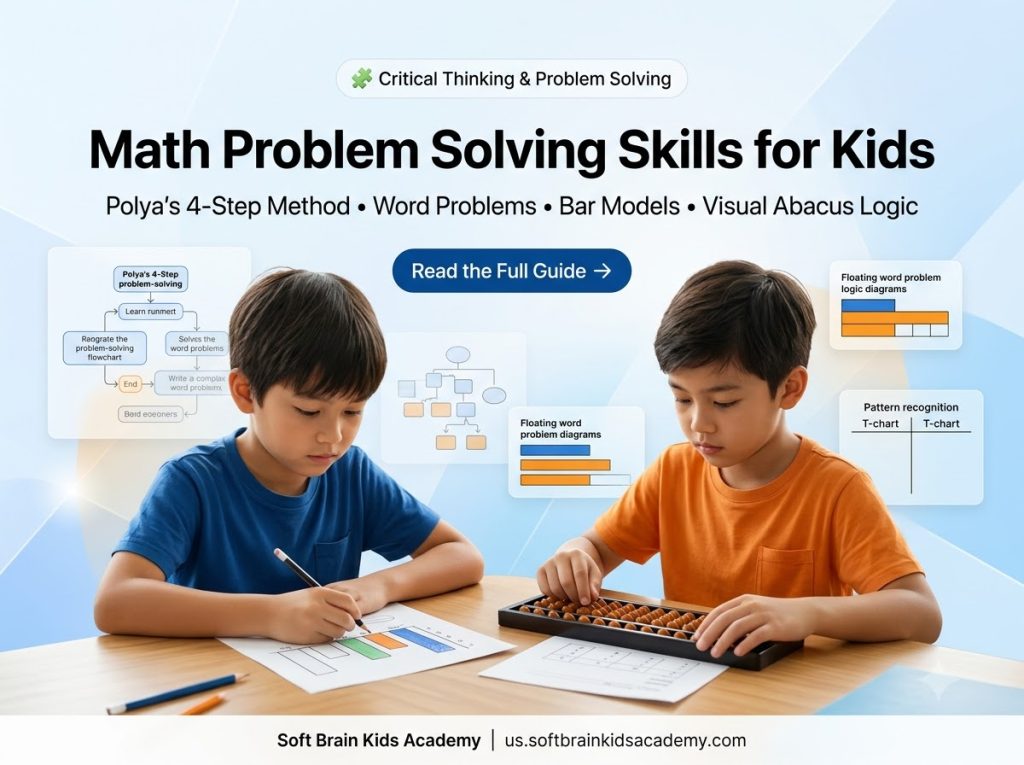

Math Problem Solving Skills for Kids: 10 Effective Strategies (2026)
At a Glance: Math Problem Solving Skills for Kids
Discover 10 proven strategies to develop math problem solving skills in kids. Learn Polya’s 4-step framework, numberless word problems, visual diagram drawing, pattern recognition, and how tactile Soroban abacus mental Anzan builds critical analytical thinking for elementary students.
Being able to execute arithmetic calculations — adding, subtracting, or multiplying numbers — is only half of mathematical literacy. The true measure of a child’s mathematical ability lies in their math problem solving skills for kids: the ability to analyze an unfamiliar scenario, break complex information into logical steps, select an appropriate strategy, and arrive at a reasoned solution. When children struggle with math, the breakdown rarely occurs in raw calculation — it occurs during problem formulation.
At SoftBrain Kids Academy, our educational framework goes beyond rote formula memorization. By teaching children to visualize math problems using Soroban abacus for brain development alongside ancient Vedic math logic sutras, we help students develop flexible, creative problem-solving minds capable of conquering complex multi-step word problems and standardized test challenges.
In this complete guide, we detail George Polya’s classic 4-step problem-solving process adapted for elementary kids, share 10 high-impact problem-solving strategies, examine common word problem traps, and demonstrate how visual abacus training builds prefrontal cortex analytical reasoning. For related reading, explore our guides on right brain training for kids, math enrichment for gifted kids, and abacus for math competitions.

Polya’s 4-Step Problem Solving Framework for Elementary Kids
Renowned mathematician George Polya established a universal 4-step framework for mathematical problem solving. Adapted for elementary children, these four steps provide an unshakeable roadmap for tackling any math challenge:
Step 1: Understand the Problem
Read the story twice. Identify what information you know (given data) and what specific question you must answer (target variable).
Step 2: Devise a Plan
Choose a strategy: draw a bar diagram, use an abacus, make a table, work backwards, or estimate first.
Step 3: Execute the Plan
Perform the steps and calculations carefully. Keep your work organized line-by-line.
Step 4: Look Back & Verify
Re-read the question. Does your answer make sense in the real world? Check your math calculations in reverse.
🧠 Transform Your Child into a Creative Math Problem Solver
SoftBrain Kids Academy teaches visual abacus logic and Vedic shortcuts that make word problems easy. Book a free trial class.
Book Free Trial Class →10 Core Math Problem-Solving Strategies Every Kid Should Know
1. Numberless Word Problems
Strip numbers out of word problems initially (e.g., ‘Maya had some apples, gave some to Ben…’). Forcing kids to explain the scenario without numbers ensures they understand the logic story before computing digits.
2. Draw Bar Models & Visual Diagrams
Singapore-style bar modeling converts abstract word problem relationships into visual proportional bars. Visualizing part-part-whole relationships clarifies multi-step addition, subtraction, and ratio problems instantly.
3. Look for Patterns & Sequences
Mathematics is the science of patterns. Teach children to create T-charts or tables to spot recurring numerical sequences when solving growing pattern problems.
4. Work Backwards Strategy
When a word problem tells you the final outcome and asks for the starting amount (e.g., ‘After spending $5 and getting $2 back, Sam has $12…’), teach kids to reverse every operation from end to start.
5. Guess, Check & Revise (Systematic Trial)
Encourage systematic guessing. Make a reasonable estimate, test it in the problem constraints, and adjust higher or lower systematically based on the result.
6. Use Tactile Abacus Bead Representation
Represent word problem quantities on a Soroban abacus. Moving physical beads gives children a concrete spatial model of quantities before computing. Read our guide on how abacus works step-by-step.
7. Simplify the Problem (Use Smaller Numbers)
If a problem uses huge numbers (e.g., 4,582 × 39), replace them temporarily with simple single-digit numbers (4 × 4) to discover the underlying mathematical operation required.
8. Make an Organized Table or List
For combination or permutation problems (e.g., ‘How many different 2-scoop ice cream cones can you make with 3 flavors?’), teach children to make an organized systematic list to prevent missed items.
9. Estimate Before Calculating
Require kids to estimate the final answer before picking up a pencil. Estimation sets a “sanity boundary” that immediately alerts them if they make a gross calculation error.
10. The ‘Show Me the Hard Part’ Prompt
When a child feels stuck, ask: ‘Show me the exact sentence or step where you got stuck.’ Pinpointing the barrier builds resilience and self-directed problem solving. Read overcoming math anxiety.
Why Keyword Tricks Fail (and What to Teach Instead)
Many traditional classrooms teach children “keyword tricks” — e.g., assuming “altogether” always means add, or “left” always means subtract. Educational researchers at the Education Endowment Foundation (EEF) warn that keyword strategies fail on 40%+ of multi-step word problems because keywords misrepresent mathematical context (e.g., ‘Sam has 12 apples, which is 4 more than Ben has. How many does Ben have?’ — here ‘more’ requires subtraction!).
Instead of teaching keyword tricks, teach children to draw visual bar models or represent quantities on an abacus. Visual representations reveal the actual structural relationships between numbers regardless of word choice.
The Abacus Advantage: Visual-Spatial Representation of Word Problems
Soroban abacus training develops superior problem-solving skills because it engages both the left logical and right visual-spatial brain hemispheres simultaneously. When solving complex word problems, an abacus-trained child translates written sentences into dynamic bead configurations, processing quantities as physical spatial layouts. This visual-spatial grounding prevents cognitive overload and builds superior working memory capacity. Explore our articles on abacus addition and subtraction rules and mental math for kids.
Problem-Solving Strategy Matrix by Grade Level
| Grade / Age | Primary Problem-Solving Strategies | Target Skills |
|---|---|---|
| K–1st (Ages 5–7) | Act out stories, Abacus bead counting, Numberless word problems | Story comprehension & concrete quantities |
| 2nd–3rd (Ages 7–9) | Draw Bar Diagrams, Times table tricks, Simplify numbers, Estimation | Multi-step word problems & visual models |
| 4th–6th (Ages 9–12) | Work Backwards, Mental Anzan abacus, Vedic cross shortcuts, Tables | Complex logic, competition math & algebra |
🚀 Build Unshakeable Problem-Solving Skills Today
Book a free trial class at SoftBrain Kids Academy. Watch your child conquer word problems with live abacus and Vedic math mentoring.
Book Free Trial Class →