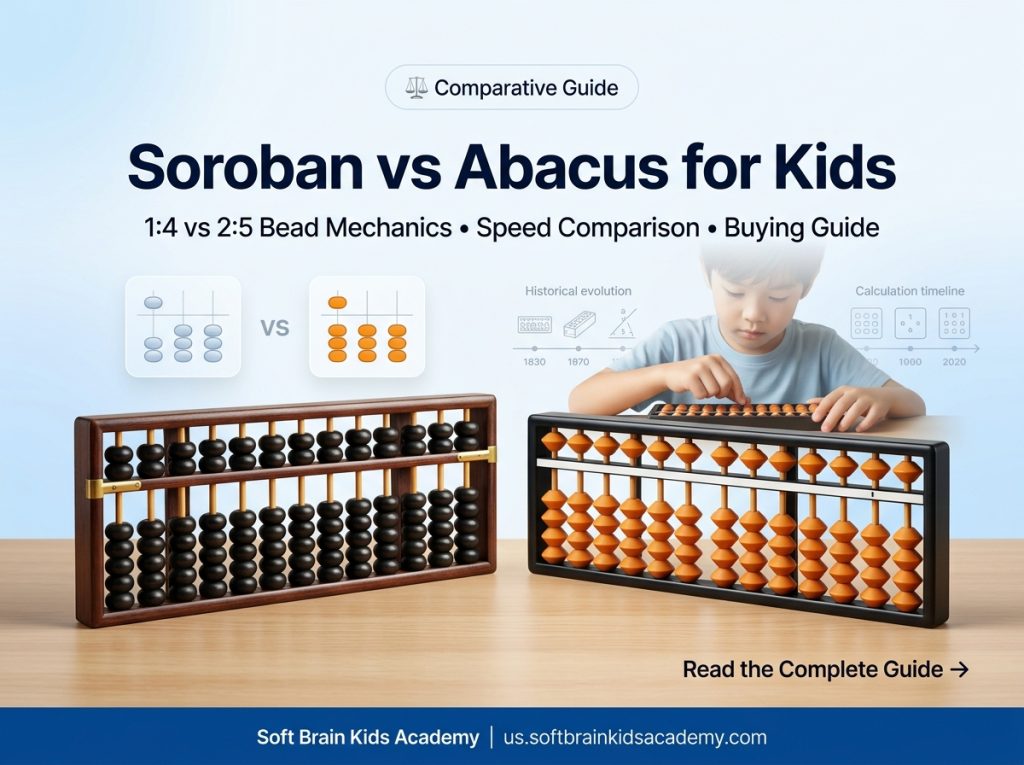

Soroban vs Abacus for Kids: Differences, Types & Best Choice (2026)
At a Glance: Soroban vs Abacus for Kids
Clear up the confusion between Soroban vs abacus for kids. While ‘abacus’ is the broad family name for all historical counting frames, the Soroban is specifically the streamlined Japanese version (1:4 bead structure) designed for modern base-10 math and rapid mental Anzan. This guide details historical evolution, bead mechanics, a 5-type comparison table, and a parent buying guide.
When parents start researching mental math classes for their children, they quickly run into confusing terminology. You might see programs advertising “Abacus Classes,” while others specify “Japanese Soroban,” “Chinese Suanpan,” or “Mental Arithmetic.” Are these the same thing? Is a Soroban different from an abacus? Which tool should your child actually be using?
The short answer is: “Abacus” is the umbrella term for all counting frames, while the “Soroban” is the refined Japanese version specifically optimized for modern mental math. Every Soroban is an abacus, but not every abacus is a Soroban. Understanding this distinction is crucial because the specific bead arrangement of the tool directly determines how quickly and effectively your child can develop mental calculation speed and spatial visualization.
At SoftBrain Kids Academy, our online abacus classes for kids use the authentic Japanese Soroban (1:4 bead configuration). In this comprehensive comparison, we explain the historical evolution of calculation frames, dissect the bead mechanics of different global models, demonstrate why the Soroban is the gold standard for mental Anzan, and provide a practical buying guide for parents. For broader context, also read our articles on how abacus works step by step and abacus math levels explained.

The Evolution of the Abacus: From Dust Boards to Modern Soroban
The word abacus originates from the Greek word abax, meaning “calculating board” or “table covered in dust.” Over thousands of years, civilizations evolved manual counting tools independently to perform commercial arithmetic:
1. Ancient Roman Hand Abacus (c. 300 BCE)
The Romans created portable bronze plates with grooves containing sliding counters. Upper grooves held single counters worth 5, while lower grooves held 4 counters worth 1 each — the direct ancestor of modern upper/lower deck layouts.
2. Chinese Suanpan (c. 1200 CE)
The Chinese developed the Suanpan (“counting tray”), featuring a 2:5 bead configuration (2 upper beads worth 5 each, 5 lower beads worth 1 each). This extra capacity allowed merchants to calculate in both decimal and base-16 hexadecimal systems (used for traditional weight measurements like taels and catties).
3. Japanese Soroban (c. 1930s Modern Refinement)
Introduced to Japan in the 16th century, the frame underwent progressive simplification. By the 1930s, Japanese mathematicians eliminated redundant beads, standardizing the 1:4 Soroban (1 upper bead worth 5, 4 lower beads worth 1 each). This streamlined design eliminated calculation redundancy, creating the ideal tool for modern base-10 arithmetic and mental Anzan visualization.
Bead Mechanics: 1:4 (Soroban) vs. 2:5 (Suanpan) Explained
Why does the difference between a 1:4 bead structure and a 2:5 bead structure matter so much for a child learning math? It comes down to **representation redundancy**:
The Chinese Suanpan Problem (2:5 Redundancy)
On a 2:5 Suanpan, each rod has 2 upper beads ($5 + 5 = 10$) and 5 lower beads ($1 \times 5 = 5$), allowing a single rod to hold a maximum value of 15! This creates multiple ways to represent the exact same number:
- Number 5 can be represented as: 1 upper bead DOWN, OR 5 lower beads UP.
- Number 10 can be represented as: 2 upper beads DOWN, OR 1 upper bead + 5 lower beads, OR 1 lower bead on the next rod.
When a child tries to build rapid mental imagery of these beads, having multiple visual patterns for the same number creates cognitive friction and slows down calculation speed.
The Japanese Soroban Perfection (1:4 Non-Redundant Design)
On a 1:4 Soroban, each rod has exactly 1 upper bead ($5$) and 4 lower beads ($1 \times 4 = 4$), allowing a single rod to hold a maximum value of 9 — matching our base-10 digit system (0 to 9) perfectly!
- Number 5 has ONLY ONE visual representation: upper bead pushed down to the beam.
- Number 9 has ONLY ONE visual representation: upper bead down + all 4 lower beads up.
- To represent 10, the child MUST carry over to the next rod (1 bead on the tens rod).
Because every single-digit number (0 to 9) maps to a unique visual bead pattern, the child’s brain can photographically memorize bead positions instantly, enabling high-speed mental Anzan calculation.
5 Global Abacus Types Comparison Table
Examine how 5 major global abacus designs compare across structure, regional origin, and suitability for children:
| Abacus Type | Origin & Period | Bead Structure | Number Base | Best Use Case for Kids |
|---|---|---|---|---|
| Japanese Soroban | Japan (Modern 1930s) | 1 upper bead, 4 lower beads (1:4) | Base-10 Decimal | ⭐ Best overall for mental math, speed & Anzan visualization |
| Chinese Suanpan | China (c. 1200 CE) | 2 upper beads, 5 lower beads (2:5) | Base-10 & Base-16 | Historical trade calculations; less optimal for child mental speed |
| Russian Schoty | Russia (c. 1600 CE) | 10 beads per horizontal wire (no beam) | Base-10 Decimal | Simple counting; lacks subitizing optimization of upper 5-bead |
| Dutch Rekenrek | Netherlands (Modern) | 10 beads per wire in 5 red / 5 white groups | Base-10 (5-grouping) | Preschool & K-1 early subitizing; doesn’t support multi-digit mental math |
| Roman Hand Abacus | Ancient Rome (c. 300 BCE) | Grooved slots with sliding metal studs | Base-10 & Roman Fractions | Historical artifact interest; not used in modern education |
Experience Authentic Japanese Soroban Training
SoftBrain Kids Academy uses authentic Soroban methodology to build rapid mental math skills in children aged 5 to 14.
Book a Free Soroban Trial Class →Why Mental Math (Anzan) Exclusively Requires the Soroban
Anzan is the art of performing high-speed calculations by mentally visualizing an abacus in the mind’s eye without touching a physical device. World mental calculation champions and elite competitive students exclusively use **Soroban Anzan**.
Neuroimaging studies published in Cerebral Cortex reveal that when children perform Soroban Anzan, their brain exhibits intense activity in the right parietal lobe — the area responsible for 3D spatial visualization and visual working memory. The 1:4 Soroban structure provides the exact minimum visual information necessary to represent numbers 0 through 9 uniquely. This minimal visual footprint allows the brain to refresh mental images up to 5 times per second during complex multi-digit calculations!
If a child attempted Anzan visualization using a 2:5 Suanpan frame, the additional redundant upper and lower beads would create visual clutter in working memory, slowing down mental processing speed by over 60%. This is why every modern mental arithmetic organization worldwide — including SoftBrain Kids Academy — teaches using the Soroban. Learn more about abacus for brain development and is abacus useful for school math.
Physical Features of an Authentic Japanese Soroban
When inspecting a Soroban abacus, you will notice distinct design elements engineered specifically for tactile speed:
1. Bi-Conical (Sharp Diamond) Beads
Soroban beads are not round balls; they are bi-conical (tapered to a sharp edge in the middle). This diamond-shaped edge allows fingertips to slide under beads quickly without slipping.
2. The Reckoning Beam & Unit Dots
A horizontal beam separates the upper deck (1 bead worth 5) from the lower deck (4 beads worth 1 each). Embedded along the beam are small ivory or plastic “unit dots” spaced every 3 rods to designate unit rods and decimal points.
3. One-Touch Reset Button
High-quality student Sorobans feature a spring-loaded button on the top corner. Pressing the button instantly returns all upper beads UP and all lower beads DOWN to clear the frame to zero in a fraction of a second.

Parent Buying Guide: Selecting the Right Frame for Your Child
Use this practical buying guide when purchasing a Soroban abacus for your child:
| Child’s Age & Level | Recommended Rod Count | Frame Material | Key Features to Look For |
|---|---|---|---|
| Preschool (Ages 3–5) | 7-rod or 13-rod frame | Durable ABS Plastic or Beechwood | Larger beads, smooth rounded edges, bright contrast colors |
| Beginner (Ages 6–8) | 13-rod or 17-rod Soroban | ABS Plastic or Birch Frame | One-touch reset button, bi-conical beads, unit dots |
| Advanced / Competition (Ages 9+) | 17-rod or 23-rod Soroban | Traditional Ebony/Birch Hardwood | High-speed metal rods, sharp wood beads, reset button |
How Soroban Training Integrates with School Mathematics
Some parents worry that learning a Soroban abacus will conflict with standard school math taught in US classrooms. In reality, Soroban methodology directly aligns with and enhances Common Core state standards:
- Place Value Alignment (NBT Standards): The Soroban’s physical rod structure makes place value (ones, tens, hundreds, thousands) tangible and clear, resolving the place-value confusion common in 2nd and 3rd grade.
- Eliminating Borrowing/Carrying Errors: Soroban complement rules (“Big Friends” to 10 and “Small Friends” to 5) replace tedious borrowing and carrying with automatic complement addition and subtraction.
- Multiplication & Division Mastery: Multi-digit multiplication and division are performed on the Soroban by setting partial products directly onto rods, reinforcing distributive property concepts. Explore abacus multiplication for kids and Vedic math division tricks.
To read comparative reviews against other math approaches, check out our guides on abacus vs calculator for kids, abacus vs UCMAS, and abacus learning center for kids.
Frequently Asked Questions
What is the difference between a Soroban and a regular abacus?
Why do modern mental math programs use the Soroban abacus instead of other types?
Which type of abacus should I buy for my child starting classes?
What is the Chinese Suanpan and how does it compare to the Soroban?
How long does it take for a child to master the Soroban abacus?
Can learning the Soroban help with school math performance?
Master the Japanese Soroban with SoftBrain Kids Academy
Book a free live trial class to see how authentic Soroban abacus training unlocks your child’s mental math speed.
Schedule Your Free Trial →