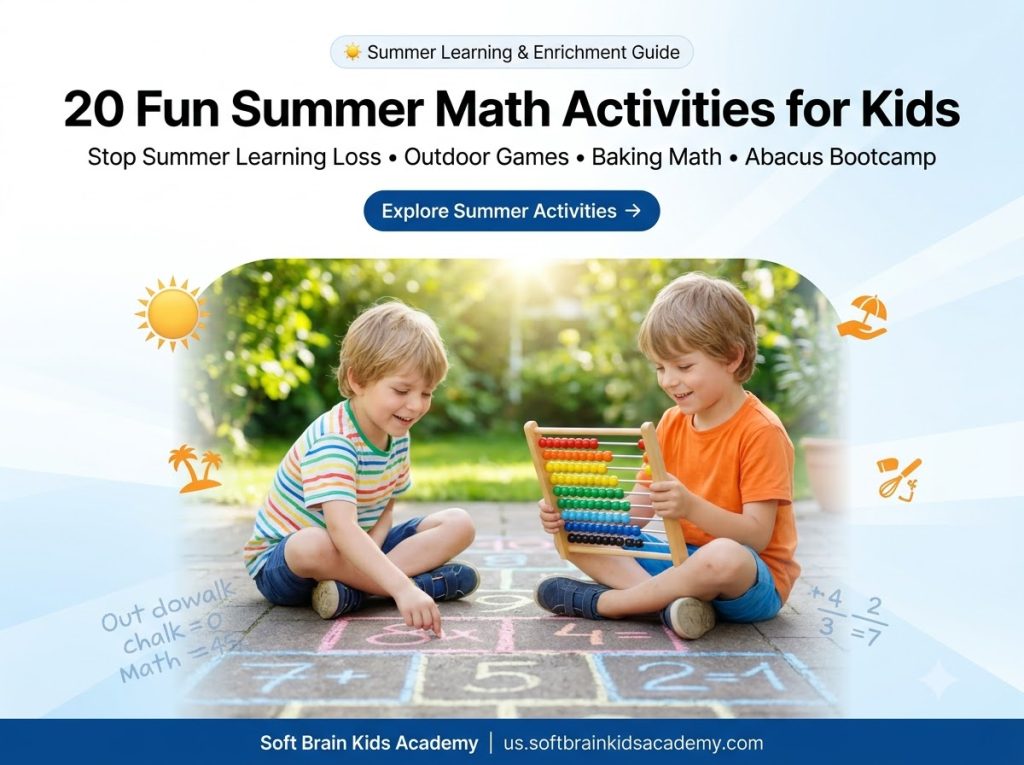

20 Fun Summer Math Activities for Kids: Stop Summer Learning Loss (2026)
At a Glance: Summer Math Activities for Kids
Discover 20 engaging summer math activities for kids to prevent the ‘summer slide’. From outdoor sidewalk chalk games and kitchen baking math to board games, Soroban abacus challenges, and live online summer math bootcamps, keep your child’s math skills sharp and fun all summer long.
Summer vacation is a time for relaxation, outdoor play, and family memories. However, for many students, it is also a period of significant academic regression. Educational researchers refer to this phenomenon as the “summer slide” — the loss of academic skills that occurs during the 2-to-3 month summer break. Studies conducted by NWEA and Johns Hopkins University reveal that elementary children lose up to 2.6 months of grade-level math computational skills over the summer — a loss greater than in reading or any other subject.
The good news? Preventing summer math loss does not require forcing your child to complete tedious drill worksheets while their friends play outside. Incorporating 10 to 15 minutes of engaging summer math activities for kids into your family routine completely halts skill regression and prepares your child to enter the next grade level with confidence.
At SoftBrain Kids Academy, our summer enrichment programs — including our specialized online abacus classes for kids and Vedic math summer bootcamps — transform summer math practice into an exciting, game-based brain workout. Read our guide on screen-free learning activities for kids and mental math games for kids for complementary home ideas.

The Science of the Summer Slide: Why Math Regresses Faster Than Reading
Why does mathematics suffer a steeper summer drop than reading comprehension? Educational researchers explain that reading is integrated into everyday summer life — street signs, comic books, video game dialogues, and bedtime stories. Mathematics, however, is procedural and conceptual. Unless parents consciously create opportunities to practice numerical reasoning, children go 80+ days without executing a single math calculation.
When children return to school in September, teachers spend an average of 4 to 6 weeks re-teaching forgotten material from the previous grade before introducing new concepts. Children who engage in consistent summer math activities for kids bypass this re-learning phase entirely, entering the new academic year at peak cognitive readiness. Read our guide on how to improve math speed for kids to see how summer practice builds long-term speed.
☀️ Join Our Summer Mental Math & Abacus Bootcamp!
Turn summer break into a cognitive launchpad. Live online small-group sessions taught by certified teachers. Book a free trial class.
Book Free Summer Trial →10 Screen-Free Outdoor & Real-World Summer Math Activities
1. Sidewalk Chalk Math Hopscotch
Draw a 10-frame hopscotch grid on the driveway with sidewalk chalk. Fill squares with math equations instead of numbers (e.g., 6 × 7, 14 + 8). The jumper must call out the correct answer before landing. Combines aerobic movement with rapid mental retrieval.
2. Nature Shape & Geometry Scavenger Hunt
Give your child a clipboard during a park walk. Challenge them to find natural examples of symmetry (leaves), concentric circles (tree trunk rings), right angles (branches), and tessellations (pinecones/honeycombs). Connects abstract geometry to nature.
3. Water Balloon Target Estimation
Draw target circles on a fence with chalk, assigning points (10, 25, 50, 100). Kids throw water balloons, tracking and adding their cumulative scores mentally after 5 throws. Excellent for multi-digit mental addition practice.
4. Grocery Store Unit Price Comparison
Hand your child the shopping list and calculator. Challenge them to find the “best buy” between two cereal sizes by calculating price per ounce or estimating total bill cost before reaching checkout. Builds real-world number sense.
5. Summer Lemonade Stand Financial Literacy
Help your child run a backyard lemonade stand. Guide them through calculating ingredient costs, setting price margins, making change for customers, and calculating net profit. Teaches practical practical math and financial literacy.
6. Road Trip Distance & Speed Tracking
During summer drives, ask your child to calculate arrival time based on current speed and remaining mileage (Distance = Speed × Time). Have them track fuel efficiency (miles per gallon) at gas stops.
7. Backyard Measurement Olympics
Set up fun mini-events: standing long jump, sponge toss, or marble roll. Have kids measure distances using tape measures in inches and centimeters, convert between units, and calculate average performance.
8. Baseball Statistics & Averages
If your child loves sports, teach them to calculate batting averages (Hits ÷ At-Bats) or team win percentages. Sports analytics makes statistics highly engaging for young fans.
9. Tactile Soroban Abacus Backyard Bead Challenge
Take a physical wooden Soroban abacus to the patio. Practice rapid bead movement under the shade of a tree. Physical bead manipulation engages fine motor skills and builds working memory. Explore our guide on abacus for preschoolers.
10. Shadow Height & Angle Measurement
Measure your child’s shadow height at 9 AM, 12 PM, and 4 PM using a yardstick. Graph shadow length against time of day to visually explore solar angles and proportions.
5 Creative Kitchen & Family Board Game Math Ideas
11. Kitchen Recipe Scaling (Fraction Mastery)
Bake cookies or make pizza together, but double or triple the recipe! Have your child compute 1½ cups doubled (3 cups) or ¾ tsp halved (⅜ tsp). Kitchen baking makes fractions visual, tactile, and delicious.
12. Prime Climb Board Game Night
Play Prime Climb, a color-coded mathematical board game that teaches prime numbers, multiplication, and division through strategic pawn movement. Highly engaging for ages 8+.
13. Yahtzee Probability & Mental Addition
Yahtzee is an outstanding game for practicing mental addition, multiplication combinations, and basic probability. Tracking scorecards builds fast mental math fluency.
14. Monopoly Junior Money Counting
Monopoly Junior teaches young children cash transaction math, change calculation, and property budgeting in a low-pressure game setting.
15. Pizza Slicing Fraction Visualizer
Use a real pizza or pie to explore equivalent fractions (2/8 = 1/4). Cut slices into different fractions and ask children to build equivalent portions.
5 High-Impact Digital & Abacus Summer Enrichment Programs
16. SoftBrain Kids Academy Live Summer Abacus Bootcamp
Our flagship summer program. Live interactive classes taught by certified teachers. Builds dual-hemispheric brain connectivity, Soroban mental Anzan speed, and Vedic math shortcuts in a fun, small-group format. Explore best age to learn abacus.
17. Camp Khan Kids Free Summer Program
A 100% free virtual summer program for ages 2 to 8 blending app-based learning games with off-screen creative play prompts.
18. Prodigy Math Gamified Quest App
A fantasy role-playing video game where children solve curriculum-aligned math problems to win battles. Keeps kids engaged independently.
19. Vedic Speed Math Multiplication Workshop
A 4-week summer workshop focusing on ancient Indian Vedic math sutras. Children learn to multiply multi-digit numbers in seconds. Read our guide on Vedic math tricks.
20. Outschool Summer Niche Math Clubs
Topic-specific live video clubs covering Minecraft math, coding logic, and origami geometry for casual weekly engagement.
Summer Activity Matrix by Age Group
| Age Group | Recommended Activities | Primary Skill Focus |
|---|---|---|
| Preschool (Ages 4–6) | Chalk Hopscotch, Nature Scavenger Hunt, Abacus Bead Counting | Number sense & tactile patterns |
| Elementary (Ages 7–10) | Lemonade Stand, Recipe Baking, SoftBrain Abacus Bootcamp, Yahtzee | Times tables, mental Anzan, fractions |
| Middle School (Ages 11–14) | Grocery Unit Pricing, Baseball Stats, Vedic Speed Math, Prime Climb | Vedic math speed, algebra, budgeting |
How to Build a 15-Minute Daily Summer Math Routine
Consistency beats intensity. Set aside 15 minutes right after breakfast before screen time begins. Alternate between outdoor screen-free games on Mondays/Wednesdays/Fridays, live online abacus sessions on Tuesdays/Thursdays, and family board games on weekends. This balanced routine completely halts summer slide with zero student resistance!
☀️ Make This Summer Your Child’s Brain Breakthrough!
Enroll in SoftBrain Kids Academy’s Live Summer Abacus & Vedic Math Bootcamp. Free trial available.
Book Free Trial Class →