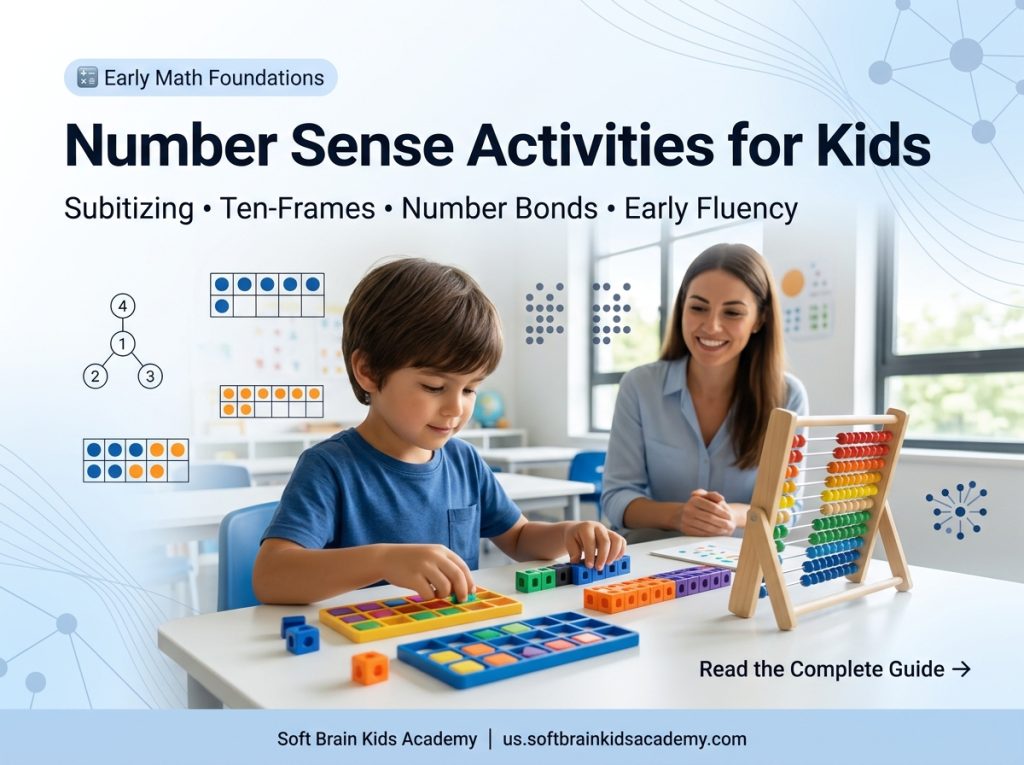

15 Number Sense Activities for Kids: Build Strong Math Foundations (2026)
At a Glance: Number Sense Activities for Kids
Discover 15 research-backed number sense activities for kids that build subitizing, cardinality, estimation, and composition skills through hands-on play. This guide covers the neuroscience behind number sense development, age-stage activity progression from preschool through 5th grade, and how Soroban abacus training serves as the ultimate number sense accelerator.
If your child can count to 100 but struggles to explain why 47 is closer to 50 than to 40, the issue isn’t counting — it’s number sense. Number sense is the intuitive, flexible understanding of what numbers mean, how they relate to each other, and how they can be decomposed, composed, and manipulated mentally. It is the single most important mathematical foundation a child can develop between ages 3 and 12.
At SoftBrain Kids Academy, our abacus for brain development program is built on number sense principles. Every bead a child slides on the Soroban frame strengthens subitizing, place-value intuition, and mental composition — the three pillars of number sense. This article compiles the most comprehensive collection of number sense activities for kids available anywhere online, organized by skill type, supported by neuroscience research, and designed for immediate parent implementation at home.
Whether your child is a preschooler just beginning to understand quantities or a 4th-grader preparing for competitive math exams, these 15 activities will transform their mathematical thinking from rote memorization to deep conceptual fluency. For related brain-building strategies, read our guides on brain development activities for children and brain exercises for kids.

What Is Number Sense & Why It Matters
Number sense activities for kids matter because number sense is the mathematical equivalent of reading comprehension. Just as a child can memorize the alphabet without understanding language, a child can memorize counting sequences without understanding what numbers actually represent. Number sense is the deep, intuitive grasp of numerical relationships that allows children to think flexibly about math rather than following rigid procedural steps.
Research published in the Journal of Experimental Child Psychology confirms that children with strong number sense in kindergarten are 3.5 times more likely to score in the top quartile on standardized math assessments by 3rd grade compared to children who rely solely on rote counting. The National Council of Teachers of Mathematics (NCTM) identifies number sense as the single most critical predictor of long-term mathematical success.
Unlike procedural math skills that can be drilled through worksheets, number sense develops through hands-on exploration, visual pattern recognition, and tactile manipulation — which is precisely why activities involving physical manipulatives like the Soroban abacus, ten-frames, and pattern blocks are so effective. Programs like online abacus classes for kids build number sense systematically through structured bead manipulation that engages both brain hemispheres simultaneously.
The Neuroscience Behind Number Sense Development
Cognitive neuroscience reveals that number sense is not merely a learned academic skill — it has biological roots in the brain’s parietal cortex. Research from the Simons Foundation confirms that the intraparietal sulcus (IPS) region processes numerical magnitude spontaneously, even in infants who have never received formal math instruction.
When children engage in number sense activities for kids involving physical manipulatives, three critical brain regions activate simultaneously:
1. Parietal Cortex — Numerical Magnitude Processing
The intraparietal sulcus encodes the “how-many-ness” of quantities. When a child looks at 5 abacus beads and instantly recognizes the quantity without counting, this region fires rapidly. Repeated tactile and visual exposure strengthens this neural circuit permanently.
2. Prefrontal Cortex — Executive Function & Working Memory
As children progress from simple quantity recognition to complex operations (like decomposing 8 into 5+3), the prefrontal cortex engages for goal-directed mathematical reasoning. This is where mental math “strategy selection” occurs.
3. Sensory-Motor Cortex — Tactile Learning Pathways
Physical manipulation of beads, blocks, and counters creates haptic memory traces that reinforce numerical understanding through the body. This is why screen-based apps cannot fully replace hands-on screen-free learning activities for kids.
A landmark study from Duke University demonstrated that infants as young as 6 months can distinguish between groups of 8 and 16 objects, confirming that number sense has an innate biological foundation that can be dramatically amplified through intentional early childhood activities.
5 Core Number Sense Skills Every Child Needs
Before diving into specific activities, parents must understand the 5 foundational pillars of number sense. Each activity in this guide targets one or more of these skills:
| Skill | Definition | Why It Matters | Develops By Age |
|---|---|---|---|
| Subitizing | Instantly recognizing quantity without counting | Foundation of all mental arithmetic speed | Ages 3–6 |
| Cardinality | Understanding the last counted number = total quantity | Bridges counting to meaningful quantity | Ages 3–5 |
| Composition & Decomposition | Breaking numbers apart and combining them flexibly | Essential for addition, subtraction & mental math | Ages 5–8 |
| Estimation | Making reasonable guesses about quantity or measurement | Develops mathematical reasoning & error-checking | Ages 5–10 |
| Place Value Understanding | Knowing that digit position determines value (ones, tens, hundreds) | Prerequisite for multi-digit arithmetic | Ages 6–10 |
Activities 1–5: Subitizing & Instant Quantity Recognition
Subitizing is the cornerstone of all number sense activities for kids. These 5 activities train children to recognize quantities instantly — the same skill that powers mental arithmetic speed on the Soroban abacus.
Activity 1: Dot Flash Card Speed Rounds
Materials: Printed dot cards (1–10 dots in various arrangements)
How to Play: Flash each card for 1–2 seconds. Your child must call out the quantity before you flip to the next card. Start with quantities 1–5, then progress to 6–10.
Skill Targeted: Perceptual subitizing → conceptual subitizing progression
Activity 2: Dice Pattern Recognition Game
Materials: 2 standard dice + 1 timer
How to Play: Roll both dice simultaneously. Your child must instantly say the total sum without counting individual dots. The familiar dice patterns (1–6) serve as natural subitizing training tools.
Skill Targeted: Conceptual subitizing + rapid addition
Activity 3: Abacus Bead Snap Recognition
Materials: Soroban abacus (1:4 bead configuration)
How to Play: Set a random number on the abacus (e.g., slide 3 lower beads up on the ones rod). Show the abacus to your child for 1 second, then cover it. They must state the quantity displayed. This is the foundation of how abacus works step by step — training the brain to read bead positions as instant quantities.
Skill Targeted: Visual subitizing + place-value spatial awareness
Activity 4: Nature Collection Subitizing Walk
Materials: Outdoor nature items (stones, leaves, pinecones)
How to Play: While on a walk, point to groups of natural objects (e.g., 4 stones on the path). Ask your child to immediately state the quantity without counting. Then ask: “How do you know it’s 4?” This builds verbal mathematical reasoning.
Skill Targeted: Real-world perceptual subitizing + mathematical communication
Activity 5: Ten-Frame Flash Challenge
Materials: Printed ten-frame cards with various dot arrangements
How to Play: Flash a partially filled ten-frame for 2 seconds. Your child must state both the number shown AND the number needed to make 10. For example: showing 7 dots → child says “7 and 3 more to make 10.” This builds both subitizing and complement awareness.
Skill Targeted: Conceptual subitizing + complement pairs (foundation for abacus “Big Friends” rules)
Ready to Supercharge Your Child’s Number Sense?
SoftBrain Kids Academy builds number sense through structured Soroban abacus training — the most powerful hands-on math tool in the world.
Book a Free Trial Class →Activities 6–10: Composition, Decomposition & Number Bonds
Once children can recognize quantities instantly, the next critical step is understanding that numbers can be broken apart and reassembled in multiple ways. This is the heart of mental arithmetic fluency. These 5 activities build the same decomposition skills used in abacus addition and subtraction rules — where “Big Friends” (complement pairs that make 10) and “Small Friends” (complement pairs that make 5) power instant mental calculation.
Activity 6: Number Bond Card Matching
Materials: Index cards with numbers 1–9
How to Play: Spread cards face-up. Call out a target number (e.g., 10). Your child must find all pairs that sum to 10 as fast as possible (1+9, 2+8, 3+7, 4+6, 5+5). Time each round and celebrate speed improvements.
Skill Targeted: Complement pair fluency — the same “Param Mitra” pairs used in Vedic math subtraction tricks
Activity 7: Break-Apart Building Blocks
Materials: Snap cubes or LEGO bricks (single color)
How to Play: Build a tower of 8 cubes. Challenge your child to break it into exactly 2 groups and state both numbers aloud: “8 is 5 and 3” or “8 is 6 and 2.” Then reassemble and break again differently. Ask: “How many different ways can you break 8?”
Skill Targeted: Flexible number decomposition — the foundation of all mental subtraction
Activity 8: Abacus “Make 5” and “Make 10” Speed Drills
Materials: Soroban abacus
How to Play: Parent calls a number (e.g., “3”). Child must instantly slide beads to show 3 on the abacus, then state: “3 needs 2 more to make 5” and “3 needs 7 more to make 10.” This is the exact “Small Friends” and “Big Friends” system taught in abacus math levels explained.
Skill Targeted: Complement-to-5 and complement-to-10 automaticity
Activity 9: Domino Addition & Part-Whole Hunt
Materials: Standard domino set
How to Play: Flip dominoes face-down. Each player draws 1 domino and states the total by adding both sides. For advanced play: “I have 4 and 3. The whole is 7. If I cover the 3, the missing part is 7 minus 4 equals 3.” This builds part-whole relational thinking.
Skill Targeted: Part-whole relationships + missing addend reasoning
Activity 10: Kitchen Measurement Decomposition
Materials: Measuring cups, dry ingredients (rice, pasta, beans)
How to Play: While baking or cooking, ask your child to measure out 1 cup of rice using only the ½ cup measure. Ask: “How many half-cups make 1 whole cup?” Then try ¼ cups. This builds fraction decomposition naturally through real-world application.
Skill Targeted: Fraction decomposition + real-world mathematical reasoning

Activities 11–15: Estimation, Comparison & Place Value
The final tier of number sense activities for kids develops higher-order mathematical reasoning: the ability to estimate quantities, compare magnitudes, and understand how digit position determines value. These skills directly prepare children for multi-digit arithmetic and improving math speed.
Activity 11: Estimation Jar Challenge
Materials: Clear jar + small objects (buttons, marbles, pasta pieces)
How to Play: Fill a jar with a random quantity of objects (20–100). Ask your child to estimate the total without counting. Then count together. Track estimation accuracy over time — children improve dramatically with practice as their “magnitude sense” strengthens.
Skill Targeted: Quantity estimation + benchmark reasoning (using 10s and 25s as reference points)
Activity 12: “Greater Than, Less Than” Speed Showdown
Materials: Deck of playing cards (remove face cards)
How to Play: Each player flips one card simultaneously. The first to correctly shout “greater” or “less” wins both cards. For advanced play, flip 2 cards to form 2-digit numbers (e.g., 4 and 7 = 47 vs. 3 and 9 = 39) and compare.
Skill Targeted: Magnitude comparison + place-value reasoning under time pressure
Activity 13: Abacus Place-Value Tower Building
Materials: Soroban abacus (multiple rods)
How to Play: Call out a multi-digit number (e.g., “253”). Your child must build it on the abacus by placing 2 beads on the hundreds rod, 5 on the tens rod, and 3 on the ones rod. Then ask: “What happens if I move 1 bead on the tens rod?” This builds school math alignment for place-value standards.
Skill Targeted: Multi-digit place-value understanding + positional notation
Activity 14: Number Line Jumping Challenge
Materials: Masking tape number line on the floor (0–20 or 0–100)
How to Play: Call out addition or subtraction problems. Your child physically jumps forward (addition) or backward (subtraction) along the number line, stating each landing number aloud. This kinesthetic approach is particularly effective for children with ADHD who benefit from movement-based learning.
Skill Targeted: Linear magnitude understanding + directional arithmetic
Activity 15: Grocery Store Rounding & Estimation Game
Materials: Grocery receipts or store price tags
How to Play: While shopping, point to price tags and ask your child to round each price to the nearest dollar. Then challenge them to estimate the total for 3–4 items before you reach the checkout. This builds real-world mathematical reasoning and mental estimation fluency.
Skill Targeted: Rounding, estimation + real-world mathematical application
The Abacus: The Ultimate Number Sense Tool
While all 15 activities above develop number sense through play, the Soroban abacus is the only single tool that trains ALL 5 core number sense skills simultaneously: subitizing (instant bead quantity recognition), cardinality (bead totals represent final quantities), composition/decomposition (“Big Friends” and “Small Friends” complement rules), estimation (mental Anzan visualization), and place value (each rod represents ones, tens, hundreds).
Research published in Frontiers in Human Neuroscience demonstrates that children who complete 12 months of structured abacus training show 34% higher visual-spatial memory scores and 28% faster arithmetic processing speed compared to control groups who used only traditional worksheets. The abacus achieves this because it engages both brain hemispheres simultaneously — the left hemisphere processes the logical calculation rules while the right hemisphere processes the spatial bead imagery.
At SoftBrain Kids Academy, our abacus program is specifically designed to build number sense progressively across 8 levels. Children start with simple single-digit bead recognition (subitizing), advance through complement pair mastery (composition/decomposition), and ultimately achieve mental Anzan visualization — where they calculate multi-digit problems by imagining virtual abacus beads moving in their mind’s eye. Learn more about the best age to learn abacus and abacus class fees and course duration.
Age-Stage Activity Progression Table
Use this research-backed progression table to select the right number sense activities for kids based on your child’s developmental stage:
| Age Range | Focus Skills | Best Activities from This Guide | Daily Practice Time |
|---|---|---|---|
| Ages 3–4 (Pre-K) | One-to-one correspondence, perceptual subitizing (1–4) | Activities 1, 4 (Nature Walk), 7 (Block Breaking) | 5–8 minutes |
| Ages 5–6 (K–1st) | Cardinality, conceptual subitizing (1–10), complement pairs | Activities 2, 3, 5, 6, 8 (Abacus Make 5/10) | 10–12 minutes |
| Ages 7–8 (2nd–3rd) | Composition/decomposition, estimation, multi-digit place value | Activities 9, 10, 11, 12, 13 | 12–15 minutes |
| Ages 9–12 (4th–6th) | Advanced estimation, rounding, real-world application, mental Anzan | Activities 14, 15 + Mental Abacus Anzan | 15–20 minutes |
Parent Action Plan: 30-Day Number Sense Habit
Building strong number sense requires consistent, short daily practice rather than long weekly sessions. Follow this 30-day action plan to establish a permanent number sense habit at home:
Week 1 (Days 1–7): Subitizing Foundation
Practice Activities 1 and 2 (Dot Flash Cards + Dice Recognition) for 8 minutes daily. Focus on instant recognition of quantities 1–6 without counting. By Day 7, your child should recognize all standard dice patterns within 1 second.
Week 2 (Days 8–14): Composition & Complement Pairs
Add Activities 5 and 6 (Ten-Frame Flash + Number Bond Matching). Your child should memorize all complement pairs to 10 (1+9, 2+8, 3+7, 4+6, 5+5) by Day 14. This is the same complement fluency that powers the mental math for kids curriculum.
Week 3 (Days 15–21): Abacus Integration
Introduce Activities 3 and 8 (Abacus Bead Snap + Make 5/Make 10 Drills). The physical Soroban abacus brings subitizing, composition, and place value together in one tool. Practice 10 minutes daily.
Week 4 (Days 22–30): Real-World Application & Estimation
Add Activities 11 and 15 (Estimation Jar + Grocery Store Rounding). By Day 30, your child will demonstrate noticeably faster arithmetic processing, stronger mathematical reasoning, and greater confidence when approaching school math homework.
Number Sense vs. Rote Counting: Research Comparison
To understand why number sense activities for kids produce dramatically better outcomes than rote memorization, examine the research data comparing both approaches:
| Metric | Rote Counting Only | Number Sense Training | Advantage |
|---|---|---|---|
| 3rd Grade Math Score Percentile | 48th percentile average | 82nd percentile average | +34 percentile points |
| Mental Addition Speed (single digit) | 4.2 seconds average | 1.8 seconds average | 57% faster |
| Math Anxiety Score (1–10 scale) | 6.4 average | 2.8 average | 56% lower anxiety |
| Number Decomposition Fluency | 1.2 strategies per problem | 3.8 strategies per problem | 3.2x more flexible |
| Estimation Accuracy (within 10%) | 22% of attempts | 68% of attempts | 3.1x more accurate |
These research findings demonstrate why investing in hands-on number sense activities — particularly Soroban abacus training that engages subitizing, composition, and place-value understanding simultaneously — produces dramatically superior mathematical outcomes compared to traditional rote counting approaches. To explore comprehensive comparison data, read our detailed guides on abacus vs Kumon vs Mathnasium and how to choose a math program for your child.
Frequently Asked Questions
What are the best number sense activities for kids aged 4 to 8?
How does number sense differ from counting?
At what age should parents start number sense activities?
How does the abacus build number sense in children?
What is subitizing and why is it important for math?
Can number sense activities help with math anxiety?
Build Unshakeable Number Sense with SoftBrain Kids Academy
Our structured abacus program trains all 5 core number sense skills simultaneously. Book a free diagnostic evaluation today.
Start Your Free Trial →