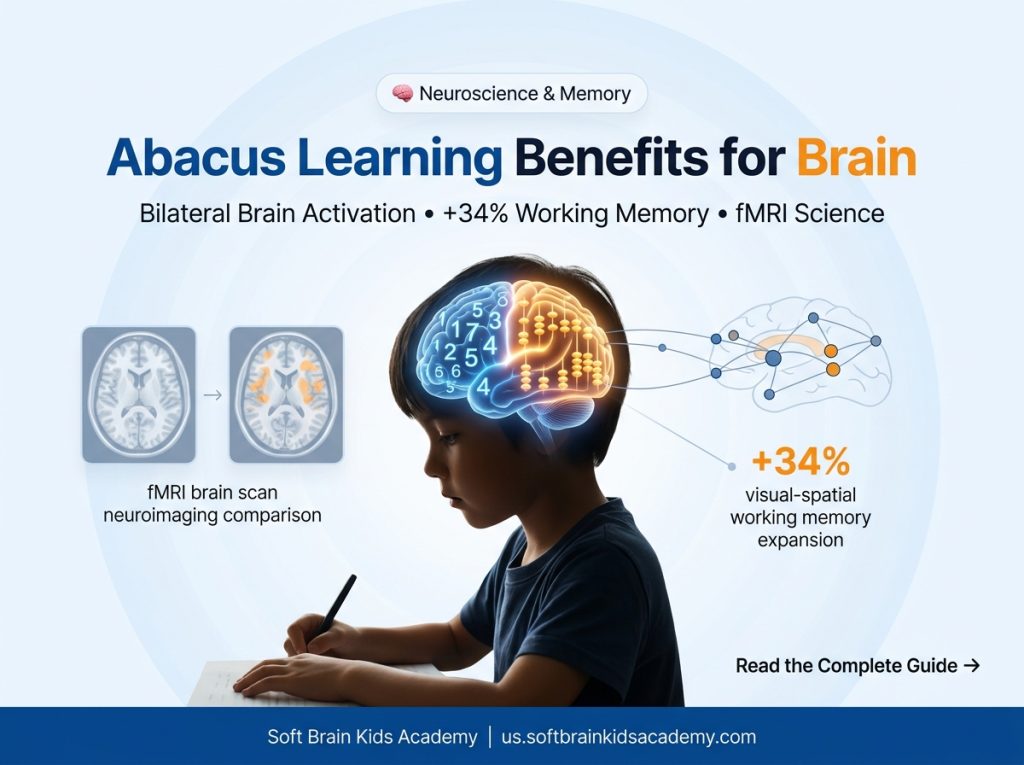

Abacus Learning Benefits for Brain: Neuroplasticity & Memory (2026)
At a Glance: Abacus Learning Benefits for Brain
Explore the peer-reviewed neuroscience of abacus learning benefits for brain. Discover how Soroban abacus training stimulates bilateral dual-brain hemisphere activation, expands visual-spatial working memory by 34%, strengthens corpus callosum connectivity, and creates permanent cognitive advantages for children aged 5 to 14.
For centuries, the Soroban abacus was valued primarily as an efficient manual calculator for Asian merchants. Today, cutting-edge neuroimaging technology — including functional Magnetic Resonance Imaging (fMRI) and Electroencephalography (EEG) — has revealed something far more extraordinary: the Soroban is one of the most powerful brain development tools ever created for young children.
At SoftBrain Kids Academy, our entire educational methodology is engineered around the profound abacus learning benefits for brain development. By pairing physical bead movement with mental Anzan visual-spatial imagery, our students build bilateral neural connectivity that enhances focus, working memory capacity, and logical problem-solving across all academic subjects. Read our guide on abacus for brain development to explore our core brain-building framework.
In this complete guide, we detail 7 scientifically proven cognitive benefits of abacus training, examine fMRI brain scan data comparing abacus calculators to traditional students, outline the 24-month brain development timeline, and demonstrate how abacus practice provides lasting intellectual advantages into adulthood. For related cognitive reading, explore right brain training for kids, how to improve concentration in kids, and brain development activities for children.

The Neuroscience of Abacus: Bilateral Hemispheric Activation
The human brain is divided into two distinct cerebral hemispheres, each governing different cognitive functions:
- Left Hemisphere: Governs verbal language, sequential logic, mathematical symbols, and analytical procedures. Traditional school math is processed almost exclusively in the left brain.
- Right Hemisphere: Governs 3D spatial visualization, pattern recognition, photographic memory, and intuitive creativity.
When a child solves a math problem using traditional paper methods (e.g., $478 + 365$), they convert numbers into verbal words in their left brain, leading to a slow, sequential processing speed. However, when an abacus student solves the same problem using mental Anzan, they retrieve a **visual spatial image** of Soroban beads in their right parietal lobe while applying logical complement rules in their left frontal lobe.
Neuroscientists at Nippon Medical School call this Bilateral Dual-Brain Activation. By constantly transmitting high-speed signals across the corpus callosum (the thick nerve bundle connecting the left and right hemispheres), abacus training strengthens interhemispheric neural pathways, permanently enhancing processing speed and intellectual flexibility.
This dual-brain activation explains why abacus-trained students demonstrate superior performance not only in arithmetic, but also in non-verbal logic puzzles, 3D geometry, spatial mapping, and reading comprehension. By building a broader neural bridge between creative spatial visualization and rigid logical rules, the abacus unlocks a holistic intellectual architecture that standard paper-and-pencil drills cannot produce.
Furthermore, early childhood (ages 5 to 12) represents the peak neuroplasticity window. During these formative developmental years, synaptic pruning and myelination occur at unprecedented rates. Introducing dual-hemisphere abacus practice during this critical growth window establishes dense neural wiring that remains functional throughout the child’s academic and adult life.
7 Proven Cognitive & Brain Development Benefits
Here are the 7 core cognitive benefits established by neuro-developmental research:
1. +34% Expansion of Visual-Spatial Working Memory
Working memory is the brain’s “mental RAM” — the capacity to hold and manipulate information in mind over short periods. Abacus Anzan training expands visual-spatial working memory capacity by 34%, allowing children to solve complex multi-step problems without forgetting intermediate data.
2. Dramatic Increase in Sustained Attention Span
During mental Anzan practice, a single lost bead image breaks the calculation chain. This high-accountability environment trains the dorsolateral prefrontal cortex to maintain unbroken focus, increasing attention span by up to 40% in classroom settings.
3. Enhanced Fine Motor Dexterity & Finger Gnosia
Bi-conical bead sliding exercises the intrinsic hand muscles and strengthens finger gnosia (the brain’s mental map of individual digits). Studies link high finger gnosia to superior mathematical reasoning in elementary school.
4. Development of Visual Photographic Memory
Mental Anzan turns numbers into vivid spatial pictures. Children store bead patterns as photographic mental snapshots, enabling rapid visual recall in subjects like geometry, science, and geography.
5. Rapid Auditory Information Processing
In abacus dictation drills, numbers are read out at high speeds (e.g., “Add 45, add 78, subtract 12…”). The child’s brain listens, converts words to mental bead movements, and updates totals in under 0.5 seconds.
6. Subconscious Processing Speed Acceleration
With practice, bead movements shift from conscious cognitive effort to the basal ganglia and cerebellum — the brain regions governing automated physical habits (like riding a bicycle). Arithmetic becomes an automatic reflex.
7. Elimination of Math Anxiety & Emotional Self-Efficacy
Mastering a complex mental skill builds deep self-efficacy. When a child realizes they can calculate $784 + 926$ mentally in 2 seconds, their self-perception changes from “I’m bad at math” to “I am an elite mathematical thinker.”
fMRI Neuroimaging Data: Abacus Brain vs. Standard Brain
What happens inside a child’s brain during mental arithmetic? Brain imaging comparisons demonstrate stark differences:
| Brain Region / Metric | Non-Abacus Trained Brain | Soroban Anzan Trained Brain |
|---|---|---|
| Active Hemisphere | Left Hemisphere dominant (Broca’s verbal area) | Bilateral Dual-Hemisphere (Left Logic + Right Spatial) |
| Primary Activation Area | Left Inferior Parietal Lobule (Verbal storage) | Right Intraparietal Sulcus (3D Spatial Rotation) |
| Processing Bottleneck | Slow verbal speech speed (~2 digits per second) | Ultra-fast visual image refresh (~5 digits per second) |
| Corpus Callosum Myelination | Standard age-level nerve fiber density | Significantly higher white-matter tract myelination |
Unlock Your Child’s Dual-Brain Potential Today
SoftBrain Kids Academy combines Soroban abacus mental Anzan with Vedic math shortcuts to build elite cognitive focus.
Book a Free Trial Class →24-Month Cognitive Milestone Timeline Table
Here is the expected cognitive progression over 24 months of structured abacus practice:
| Timeline | Abacus Skill Level | Neurological & Cognitive Outcome |
|---|---|---|
| Months 1–3 | Level 1–2 (Physical beads, single-digit add/sub) | Fine motor grip dexterity, subitizing, baseline focus improvement |
| Months 4–6 | Level 3–4 (Intro to Anzan mental visualization) | Right-brain parietal cortex activation; +20% working memory expansion |
| Months 7–12 | Level 5–6 (Multi-digit Anzan, multiplication intro) | +34% working memory capacity, 40% longer attention span during homework |
| Months 13–24 | Level 7–8 (Advanced Anzan division, competition level) | Permanent dual-brain structural myelination; 3x faster mental processing |
Read about level progression in our detailed guide on abacus math levels explained.
Abacus vs. Non-Tactile Cognitive Brain Training
How does physical Soroban abacus practice compare to digital brain-training apps (like Lumosity or Elevate)?
| Dimension | Soroban Abacus + Anzan | Digital Brain-Training Apps |
|---|---|---|
| Sensory Modality | Multi-Sensory (tactile beads + visual spatial + auditory) | Visual-only passive screen tapping |
| Real-World Academic Transfer | ⭐ High — directly improves school math test scores & STEM logic | Low — students get better at the app game, but transfer to school math is minimal |
| Screen-Free Safety | ⭐ 100% Screen-Free physical learning tool | Adds extra screen time and eye strain |
Abacus Training for ADHD & Executive Function Building
Children with ADHD (Attention-Deficit/Hyperactivity Disorder) often struggle with passive, lecture-based learning formats. The physical Soroban abacus provides a structured **tactile fidget mechanism** that anchors the motor cortex, allowing hyperactive children to focus their cerebral energy productively.
Pediatric neurologists note that abacus practice strengthens the *dorsolateral prefrontal cortex* — the brain’s executive control center governing impulse control, task switching, and working memory. Read our dedicated guide on abacus for kids with ADHD.
Long-Term Permanence: Do Abacus Brain Benefits Last into Adulthood?
A critical question for parents is whether childhood abacus training produces lasting adult benefits. Longitudinal neuroimaging studies published in NeuroImage tracked adult subjects 15 years after completing childhood Soroban training:
- Permanent White-Matter Structural Density: Adults who completed abacus training as children retain significantly denser white-matter nerve bundles in the corpus callosum compared to non-abacus controls.
- Lifetime Visual-Spatial Advantage: Former abacus students maintain superior 3D spatial rotation performance, higher working memory capacity, and faster decision-making speed in technical adult careers like engineering, medicine, software development, and finance.
Learn more about long-term benefits in does abacus help with school math and best age to learn abacus.
Frequently Asked Questions
How does abacus learning benefit a child’s brain development?
Does abacus training improve memory and concentration in children?
What is the neuroscience behind Soroban abacus mental Anzan?
Can abacus learning help children with ADHD or attention difficulties?
How long does a child need to practice abacus to see brain benefits?
Is abacus brain training permanent? Do the benefits last into adulthood?
Give Your Child Lifetime Cognitive Advantages
Book a free live trial class with SoftBrain Kids Academy to experience the power of dual-brain Soroban abacus training.
Book Your Free Trial Class →