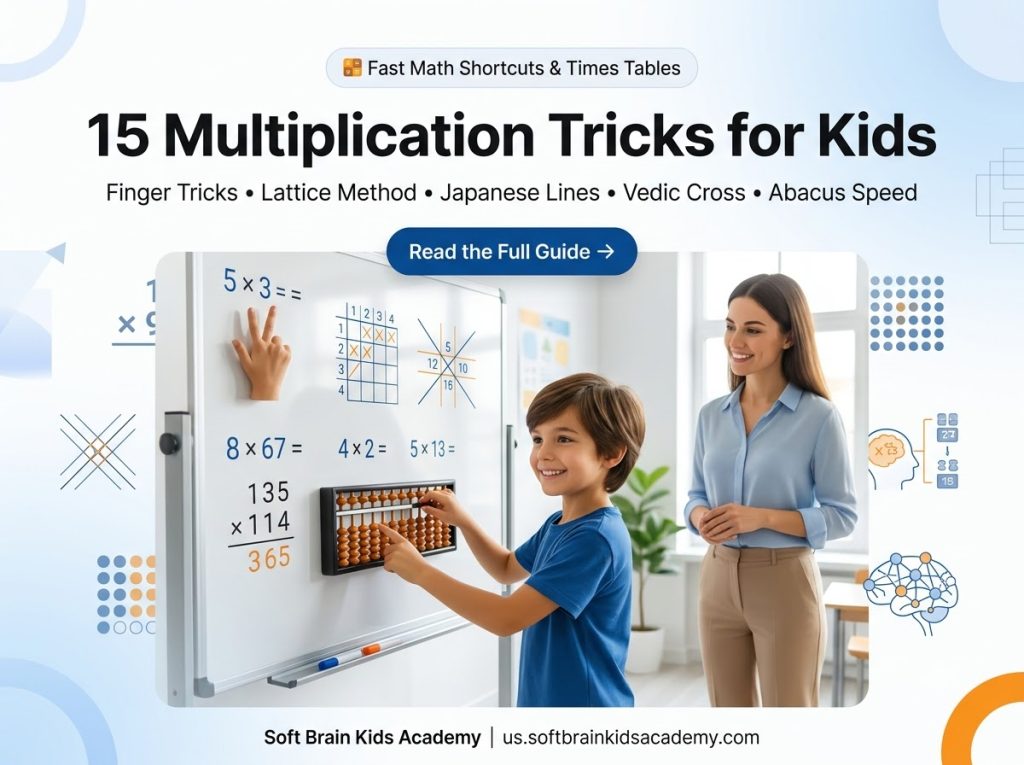

15 Multiplication Tricks for Kids: Easy Methods to Master Times Tables (2026)
At a Glance: Multiplication Tricks for Kids
Discover 15 proven multiplication tricks for kids — from the famous 9s finger trick and double-double strategy to the Japanese line method, Vedic cross multiplication, lattice grids, and abacus speed techniques. Each trick includes step-by-step instructions, visual examples, and age recommendations so your child can master times tables confidently and quickly.
Multiplication is one of the most critical math milestones for elementary-age children, yet it is also the skill that triggers the greatest frustration. If your child dreads times tables, struggles to memorize math facts, or freezes during timed tests, the problem is not intelligence — the problem is methodology. Traditional rote memorization through endless repetition rarely produces lasting fluency. What transforms multiplication from a dreaded chore into an exciting mental superpower is the right collection of multiplication tricks for kids — clever shortcuts, visual strategies, and hands-on techniques that make the logic behind numbers click.
At SoftBrain Kids Academy, we combine ancient calculation systems — including Vedic math multiplication tricks and abacus multiplication for kids — with modern cognitive science to help children build lightning-fast mental math fluency. Our students regularly outperform peers on standardized tests because they understand the patterns underneath multiplication rather than simply memorizing isolated facts.
In this comprehensive guide, we present 15 battle-tested multiplication tricks organized from simplest to most advanced. Each trick includes clear step-by-step instructions, worked examples, recommended age ranges, and practical parent tips. Whether your child is just starting skip-counting or is ready for multi-digit mental Anzan speed, there is a trick here that will accelerate their journey. For foundational support, also explore our guides on mental math for kids and how to improve math speed for kids.

Why Multiplication Tricks Beat Rote Memorization
Before diving into specific multiplication tricks for kids, it is essential to understand why tricks work better than brute-force memorization. Neuroscience research published in the journal Developmental Science shows that when children learn multiplication through pattern recognition, visual strategies, and physical manipulation, they activate multiple brain regions simultaneously — the prefrontal cortex for logical reasoning, the parietal lobe for spatial processing, and the motor cortex for kinesthetic learning. This multi-pathway encoding creates stronger, longer-lasting neural connections than single-pathway rote repetition, which only activates the left-brain verbal memory circuit.
The practical difference is dramatic. Children who rely exclusively on memorization often “forget” math facts under pressure during timed tests because their retrieval pathway is fragile and singular. Children who learn through tricks and strategies can reconstruct the answer even if memory fails because they understand the underlying pattern. A child who knows the “double-double” trick for 4s can always derive 7 × 4 by computing 7 × 2 = 14, then 14 × 2 = 28 — no memorization required. The trick itself becomes a safety net that builds unshakeable math confidence and reduces anxiety.
Additionally, multiplication tricks promote mathematical thinking rather than computational obedience. When a child learns the Commutative Property Twin Rule — that 3 × 8 and 8 × 3 produce identical results — they are not just saving time; they are grasping a fundamental algebraic property that will serve them through calculus. The number sense developed through tricks creates a foundation that transfers to division, fractions, and algebraic reasoning far more effectively than isolated fact recall. Our full guide on how to teach mental math to kids at home covers the broader pedagogical framework behind strategy-based learning.
🧮 Want Your Child to Master Mental Multiplication?
Our live abacus and Vedic math programs teach kids to multiply multi-digit numbers mentally in seconds. Book a free trial class.
Book Free Trial →5 Foundation Multiplication Tricks (Ages 5–7)
These beginner-friendly multiplication tricks for kids are perfect for kindergarteners and first graders who are just discovering that multiplication is a faster way of doing repeated addition. Each trick uses concrete objects, finger counting, or simple mental shortcuts that require zero memorization.
Trick 1: The Doubling Trick (× 2)
Multiplying by 2 is simply adding a number to itself. This is the most intuitive multiplication trick because children already understand doubling from everyday experiences — two shoes in a pair, two eyes on a face, two scoops of ice cream. Teach your child to reframe “6 × 2” as “6 + 6 = 12.” Once doubling is automatic (which most children achieve within two weeks of practice), it becomes the foundation for the Double-Double trick for 4s and the Double-and-Add trick for 3s.
Step-by-step example: What is 8 × 2?
→ Think: “8 plus 8”
→ Answer: 16.
Parent tip: Practice doubling with real objects. Ask your child to set the table for dinner — “We need 4 plates. If we double that for dessert plates, how many total plates?” This builds real-world multiplication fluency naturally.
Trick 2: Skip-Counting for 5s and 10s
Skip-counting is the rhythmic chanting of numbers in intervals — 5, 10, 15, 20, 25, 30 for the 5s table, and 10, 20, 30, 40, 50 for the 10s table. This trick works because the 5s and 10s tables follow a perfectly predictable pattern: 5s always end in 0 or 5, and 10s always add a zero to the multiplier. Children can learn both tables in a single afternoon using songs, clapping rhythms, or counting on their fingers. Each finger represents one skip — holding up 7 fingers while counting by 5s lands on 35 (= 5 × 7).
Step-by-step example: What is 5 × 7?
→ Hold up 7 fingers. Skip-count: 5, 10, 15, 20, 25, 30, 35.
→ Answer: 35.
Alternative pattern shortcut for 5s: If the multiplier is even, halve it and add a zero (5 × 8 → 8 ÷ 2 = 4, add zero → 40). If the multiplier is odd, subtract 1, halve it, and add 5 (5 × 7 → 7 − 1 = 6, 6 ÷ 2 = 3, add 5 → 35).
Trick 3: The Zero Rule (× 10, × 100, × 1000)
Any number multiplied by 10 simply gains an extra zero at the end. Multiplied by 100 gains two zeros. Multiplied by 1000 gains three zeros. This is the simplest multiplication trick for kids to teach and the most universally applicable. Explain it as “the number moving one place to the left on the place-value chart.” For example, 7 × 10 = 70 (the 7 moved from the ones column to the tens column), and 7 × 100 = 700 (the 7 moved to the hundreds column). This trick also connects directly to number sense and place value understanding.
Trick 4: The Double-Double Strategy (× 4)
Multiplying by 4 is simply doubling twice. This trick builds directly on Trick 1 (the doubling trick for 2s) and requires no new concepts — just two consecutive doublings. For 7 × 4: first double 7 to get 14, then double 14 to get 28. This strategy is particularly powerful because it transforms what feels like a “hard” multiplication fact (7 × 4 seems difficult to many children) into two easy additions (7 + 7 and 14 + 14). The Double-Double trick eliminates the need to memorize the 4s table entirely.
Step-by-step example: What is 9 × 4?
→ Step 1: Double 9 → 9 + 9 = 18
→ Step 2: Double 18 → 18 + 18 = 36
→ Answer: 36.
Trick 5: Array Visualization (Any Fact)
An array is a rectangular arrangement of objects in rows and columns. Drawing arrays transforms abstract multiplication into a concrete, countable picture. For 3 × 5, draw 3 rows of 5 dots — counting all dots gives 15. Arrays are enormously powerful because they help children understand that multiplication represents area, which becomes essential in geometry. They also visually prove the Commutative Property: a 3 × 5 array and a 5 × 3 array contain the same number of dots, just rotated 90 degrees. Use small objects (buttons, coins, LEGO bricks) to build physical arrays before transitioning to drawn arrays. Understanding arrays also supports brain exercises for kids that combine visual-spatial reasoning with arithmetic.
5 Intermediate Multiplication Tricks (Ages 7–10)
Once your child has mastered the foundation tricks above, these intermediate multiplication tricks for kids introduce pattern recognition, number relationships, and the first multi-digit strategies. These tricks are ideal for second through fourth graders who are building times table fluency.
Trick 6: The Famous 9s Finger Trick
This is the most beloved multiplication trick in every classroom. Hold both hands up with all 10 fingers extended. To multiply 9 by any number from 1 to 10, fold down the finger corresponding to that number (counting from left to right). The fingers to the LEFT of the folded finger represent the tens digit, and the fingers to the RIGHT represent the ones digit.
Step-by-step example: What is 9 × 4?
→ Hold up all 10 fingers. Fold down finger #4 (your left ring finger).
→ Left of folded finger: 3 fingers (= tens digit: 3)
→ Right of folded finger: 6 fingers (= ones digit: 6)
→ Answer: 36.
Why it works: The 9s table has a hidden pattern — the tens digit always increases by 1 (0, 1, 2, 3, 4, 5, 6, 7, 8, 9) while the ones digit always decreases by 1 (9, 8, 7, 6, 5, 4, 3, 2, 1, 0), and the two digits always sum to 9. The finger trick exploits this pattern physically.
Bonus 9s trick — the Digital Root method: For any 9s fact, subtract 1 from the multiplier to get the tens digit, then subtract the tens digit from 9 to get the ones digit. Example: 9 × 7 → tens digit = 7 − 1 = 6; ones digit = 9 − 6 = 3; answer = 63.
Trick 7: The Commutative Property Twin Rule
This is not a calculation shortcut — it is a memorization halving strategy. The Commutative Property states that 3 × 8 equals 8 × 3. Once your child learns one fact, they automatically know its “twin.” In a standard 12 × 12 multiplication table containing 144 facts, the Twin Rule eliminates approximately 66 duplicate facts, reducing the effective memorization load to roughly 78 unique facts. Combined with the tricks above (which eliminate the 2s, 5s, 9s, and 10s tables), a child really only needs to deeply memorize about 15 to 20 “hard” facts (like 6 × 7, 7 × 8, 8 × 6). This dramatically reduces the sense of overwhelm that many children experience when facing a full multiplication chart.
Trick 8: The Double-and-Add Strategy (× 3)
Multiplying by 3 means doubling the number, then adding the original number once more. This trick builds on the doubling skill from Trick 1. For 7 × 3: double 7 to get 14, then add 7 to get 21. Children who are fast doublers find the 3s table surprisingly easy because it reduces to “double plus one more.” This strategy also strengthens mental addition, reinforcing skills that transfer to multi-step mental math calculations.
Step-by-step example: What is 8 × 3?
→ Step 1: Double 8 → 16
→ Step 2: Add one more 8 → 16 + 8 = 24
→ Answer: 24.
Trick 9: The 11s Pattern Trick
For single-digit numbers, the 11s table produces “double-digit” answers: 11 × 3 = 33, 11 × 7 = 77, 11 × 9 = 99. Children love this pattern because it feels like magic. For two-digit numbers multiplied by 11, use the “split and insert” trick: split the two digits apart and insert their sum in the middle. For 11 × 23: split 2 and 3, insert 2 + 3 = 5 in the middle → 253. If the inserted sum exceeds 9, carry the 1 to the left digit. For 11 × 48: split 4 and 8, insert 4 + 8 = 12 in the middle, carry the 1 → 528. This trick astounds children and builds confidence for multi-digit multiplication. It also connects to Vedic math tricks that use similar algebraic shortcuts.
Trick 10: The Lattice Multiplication Grid
The lattice method (also called Napier’s Bones or gelosia multiplication) organizes multi-digit multiplication into a neat grid where each cell handles a single-digit multiplication. Draw a rectangle divided into columns (one per digit of the first number) and rows (one per digit of the second number). Draw a diagonal line through each cell from upper-right to lower-left. Write the tens digit of each cell product above the diagonal and the ones digit below. Finally, add the digits along each diagonal to get the answer.
Step-by-step example: What is 34 × 12?
→ Draw a 2-column × 2-row grid. Top labels: 3, 4. Side labels: 1, 2.
→ Cell (3,1) = 03. Cell (4,1) = 04. Cell (3,2) = 06. Cell (4,2) = 08.
→ Add diagonals right-to-left: rightmost = 8. Next = 4 + 6 + 0 = 10 (write 0, carry 1). Next = 0 + 0 + 1 = 1. Leftmost = 3.
→ Answer: Read top-to-bottom → 408.
The lattice method eliminates the confusion of “where to put the partial product” that plagues traditional long multiplication. It is visually organized, reduces careless errors, and is particularly effective for children who struggle with spatial alignment. Many children find it more intuitive than the standard algorithm and it builds pattern-recognition skills that support brain development activities.
5 Advanced Multiplication Tricks (Ages 9–14)
These advanced multiplication tricks for kids transform children into mental math champions. They require stronger number sense but produce dramatically faster calculation speeds — often rivaling or exceeding calculator performance.
Trick 11: Japanese Line Multiplication (Visual Cross Method)
The Japanese line multiplication method converts multi-digit multiplication into a line-drawing and intersection-counting exercise. Draw parallel diagonal lines representing each digit of the first number (grouped with small gaps between digit groups), then cross them with parallel diagonal lines representing each digit of the second number (drawn perpendicular to the first set). Count the intersection dots in three zones: right (ones), middle (tens), and left (hundreds). Each zone’s dot count gives that place value’s digit, with carrying for counts exceeding 9.
Step-by-step example: What is 23 × 12?
→ Draw 2 lines, then a gap, then 3 lines (representing 23).
→ Cross with 1 line, then a gap, then 2 lines (representing 12).
→ Count intersections: Right zone (3×2) = 6 dots. Middle zone (2×2 + 3×1) = 7 dots. Left zone (2×1) = 2 dots.
→ Read left-to-right: 276.
Why it works: The intersection zones correspond exactly to the partial products of the FOIL method in algebra. This trick is powerful because children who struggle with mental arithmetic can solve multi-digit multiplication using only drawing and counting. It also builds spatial reasoning and fine motor skills. For children who enjoy visual-spatial approaches, our right brain training for kids program amplifies these abilities.
Trick 12: Vedic Cross Multiplication (Urdhva-Tiryagbhyam)
The Vedic math “Vertically and Crosswise” sutra is one of the most elegant multiplication tricks for kids aged 10 and above. It allows you to multiply any two-digit numbers in a single horizontal line without separate partial products. The method involves three steps: multiply vertically on the right, multiply crosswise in the middle, and multiply vertically on the left.
Step-by-step example: What is 23 × 14?
→ Step 1 (Right vertical): 3 × 4 = 12. Write 2, carry 1.
→ Step 2 (Crosswise): (2 × 4) + (3 × 1) = 8 + 3 = 11. Add carry: 11 + 1 = 12. Write 2, carry 1.
→ Step 3 (Left vertical): 2 × 1 = 2. Add carry: 2 + 1 = 3.
→ Read left-to-right: 322.
This method dramatically reduces paper work and calculation time compared to traditional long multiplication. For a deeper exploration, read our complete guide on Vedic math multiplication tricks. The Vedic cross method also extends to three-digit and four-digit numbers using the same pattern principle, making it scalable for competitive math preparation. Learn more in our Vedic math for competitive exams guide.
Trick 13: The Squaring Shortcut (Numbers Ending in 5)
To square any number ending in 5 (15², 25², 35², 45², etc.), multiply the tens digit by the next whole number, then append 25. For 35²: the tens digit is 3, the next whole number is 4, so 3 × 4 = 12. Append 25 → 1225. This trick works for every number ending in 5 and takes about two seconds once mastered. For 75²: 7 × 8 = 56, append 25 → 5625. It derives from the Vedic sutra “By one more than the one before” (Ekadhikena Purvena). Children who master this trick often become fascinated by number patterns and develop a deeper appreciation for mathematical elegance.
Trick 14: Abacus Multiplication (Soroban Speed Method)
Abacus multiplication on a Soroban is the most comprehensive multiplication trick for kids because it teaches not just speed but deep number-position understanding. Unlike paper-based methods, the abacus forces children to work with place values physically — each rod represents a specific power of ten. When multiplying 23 × 4 on a Soroban, the child places partial products (3 × 4 = 12 and 2 × 4 = 8) on the correct rods, automatically handling carrying and alignment through bead movements rather than mental gymnastics.
Over months of practice, children internalize the physical bead image and can perform “mental Anzan” multiplication — solving multi-digit problems by visualizing bead movements in their mind. This is the same technique that allows abacus-trained competitors to multiply 4-digit numbers in seconds during mental math championships. At SoftBrain Kids Academy, our structured abacus math levels program progressively builds this skill from single-digit multiplication to multi-digit mental Anzan mastery.
Trick 15: The Near-Base Strategy (Multiplying Numbers Close to 10, 100, or 1000)
When both numbers are close to a “base” number (10, 100, 1000), this Vedic-inspired trick produces lightning-fast results. For numbers near 100: find each number’s deviation from 100, cross-add (or cross-subtract), then multiply the deviations for the last two digits.
Step-by-step example: What is 97 × 96?
→ Deviations from 100: 97 is −3, 96 is −4.
→ Cross-operation: 97 − 4 = 93 (or equivalently, 96 − 3 = 93). This gives the first digits.
→ Multiply deviations: 3 × 4 = 12. This gives the last two digits.
→ Answer: 9312.
This trick transforms what looks like an impossibly difficult mental calculation into two simple steps. It works equally well for numbers near 10 (e.g., 8 × 7: deviations are −2 and −3; cross = 5; multiply = 06; answer = 56) and numbers near 1000. It derives from the Vedic sutra Nikhilam (All from 9 and the last from 10).
Multiplication Tricks Comparison Table
Use this reference table to choose the right multiplication tricks for kids based on your child’s age, skill level, and learning style:
| Trick | Best Age | Difficulty | Speed Rating | Best For |
|---|---|---|---|---|
| 1. Doubling (× 2) | 5–6 | ⭐ | ⚡⚡⚡ | First multiplication concept |
| 2. Skip-Counting (× 5, × 10) | 5–7 | ⭐ | ⚡⚡⚡ | Rhythm-based learners |
| 3. Zero Rule (× 10/100/1000) | 5–7 | ⭐ | ⚡⚡⚡⚡ | Place value understanding |
| 4. Double-Double (× 4) | 6–8 | ⭐⭐ | ⚡⚡⚡ | 4s table mastery |
| 5. Array Visualization | 5–8 | ⭐ | ⚡⚡ | Visual/tactile learners |
| 6. 9s Finger Trick | 7–9 | ⭐⭐ | ⚡⚡⚡ | 9s table instant recall |
| 7. Commutative Twin Rule | 7–10 | ⭐ | — | Halving memorization load |
| 8. Double-and-Add (× 3) | 7–9 | ⭐⭐ | ⚡⚡⚡ | 3s table mastery |
| 9. 11s Pattern / Split & Insert | 8–10 | ⭐⭐ | ⚡⚡⚡⚡ | Impressing friends & math confidence |
| 10. Lattice Grid | 8–11 | ⭐⭐⭐ | ⚡⚡ | Multi-digit without errors |
| 11. Japanese Line Method | 9–12 | ⭐⭐⭐ | ⚡⚡ | Visual learners, spatial thinkers |
| 12. Vedic Cross (Urdhva-Tiryagbhyam) | 10–14 | ⭐⭐⭐⭐ | ⚡⚡⚡⚡ | Speed math, competitions |
| 13. Squaring Numbers Ending in 5 | 9–14 | ⭐⭐ | ⚡⚡⚡⚡⚡ | Instant square calculations |
| 14. Abacus Soroban Method | 7–14 | ⭐⭐⭐⭐ | ⚡⚡⚡⚡⚡ | Long-term mental math mastery |
| 15. Near-Base Strategy (Nikhilam) | 10–14 | ⭐⭐⭐ | ⚡⚡⚡⚡⚡ | Numbers near 10, 100, or 1000 |
How to Practice: 10-Minute Daily Multiplication Drill Plan
Knowing multiplication tricks for kids is valuable, but consistent practice is what transforms tricks into automatic recall. Research in cognitive psychology shows that 10 minutes of focused daily practice produces superior retention compared to 60 minutes of weekly cramming. Here is a structured weekly drill plan designed around the science of spaced repetition:
Monday — Foundation Warm-Up (2 minutes): Rapid-fire doubling drill. Call out random single-digit numbers; child doubles each one instantly. Goal: 20 correct doubles in 2 minutes. This activates the neural pathways needed for Tricks 1, 4, and 8.
Tuesday — Finger Trick Practice (3 minutes): Random 9s facts using the finger trick, then transition to mental-only recall (no fingers). Mix in 11s pattern practice. Goal: answer any 9s or 11s fact within 3 seconds.
Wednesday — “Hard Facts” Flashcard Blitz (3 minutes): Focus exclusively on the 15 to 20 hardest facts (6×7, 7×8, 8×6, 6×9, 7×7, 8×8, etc.). Use physical flashcards or a timed app. Reward correct answers within 2 seconds. This targets the remaining facts not covered by any trick.
Thursday — Visual Method Day (3 minutes): Practice lattice grids or Japanese line multiplication with two-digit problems. Alternate between methods weekly. This builds spatial reasoning and prepares children for multi-digit standardized test questions.
Friday — Speed Challenge / Abacus Day (3 minutes): Timed challenge using Vedic cross multiplication, near-base strategy, or Soroban abacus practice. Track personal best times for motivation. Children who practice abacus multiplication twice weekly typically develop mental Anzan visualization within 4 to 6 months. Explore our abacus training for kids at home guide for detailed home practice instructions.
Weekend — Fun Math Games (5–10 minutes): Play multiplication card games (like “War” with multiplication), use mental math games for kids, or do real-world multiplication challenges (calculate the total cost of 7 items at $3 each while shopping). The goal is to make multiplication feel like play, not work.
Common Multiplication Mistakes Kids Make (and How to Fix Them)
Even with the best multiplication tricks for kids, certain errors recur predictably. Understanding these patterns helps parents intervene early before mistakes become habits:
Mistake 1 — Confusing × 0 with × 1: Many children think “any number times zero equals that number” (confusing it with adding zero). Fix: use arrays — draw 5 rows of 0 objects. “See? Five groups of nothing is still nothing.” Similarly, clarify that × 1 means “one group of that number,” not “add one.”
Mistake 2 — Carrying errors in multi-digit multiplication: Children frequently forget to carry tens digits or place partial products in the wrong column. Fix: switch to the lattice method (Trick 10) which physically separates each carrying operation into its own diagonal channel, making errors visible and self-correcting.
Mistake 3 — Reversing commutative pairs: A child may know 3 × 8 = 24 but freeze at 8 × 3. Fix: explicitly teach the Twin Rule (Trick 7) using array rotations. Build two physical arrays — 3 rows of 8 blocks and 8 rows of 3 blocks — and have the child count both to prove they are identical.
Mistake 4 — Over-reliance on a single trick: Some children try to use skip-counting for every fact, including large multipliers where skip-counting is painfully slow. Fix: teach trick selection — match the trick to the problem. The double-double for 4s is faster than skip-counting by 4s. The finger trick for 9s is faster than skip-counting by 9s. Build a “trick toolbox” on a poster that your child can reference until selection becomes automatic.
Mistake 5 — Speed anxiety causing careless errors: Timed tests often cause children to rush and make avoidable mistakes. Fix: build concentration and accuracy first, then gradually increase speed. Never time a child until they can answer 90% of facts correctly without timing pressure. Accuracy-first training prevents the development of math anxiety.
Why Abacus Is the Ultimate Multiplication Tool for Kids
While each of the 15 multiplication tricks for kids above serves a specific purpose, the Soroban abacus stands alone as the only tool that develops multiplication, division, addition, and subtraction simultaneously while building cognitive abilities that transfer across all academic subjects. Here is why abacus multiplication training is unmatched:
Multi-sensory integration: The abacus engages sight (watching bead positions), touch (sliding beads physically), and spatial reasoning (understanding rod place values) simultaneously. This multi-pathway encoding creates the strongest possible neural connections for number facts. Research from the neuroscience of abacus learning shows that abacus-trained children develop 34% stronger visual-spatial working memory than peers who rely on paper-based methods alone.
Progressive skill building: Our abacus math levels program begins with single-digit multiplication facts using physical beads, then progressively transitions to mental Anzan visualization. By Level 4, most students can multiply two-digit numbers mentally. By Level 6, three-digit mental multiplication becomes possible. This structured progression ensures that children are never overwhelmed — each level builds precisely on the skills mastered in the previous level.
Competition-ready performance: Abacus-trained students dominate mental math competitions worldwide. The visualization skills built through Anzan practice allow children to process multi-digit multiplication problems faster than calculator users. Our students who combine abacus training with the Vedic tricks above (Tricks 12, 13, and 15) develop a comprehensive mental math toolkit that gives them a measurable advantage in math competitions, standardized testing, and school math performance.
Whether you start with the simple doubling trick for your 5-year-old or the advanced Vedic cross method for your 12-year-old, the key principle is the same: multiplication mastery comes from understanding patterns, not memorizing isolated facts. Choose 2 to 3 tricks from this guide that match your child’s current level, practice them for 10 minutes daily, and watch their confidence soar. And when your child is ready for the most powerful multiplication system ever created, explore our abacus multiplication for kids program and discover what happens when ancient wisdom meets modern cognitive science.
🎯 Ready to Transform Your Child’s Multiplication Skills?
Join thousands of students who mastered mental multiplication through our live abacus and Vedic math classes. Free trial available for ages 5–14.
Book Free Trial Class →