
Abacus vs Kumon vs Mathnasium: Complete Parent Comparison Guide (2026)
At a Glance: Abacus vs Kumon vs Mathnasium
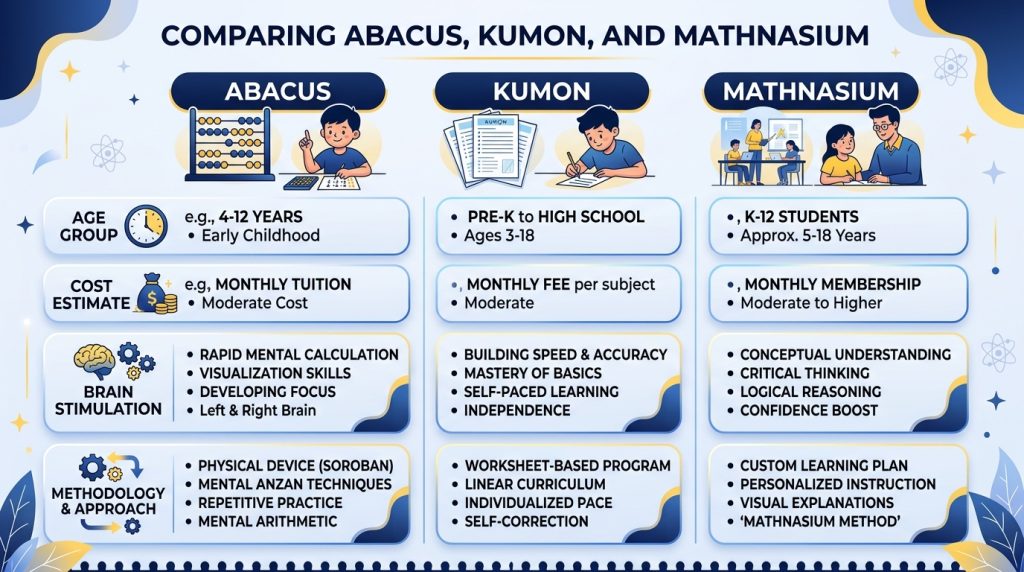
When evaluating abacus vs kumon vs mathnasium, parents are choosing between three fundamentally different philosophies: Abacus builds visual mental math speed and whole-brain memory (ages 4–9); Kumon relies on daily self-paced worksheet repetition to build speed and discipline; while Mathnasium offers customized tutoring to fill specific school curriculum gaps. Each one solves a different problem — the right choice depends on your child’s age, personality, and what you’re actually trying to fix.
As a parent in North America or the UK searching for the best supplementary education program, choosing between abacus vs kumon vs mathnasium is one of the most critical decisions you will make for your child’s academic foundation. Every commercial program promises higher test scores and improved confidence, but they use completely different methods to achieve them.
At SoftBrain Kids Academy, we teach Abacus ourselves — so read our take on Kumon and Mathnasium with that in mind. We’ve tried to be fair to what each program actually does well, because the honest answer is that the “best” program depends entirely on your child, not on which company is writing the article.

1. Core Program Comparison: Executive Summary Table
To help you evaluate abacus vs kumon vs mathnasium quickly, the table below highlights the key differences in teaching style, ideal age window, skill outcome, and monthly investment:
| Feature | Abacus Mental Math | Kumon | Mathnasium |
|---|---|---|---|
| Primary Focus | Mental calculation speed & photographic brain visualization | Rote computational fluency & self-study habit | School curriculum comprehension & filling gaps |
| Golden Age Window | Ages 4 to 9 (Peak neuroplasticity) | Ages 5 to 12 | Grades K to 12 (Ages 6–17) |
| Learning Method | Tactile bead movement progressing to mental image visualization | Daily timed paper worksheets (15–30 min/day) | Diagnostic assessment + personalized tutoring in center |
| Brain Hemisphere Use | Whole-Brain (Left Logic + Right Spatial Imagery) | Primarily Left-Brain (Sequential recall) | Primarily Left-Brain (Conceptual understanding) |
| Avg. Monthly Cost | $100 – $180 / month (Online Live 1-on-1) | $150 – $200 / month per subject | $250 – $450 / month |
2. Abacus Training: How It Works & Brain Benefits
Abacus training uses the ancient soroban counting frame to teach arithmetic visually and tactilely. In the first phase, children manipulate physical wooden or plastic beads to calculate addition, subtraction, multiplication, and division. In the second phase, students learn to project a mental picture of the abacus in their mind’s eye — calculating multi-digit equations at lightning speed without touching a physical device.
The core distinction when comparing abacus vs kumon vs mathnasium is that Abacus is not just a math program; it is an intensive brain development program. Neuroimaging research on long-term abacus training has linked it to structural changes in memory-related and visual-processing brain regions — one 2024 study found that gray matter volume in the medial temporal lobe, along with its connectivity to frontal and visual-processing areas, predicted how much a child’s math ability improved from training (PubMed, 2024).
Key Benefits of Abacus Training:
- Unmatched Mental Speed: Children solve complex 3-digit calculations mentally in seconds.
- Enhanced Working Memory & Focus: Requires sustained visual attention, significantly boosting memory capacity for school subjects. Read more on the 15 benefits of abacus for kids.
- Eliminates Math Anxiety: Replaces scary abstract symbols with tangible, friendly beads. See how abacus reduces math anxiety in kids.
- Ideal Age Window: Best introduced between ages 4 and 9 when neuroplasticity is at its lifetime peak. Check the best age guide for abacus.
Where Abacus is a weaker fit: it doesn’t directly track your child’s school syllabus, so it won’t help with tonight’s fractions homework the way Mathnasium can, and results take longer to show than a worksheet-based drill program.
3. Kumon Method: Pros, Cons & Drill Methodology
Founded in Japan in 1958, Kumon is a franchised learning center model built on daily, repetitive paper worksheets. Students take an initial placement test and are placed at a level where they can achieve 100% accuracy quickly. They complete worksheets daily at home (15–30 minutes) and attend a physical center once or twice a week to submit completed work and take timed speed tests.
Kumon Pros:
- Builds strong daily homework discipline and independent study habits.
- Develops quick recall of basic arithmetic facts (addition tables, times tables).
- Structured, linear progression from basic counting up to calculus, with a well-documented, consistent international curriculum.
Kumon Cons:
- Repetitive & Drill-Heavy: Many children find completing daily worksheets tedious, leading to resistance or burnout.
- Lack of Conceptual Explanation: Kumon emphasizes how to compute fast, rather than why math rules work.
- Can Increase Anxiety: Timed tests and mandatory repetition can aggravate math anxiety in sensitive children.
Looking for Whole-Brain Math Development?
SoftBrain Kids Academy offers live, 1-on-1 online Abacus and Vedic Math classes. Build high-speed mental math, photographic memory, and confidence without boring daily worksheets.
Book a Free Trial Class →4. Mathnasium Method: Custom Tutoring & Curriculum Alignment
Mathnasium (“The Math Learning Center”) focuses on custom tutoring tailored directly to school curricula. When a child starts at Mathnasium, they undergo a comprehensive diagnostic test to identify specific skill gaps (e.g., struggling with fractions or word problems). Instructors create a custom binder of learning materials and provide small-group tutoring (typically 1 instructor to 3–4 students).
Mathnasium Pros:
- Direct School Help: Helps students catch up on current school grade topics and homework.
- Conceptual Focus: Explains number sense and “why” mathematical formulas work.
- Low Pressure: No mandatory daily home worksheets like Kumon.
Mathnasium Cons:
- Highest Cost: Often costs $250 to $450 per month, making it significantly more expensive.
- Does Not Build High Mental Math Speed: Focuses on remediation rather than high-speed mental calculation or bilateral brain activation. Compare with mental math strategies for kids.
5. Cognitive Science: Left Brain vs. Right Brain Activation
Understanding the neuroscience behind abacus vs kumon vs mathnasium explains why their long-term outcomes differ so dramatically. The human brain consists of two hemispheres with distinct processing strengths:
- Left Hemisphere: Handles sequential logic, linear rules, written symbols, and verbal memory.
- Right Hemisphere: Handles visual-spatial processing, photographic imagery, pattern recognition, and intuitive synthesis.
Both Kumon and Mathnasium lean more heavily on left-brain processing, since both rely on written digits, paper or workbook-style materials, and symbolic rules. Abacus training additionally engages right-hemisphere visual-spatial processing: when a child visualizes mental beads, the left hemisphere applies arithmetic rules while the right hemisphere maps spatial bead patterns. Researchers describe this bilateral engagement as a distinguishing feature of abacus-based mental calculation. For additional brain exercises, read our guide on brain exercises for kids.
6. Cost & Time Commitment Breakdown (2026 Pricing)
Here is what parents can expect to spend in North America and the UK in 2026 across all three options:
| Program | Monthly Tuition | Registration & Materials | Weekly Time Commitment |
|---|---|---|---|
| Abacus (Online Live 1-on-1) | $100 – $180 / month | $0 – $30 (Abacus kit included) | 1–2 live classes/wk + 10 min daily practice |
| Kumon Center | $150 – $200 / month per subject | $50 – $100 registration + ~$30 materials | 2 center visits/wk + 15-20 min daily worksheets |
| Mathnasium Center | $250 – $450 / month | $99 – $150 assessment fee | 2–3 center visits/wk (60 min each) |
Note: Kumon and Mathnasium are independently owned franchises, so tuition varies by location — confirm current pricing with your local center before enrolling.
7. Abacus vs Kumon, Kumon vs Mathnasium, Abacus vs Mathnasium: Head-to-Head
Abacus vs Kumon: both build daily practice habits and strong number fluency, but Abacus develops mental visualization and speed while Kumon builds accuracy through repeated worksheet drills. Abacus tends to suit younger children (4-9) better, since it’s tactile rather than paper-based.
Kumon vs Mathnasium cost and approach: Kumon is the more affordable, self-paced option at $150-$200/month per subject; Mathnasium costs more ($250-$450/month) but adds instructor-led, curriculum-specific tutoring rather than generic worksheets — a better fit if your child needs help with a specific school topic right now.
Abacus vs Mathnasium: these solve different problems entirely. Abacus is a long-term cognitive development program; Mathnasium is short-to-medium-term remediation tied to school grades. Some families use both — Abacus in early elementary years, then Mathnasium later if a specific topic needs shoring up.
8. Parent Decision Framework: Which Program Fits Your Child?
Use this simple rule-of-thumb to choose the ideal program for your child’s needs:
- Choose Abacus if: Your child is aged 4 to 9 and you want to build super-fast mental math calculations, boost visual focus, unlock bilateral brain activation, and reduce math anxiety before middle school. If your child is older (ages 8–14), consider combining Abacus with Vedic Math shortcuts and exploring Vedic math speed tricks.
- Choose Kumon if: Your child is self-motivated, does not mind repetitive paper drills, and needs structured daily homework discipline at a lower monthly cost.
- Choose Mathnasium if: Your child is behind in middle or high school math, needs help with immediate homework assignments, and you’re comfortable with a higher monthly cost for 1-on-1 tutoring focused on school standards.
Experience Live Online Abacus Training Today
See how visual mental math training boosts your child’s focus and confidence. Book a free 1-on-1 demo session with a certified instructor at SoftBrain Kids Academy.
Try a Free Demo Class →