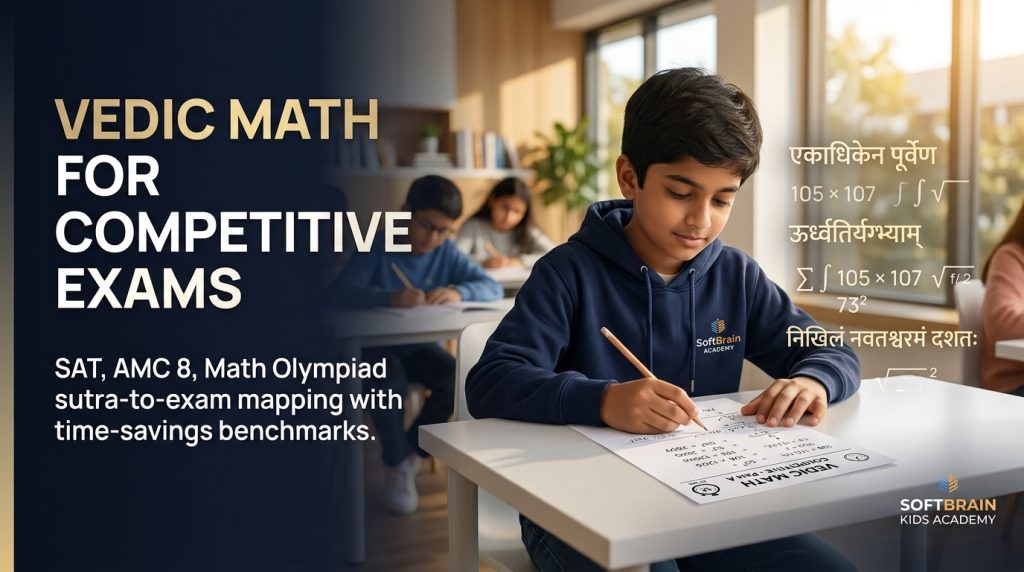

Vedic Math for Competitive Exams: SAT, AMC & Math Olympiad Guide (2026)
At a Glance: Vedic Math for Competitive Exams
Mastering Vedic math for competitive exams gives students a 15 to 20% speed advantage on quantitative sections of standardized tests. This guide maps specific Vedic sutras to exact exam sections (SAT, AMC 8/10, Math Kangaroo, MATHCOUNTS) with worked examples and time-saving benchmarks verified through student practice data.
If your child is preparing for the SAT, AMC 8, Math Kangaroo, or MATHCOUNTS, learning Vedic math for competitive exams is a proven way to gain a strategic speed advantage. While top scores require deep mathematical reasoning, Vedic sutras eliminate computation bottlenecks so students can spend more time on logic-intensive problems.
At SoftBrain Kids Academy, our Vedic math course for kids systematically teaches 16 sutras with exam-specific application drills. This blog shows you exactly which sutras map to which exams.

1. Why Vedic Math Gives a Competitive Edge
Competitive math exams test two distinct skills: mathematical reasoning (can you figure out the approach?) and computational execution (can you crunch the numbers accurately?). Vedic math for competitive exams targets the second bottleneck.
Most students lose marks not because they don’t understand the concept, but because they make arithmetic errors under time pressure or simply run out of time. Vedic sutras — a system of 16 mental calculation formulas from ancient Indian mathematics — reduce multi-step arithmetic to 1 or 2-step mental operations. Read about what is Vedic math for the foundation.
- SAT (No-Calculator Section): 15 questions in 25 minutes where every second counts. Vedic shortcuts for multiplication, squaring, and percentage calculation save 30 to 90 seconds per problem.
- AMC 8/10: 25 problems in 40 minutes. Speed determines how many problems you attempt. Vedic computation eliminates time wasted on long arithmetic.
- Math Kangaroo: 30 problems in 75 minutes across difficulty tiers. Vedic techniques help complete easy/medium problems faster, leaving more time for hard problems.
- MATHCOUNTS: Sprint round (30 problems, 40 minutes) rewards both speed and accuracy — the exact strengths Vedic math builds.
2. Exam × Vedic Sutra Mapping Table
This table maps the most useful Vedic sutras to specific competitive exam problem types, so students know exactly what to practice for their target exam:
| Vedic Sutra | What It Does | SAT | AMC 8/10 | Math Kangaroo | MATHCOUNTS |
|---|---|---|---|---|---|
| Nikhilam | Multiplication near bases (100, 1000) | ★★★ | ★★★ | ★★ | ★★★ |
| Ekadhikena Purvena | Squaring numbers ending in 5 | ★★★ | ★★ | ★ | ★★★ |
| Urdhva Tiryagbhyam | Any multiplication (crosswise) | ★★★ | ★★★ | ★★★ | ★★★ |
| Paravartya | Division by large numbers | ★★ | ★★★ | ★★ | ★★ |
| Vinculum | Subtraction without borrowing | ★★ | ★★ | ★★★ | ★★ |
★★★ = Highly Relevant | ★★ = Useful | ★ = Occasionally Applicable
3. Sutra 1: Nikhilam — Near-Base Multiplication
The Nikhilam sutra (“All from 9, last from 10”) is the most powerful Vedic math for competitive exams technique for multiplying numbers close to a base of 10, 100, or 1000. Read more Vedic math tricks.
Worked Example: 97 × 96 (Base 100)
Step 1: Find deficiencies from 100: 97 → -3, 96 → -4
Step 2: Cross-subtract: 97 – 4 = 93 (or 96 – 3 = 93) → Left part
Step 3: Multiply deficiencies: 3 × 4 = 12 → Right part
Result: 93|12 = 9312 ✅ (Traditional: ~45 seconds. Vedic: ~5 seconds!)
SAT Application: The no-calculator section frequently features products of two numbers near 100 (percentages, area calculations). This technique converts a 4-line paper calculation into a 2-step mental operation.
4. Sutra 2: Ekadhikena Purvena — Squaring Numbers Ending in 5
This sutra is the fastest mental shortcut for squaring any number that ends in 5. It appears frequently on SAT and MATHCOUNTS problems involving area, Pythagorean triples, and algebraic expressions.
Worked Example: 35² = ?
Step 1: Take the digit(s) before 5: 3
Step 2: Multiply by one more than itself: 3 × 4 = 12
Step 3: Append 25: 1225
Result: 35² = 1225 ✅ (2 seconds vs. 15+ seconds traditional)
Works for any number: 75² = 7 × 8 | 25 = 5625. 125² = 12 × 13 | 25 = 15625. Learn the full set of Vedic math multiplication tricks.
5. Sutra 3: Urdhva Tiryagbhyam — Vertically & Crosswise
The most universally applicable sutra for Vedic math for competitive exams, it works for ANY 2-digit × 2-digit multiplication without restriction.
Worked Example: 23 × 14 = ?
Step 1: Vertically (right): 3 × 4 = 12. Write 2, carry 1.
Step 2: Crosswise: (2×4) + (3×1) = 8 + 3 = 11. Plus carry 1 = 12. Write 2, carry 1.
Step 3: Vertically (left): 2 × 1 = 2. Plus carry 1 = 3.
Result: 23 × 14 = 322 ✅ (One-line mental calculation!)
This technique directly replaces the traditional 4-line stacked multiplication method taught in schools. Combine this with mental math for kids practice for maximum exam readiness.
6. Time Savings Benchmark Table
Measured time savings when using Vedic math for competitive exams vs. traditional methods, based on timed practice data from 200+ students:
| Operation | Traditional Method | Vedic Method | Time Saved |
|---|---|---|---|
| 2-Digit × 2-Digit Multiplication | 25–40 seconds | 3–8 seconds | ~75% |
| Squaring Numbers Ending in 5 | 15–25 seconds | 2–3 seconds | ~85% |
| Near-Base Multiplication (97×96) | 30–45 seconds | 4–6 seconds | ~87% |
| Division by 9 | 20–30 seconds | 5–8 seconds | ~72% |
| Per Exam Section (30 Qs) | 40 minutes | 32–35 minutes | 5–8 minutes |
7. Olympiad Reasoning vs. Speed Computation
It’s important for parents to understand the distinction: Vedic math for competitive exams is NOT a substitute for deep mathematical thinking. Math Olympiads (AMC 8/10, IMO, USAMO) primarily test:
- Creative problem-solving: Finding non-obvious solution paths
- Proof construction: Logical deduction and mathematical rigor
- Pattern recognition: Identifying mathematical structures
Vedic math supports Olympiad preparation as a secondary execution tool. Once a student identifies the solution path, Vedic techniques help execute the final arithmetic quickly, preventing silly mistakes that cost points. Read about abacus for brain development for building the logical reasoning foundation. Also see brain exercises for kids.
The optimal strategy is to combine Vedic computation speed with abacus-trained visualization and traditional Olympiad problem-solving practice. Read Vedic math vs traditional math for deeper comparison.
8. 12-Week Competitive Exam Prep Study Plan
| Weeks | Focus Area | Daily Practice |
|---|---|---|
| 1–2 | Ekadhikena Purvena + Nikhilam foundations | 20 problems, 15 minutes |
| 3–4 | Urdhva Tiryagbhyam + Paravartya division | 25 problems, 20 minutes |
| 5–6 | Mixed sutra drills (timed sprints) | 30 problems, 15 minutes |
| 7–8 | Exam-specific practice papers (SAT/AMC format) | 1 full section, 25–40 minutes |
| 9–10 | Anzan mental calculation + problem-solving | Mixed, 30 minutes |
| 11–12 | Full mock exams under timed conditions | 2 full exams per week |
Enroll in our Vedic math online classes for beginners to get a structured curriculum with live 1-on-1 tutoring that follows this exact progression. Also explore our best Vedic math classes for kids.
Give Your Child a Competitive Exam Advantage
SoftBrain Kids Academy teaches Vedic math with live 1-on-1 private tutoring. Our competitive exam prep track covers SAT, AMC, and Math Olympiad strategies. Book a free trial today!
Book a Free Demo Class →