
Whole Brain Development for Kids: Complete Guide & 7 Activities (2026)
At a Glance: Whole Brain Development for Kids
Discover the science and practice of whole brain development for kids. This guide explains how synchronizing left-brain logical processing with right-brain visual-spatial imagination builds superior working memory, razor-sharp focus, and effortless problem-solving. Includes 7 science-backed home activities and brain gym routines.
Every parent wants their child to thrive academically and creatively, but traditional school instruction often focuses heavily on left-brain rote learning. True cognitive excellence requires whole brain development for kids — a holistic educational approach that trains both the left (analytical) and right (creative/spatial) hemispheres of the brain to work in harmony.
At SoftBrain Kids Academy, our core philosophy is centered on whole brain activation through programs like abacus for brain development and right brain training for kids. In this complete 2026 guide, we explore the neuroscience of whole-brain growth, the benefits for children ages 4 to 14, and 7 practical activities you can start at home today. Also read brain exercises for kids for complementary routines.

The Science of Whole Brain Development for Kids
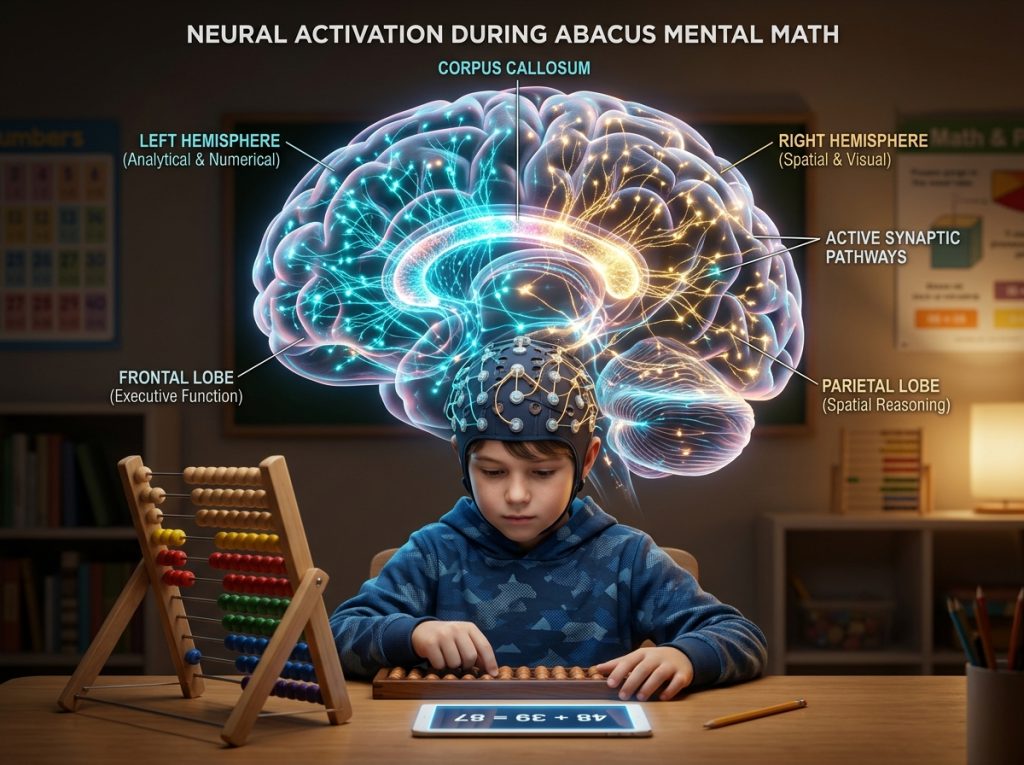
The human brain consists of two distinct cerebral hemispheres connected by a thick bundle of nerve fibers called the corpus callosum. In traditional schooling, children primarily engage the left hemisphere through reading, linear math drills, and memorization. However, neuroscientific studies from Harvard and NIH confirm that peak intellectual performance occurs when both hemispheres are engaged simultaneously.
Whole brain development for kids leverages neuroplasticity — the brain’s ability to reorganize itself by forming new neural connections. When children participate in multisensory activities that combine spatial visualization with logical rule-following, the corpus callosum thickens, accelerating communication speed between the left and right hemispheres.
Left Brain vs Right Brain Functions Comparison
Understanding how the two hemispheres complement each other helps explain why whole-brain training is so effective:
| Domain | Left Hemisphere (Logical) | Right Hemisphere (Creative/Spatial) | Whole Brain Integration |
|---|---|---|---|
| Mathematical Thinking | Formula rules, sequential steps, symbol recognition | Spatial bead visualization, speed estimation, pattern intuition | Lightning-fast mental arithmetic |
| Memory Processing | Verbal memory, word definitions, linear lists | Photographic image memory, spatial locations, colors | Long-term photographic recall |
| Problem Solving | Detailed analysis, step-by-step logic | Big-picture vision, creative synthesis, insight | Innovative & structured solutions |
| Focus & Attention | Selective attention to specific detail | Sustained broad awareness, sensory monitoring | Deep concentration state (Flow) |

How Abacus Mental Math Triggers Whole Brain Activation
Abacus training is widely recognized as the single most effective tool for whole brain development for kids. During physical abacus practice, the child uses both hands to move beads (stimulating both brain hemispheres via fine motor nerves). As they advance to “Anzan” (mental abacus), they create a vivid 3D image of the abacus frame in their right hemisphere while executing mathematical rules in their left hemisphere.
Functional MRI brain scans show that when a child solves 4-digit arithmetic mentally via abacus visualization, the visual cortex (right brain), motor cortex, and parietal lobes (left brain) light up simultaneously. This level of bilateral activation is absent in conventional paper-and-pencil math. Read abacus for brain development to learn more about neuroimaging research.
Give Your Child the Whole Brain Advantage
SoftBrain Kids Academy provides live online classes engineered specifically for whole brain development in children ages 4 to 14. Book a free 1-on-1 assessment and demo session today.
Book Free Demo Session →7 Science-Backed Whole Brain Activities for Kids
Parents can foster whole brain development at home using these 7 evidence-backed activities:
- Dual-Handed Abacus Practice: Use both thumb and index finger of both hands to move beads simultaneously. Check out how abacus works step by step.
- Cross-Lateral Body Movements (Brain Gym): Touch right elbow to left knee, then left elbow to right knee. Cross-body physical movements cross the midline, strengthening corpus callosum signals.
- Vedic Mental Shortcuts: Practice pattern-based calculations like Vedic math tricks and Vedic math subtraction tricks to combine rule-following with numerical spatial positioning.
- Visual Memory Flashcards: Show a grid of images or numbers for 3 seconds, then ask the child to recreate it from right-brain memory.
- Tangrams and Spatial Puzzles: Solving 3D spatial puzzles forces the right brain to visualize geometry while the left brain tests fit logic.
- Bilateral Drawing (Mirror Drawing): Hold a marker in each hand and draw symmetrical shapes (like butterflies or trees) simultaneously from the center outward.
- Musical Instrument Training: Playing piano or violin requires reading sheet music (left brain) while feeling rhythm, pitch, and emotion (right brain).
Long-Term Cognitive Benefits & Academic Outcomes
Children who receive structured whole-brain training exhibit measurable advantages across multiple dimensions:
- Higher Standardized Test Scores: Elevated performance in math, science, and reading comprehension (SAT/ACT, AMC 8). See Vedic math for competitive exams.
- Reduced Math Anxiety: When math is experienced as a visual, spatial game rather than dry formulas, math anxiety in kids vanishes.
- Enhanced Focus & Concentration: Improved sustained attention span in school and homework. See how to improve concentration in kids.
- Superior Speed & Accuracy: Mental math processing up to 5x faster than average peers. Read how to improve math speed for kids.
Frequently Asked Questions
What is whole brain development for kids?
At what age is whole brain development most effective?
How does abacus training promote whole brain development for kids?
What are the signs of balanced whole brain development in children?
Can whole brain development help with school performance?
Investing in whole brain development for kids unlocks potential that extends far beyond mathematics. By nurturing both the logical and creative faculties during early childhood, you give your child a foundational cognitive edge that lasts a lifetime. Explore our full blog library or learn more about brain development activities for children.