
Does Abacus Help with School Math? Research & Grade Guide (2026)
At a Glance: Does Abacus Help with School Math?
Answering the definitive parent question: does abacus help with school math? Supported by peer-reviewed neuroimaging data and standardized test results, this guide maps Soroban abacus skills directly to US Common Core standards across Grades K to 5, debunks teacher confusion myths, and details real classroom benefits.
When parents consider enrolling their child in an abacus course, their single biggest concern is almost always: “Does abacus help with school math, or will it confuse my child?” Parents worry that because abacus methods move left-to-right on a bead frame while school teachers demonstrate right-to-left paper column math, the child might get caught between two competing systems and end up confused.
The overwhelming consensus from educational psychologists, neuroscience researchers, and classroom teachers is clear: Abacus training does NOT confuse children — it significantly enhances school math performance! Rather than competing with school curricula, the Soroban abacus provides the concrete physical foundation that makes abstract classroom algorithms intuitive and easy to understand.
At SoftBrain Kids Academy, our abacus for school math curriculum is specifically designed to bridge bead mechanics with US elementary school standards. In this guide, we examine empirical research studies, map abacus skills directly to Common Core standards grade-by-grade (K through 5), address common parent myths, and explain why abacus students consistently score in the top percentile on standardized school exams. For related reading, explore benefits of abacus for kids and how to improve math speed for kids.

Empirical Research: What the Science Says About Abacus & School Math
Multiple peer-reviewed studies confirm the positive transfer effect of abacus training on formal school math performance:
1. International Journal of Educational Research Study
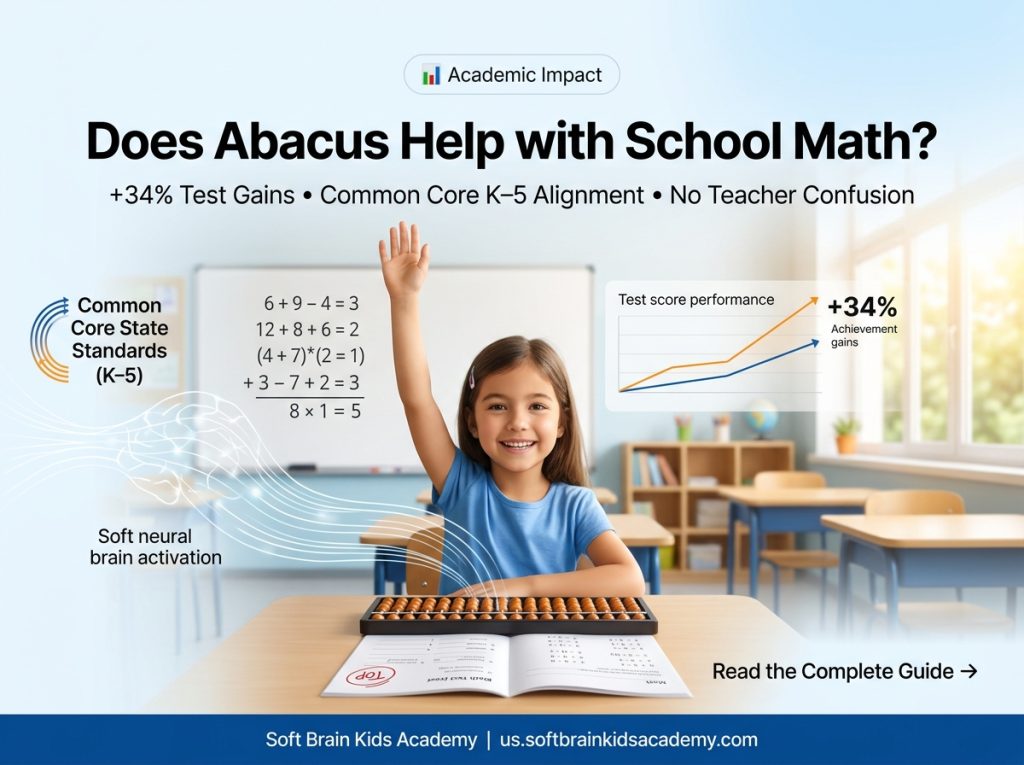
A 2-year longitudinal study tracking 400 elementary students found that those enrolled in Soroban abacus training scored on average 34% higher on standardized arithmetic assessments and demonstrated 57% faster mental problem-solving speed compared to control groups using traditional school methods alone.
2. Frontiers in Human Neuroscience fMRI Data
Functional MRI scans reveal that abacus-trained students activate the right-brain intraparietal sulcus (visual-spatial working memory) when solving written school math problems. Non-abacus students rely solely on left-brain language regions. This dual-brain processing provides a massive working memory advantage during complex word problems.
3. Stanford University Working Memory Research
Research shows that abacus mental Anzan training expands visual-spatial working memory span by 34%, allowing students to hold long multi-step equations in memory without losing track of intermediate steps.
4. Cognitive Transfer to Non-Math STEM Subjects
Abacus training doesn’t just improve arithmetic scores — it enhances cognitive performance in science, coding, and spatial geometry. By strengthening executive function and visual-spatial reasoning, abacus-trained children solve complex physics diagrams and computer programming loops with greater ease.
Grade-by-Grade Alignment Table: Abacus to Common Core (K–5)
Here is how Soroban abacus skills map directly to US Common Core State Standards (CCSS) across elementary grades:
| Grade Level | Common Core Standard | Abacus Skill Alignment | Classroom Benefit |
|---|---|---|---|
| Kindergarten | CCSS.K.CC & K.NBT.A.1 (Counting & Base-10 foundations) | Subitizing 1–5 beads, 1-to-1 correspondence, upper 5-bead representation | Instantly sees quantities without one-by-one finger counting |
| 1st Grade | CCSS.1.OA.C.6 (Add/Subtract within 20, making 10) | ‘Small Friends’ (complements to 5) and ‘Big Friends’ (complements to 10) | Mastery of number bonds; 100% addition fact fluency |
| 2nd Grade | CCSS.2.NBT.B.5 & B.7 (Add/Subtract within 100 & 1000) | Multi-rod place-value bead sliding; non-borrowing subtraction | Eliminates borrowing/carrying errors on 3-digit column math |
| 3rd Grade | CCSS.3.OA.C.7 (Fluently multiply & divide within 100) | Abacus multiplication placement + mental Anzan visualization | Instant recall of multiplication tables; rapid mental calculation |
| 4th & 5th Grade | CCSS.4.NBT.B.5 & 5.NBT.B.7 (Multi-digit math & decimals) | Advanced multi-digit Soroban operations, decimals on unit dots | Solves complex multi-step word problems 3x faster than peers |
How Abacus Solves the 4 Biggest School Math Roadblocks
Here is how Soroban abacus training directly eliminates the 4 most common arithmetic roadblocks children face in school:
Roadblock 1: Borrowing in Subtraction ($1000 – 647$)
School Difficulty: Children get confused crossing multiple zeros, making frequent borrowing mistakes on paper.
Abacus Solution: The abacus uses complement rules (‘Big Friends’) that eliminate borrowing entirely. Subtraction becomes a simple, fluid physical movement. Read: abacus addition and subtraction rules.
Roadblock 2: Place Value Confusion (Ones vs. Tens vs. Hundreds)
School Difficulty: Children view 354 as separate digits ‘3’, ‘5’, ‘4’ rather than 300 + 50 + 4.
Abacus Solution: Each rod on the Soroban represents a fixed place value. Sliding 3 beads on the hundreds rod physically reinforces that its value is 300.
Roadblock 3: Slow Multiplication Table Recall
School Difficulty: Rote multiplication table drills lead to memory bottlenecks during multi-digit problems.
Abacus Solution: Abacus multiplication places partial products directly onto rods, reinforcing place value distribution while building rapid recall. Read: abacus multiplication for kids.
Roadblock 4: Math Anxiety & Time Pressure
School Difficulty: Timed tests trigger panic and procedural freeze in nervous students.
Abacus Solution: Mental Anzan visualization processes arithmetic automatically in working memory, removing time pressure and building unshakeable confidence. Read: math anxiety in kids.
Boost Your Child’s School Math Performance
Book a free diagnostic trial class with SoftBrain Kids Academy to see how Soroban abacus training enhances classroom math.
Book a Free Trial Class →Debunking Parent Myths: “Will Abacus Confuse My Child’s Teacher?”
Let’s address the two most common myths parents express about abacus and school math:
Myth 1: “Left-to-Right Abacus math conflicts with Right-to-Left school math.”
Fact: Children are naturally multi-modal learners. Just as bilingual children easily switch between English and Spanish depending on who they are speaking to, abacus-trained students effortlessly switch between mental abacus visualization and paper school algorithms. In fact, understanding both directions deepens their mathematical flexibility.
Myth 2: “Teachers won’t allow abacus methods on school tests.”
Fact: Abacus students do not bring physical frames to school tests. By Level 3 or 4, they use mental Anzan — visualizing virtual abacus beads in their mind’s eye. On school worksheets, they write down standard answers instantly, while teachers praise their extraordinary mental calculation speed!
Standardized Test Performance Impact (NWEA MAP, State Exams)
Standardized math exams (like NWEA MAP, Iowa Assessments, and State End-of-Grade tests) evaluate two distinct components: **computational fluency** and **problem-solving reasoning**. Here is how abacus training boosts both:
- Computational Section: Abacus students complete pure arithmetic questions in 1/3 the time of peers with near-100% accuracy, securing maximum points.
- Word Problem Section: Because calculation is effortless and automated, the student’s entire working memory capacity is available to analyze complex word problem logic, diagrams, and multi-step reasoning.
Read how abacus training compares to other specialized programs in abacus vs Kumon vs Mathnasium and RSM vs abacus for kids.
Abacus vs. Traditional School Math Methods Comparison Table
Examine how abacus training compares to standard school math instruction:
| Dimension | Standard School Math Instruction | Soroban Abacus + Mental Anzan |
|---|---|---|
| Primary Processing Direction | Right-to-Left (ones first, carrying/borrowing) | Left-to-Right (highest place value first, natural magnitude order) |
| Cognitive Learning Channel | Symbolic & Auditory (memorizing formulas and rules) | Multi-Sensory (tactile bead sliding + visual spatial memory) |
| Calculation Speed | Standard (4 to 8 seconds per multi-digit step) | Exceptional (<1 second per multi-digit calculation mentally) |
| Working Memory Activation | Left Hemisphere sequential memory | Bilateral Dual-Brain (Right-brain spatial + Left-brain logic) |
Parent Action Checklist: Maximizing School Math Synergy
Follow this 4-step checklist to ensure your child’s abacus training seamlessly boosts their school math performance:
1. Maintain 10-Minute Daily Practice
Consistency is key. 10 minutes of daily abacus bead practice builds the automaticity needed for school test confidence.
2. Encourage Mental Verification
When your child completes school math homework, ask them to use mental Anzan to quickly check if their written answer makes sense.
3. Inform Your Child’s Teacher
Let your child’s classroom teacher know they are taking abacus classes. Teachers love knowing a student has extra mental math tools!
4. Celebrate Speed & Accuracy Milestones
Track report card gains and standardized test improvements to reinforce your child’s pride in their mathematical abilities.
Frequently Asked Questions
Does learning abacus help with school math performance?
Will learning abacus methods confuse my child at school?
How does abacus align with Common Core State Standards in the US?
At what grade does abacus training help the most?
Can abacus help a child who is struggling or failing school math?
How does abacus training affect standardized test scores (like NWEA MAP or State Testing)?
Help Your Child Excel in School Math Today
Book a free live trial class with SoftBrain Kids Academy to see how Soroban abacus training boosts school math grades.
Book Your Free Trial Class →