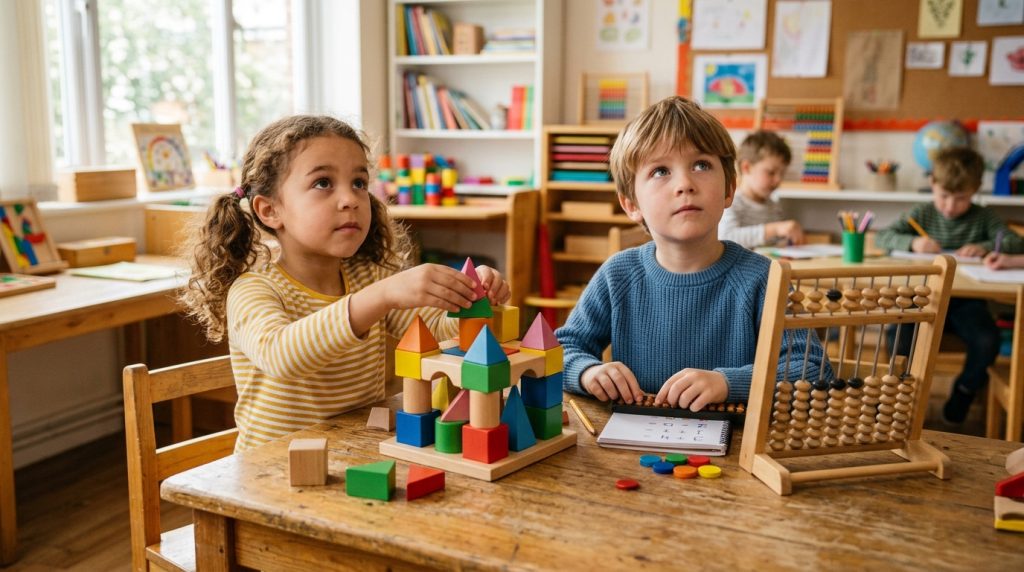

Brain Development Activities for Children: 12 Expert Tips (2026)
At a Glance: Brain Development Activities for Children
Engaging in structured brain development activities for children builds prefrontal cortex working memory, spatial reasoning, and emotional resilience. Combining hands-on tactile play (like abacus mental math) with strategic games transforms natural curiosity into lifelong academic success.
A child’s brain is not a miniature adult brain waiting to be filled with facts — it is a dynamic neural network constantly wiring itself based on environmental experiences. Parents seeking brain development activities for children want evidence-based strategies that cultivate critical thinking, working memory, and emotional focus.
At SoftBrain Kids Academy, our cognitive training methodology blends visual abacus mental calculation, Vedic pattern recognition, and sensory-motor exercises. In this guide, we outline 12 expert-recommended brain development activities categorized by age group.

1. The Neuroscience of Child Brain Plasticity
According to landmark research from Harvard University Center on the Developing Child, the brain forms over 1 million new neural connections every second during early childhood. This hyper-flexible state is called neuroplasticity.
As children explore physical surroundings, solve spatial puzzles, and manipulate objects, neural pathways become wrapped in myelin — an insulating sheath that speeds up signal transmission. Incorporating rich brain development activities for children strengthens these myelinated pathways, resulting in faster processing speed, superior working memory, and lower susceptibility to math anxiety in kids.
Furthermore, early cognitive stimulation lays down structural connections in the corpus callosum (the bridge linking the left and right brain hemispheres), enabling seamless communication between logical reasoning and creative visual-spatial processing.
2. Brain Activity Matrix: Digital vs. Tactile vs. Whole-Brain
| Activity Type | Examples | Working Memory Gain | Brain Hemisphere Impact |
|---|---|---|---|
| Passive Digital Screen Time | Cartoons, passive mobile games | Negative (Reduces attention span) | Passive visual visual cortex only |
| Tactile Spatial Puzzles | Tangrams, Lego, block sorting | Moderate to High | Right Hemisphere (Spatial) |
| Mental Abacus & Vedic Math | Soroban bead mentalization, Vedic sutras | Exceptional (+40% capacity) | Whole-Brain (Left Logic + Right Image) |
3. 12 Brain Development Activities by Age Group
Toddlers (Ages 1 to 3): Sensory & Object Permanence
- 1. Object Hiding (“What’s Under the Cup?”): Builds working memory and object permanence.
- 2. Sorting by Color and Shape: Introduces category logic and visual discrimination.
- 3. Nursery Rhyme Fingerplay: Pairs rhythm with fine motor movement to build language circuits.
Preschoolers & Kindergarteners (Ages 4 to 6): Golden Window
- 4. Mental Abacus Bead Counting: Teaches physical bead moving and early visual calculation. Learn how to teach abacus to kindergarteners and check the best age for abacus learning.
- 5. Tangram Geometric Puzzles: Sharpens spatial rotation and non-verbal reasoning. Explore right brain training for kids.
- 6. Storytelling & Memory Recounting: Ask your child to re-tell a bedtime story backwards or describe key characters.
- 7. Cross-Lateral Physical Exercises: Touching left hand to right knee stimulates the corpus callosum. Read our guide on brain exercises for kids.
Primary Schoolers (Ages 7 to 12): High-Level Strategy
- 8. Vedic Math Speed Shortcuts: Teaches rapid mental multiplication without paper. Check Vedic math tricks, Vedic math multiplication shortcuts, and what is Vedic math.
- 9. Chess & Strategic Board Games: Forces multi-step foresight, risk assessment, and executive planning.
- 10. Mental Math Speed Sprints: 10-minute daily calculation challenges. See mental math for kids and how to improve math speed for kids.
- 11. 3D Jigsaw Puzzles & Origami: Develops 3D spatial visualization and fine motor patience.
- 12. Program Comparison Reflection: Evaluating learning styles (e.g. comparing Abacus vs Kumon vs Mathnasium and Vedic Math vs Abacus).
Boost Your Child’s Cognitive Power Today
SoftBrain Kids Academy offers live certified 1-on-1 Abacus and Vedic Math programs designed for whole-brain activation. Book a free demo class.
Book a Free Demo Class →4. Why Mental Abacus Is the Ultimate Cognitive Exercise
Among all structured activities, abacus training for brain development ranks highest for long-term cognitive impact. By combining tactile bead sliding with mental image projection, it expands working memory capacity by 40% and builds lifetime focus. Read about the 15 key benefits of abacus for kids.
5. Building Executive Function & Emotional Focus
Executive function encompasses working memory, cognitive flexibility, and inhibitory control. Children who engage in consistent cognitive activities demonstrate significantly better emotional self-regulation, reduced impulsivity, and stronger problem-solving stamina in high-pressure testing environments.
6. The 20-Minute Daily Brain Development Schedule
- Min 0–5: Warm-up — 5 minutes of Tangram spatial puzzles or memory tray game.
- Min 5–15: Core Activity — 10 minutes of Mental Abacus or Vedic Math speed practice.
- Min 15–20: Wind-down — 5 minutes of storytelling or cross-lateral physical movement.
Transform Your Child’s Learning Capabilities
Experience how SoftBrain Kids Academy builds super-fast calculation, memory, and concentration. Book a free 1-on-1 trial class today.
Try a Free Demo Class →