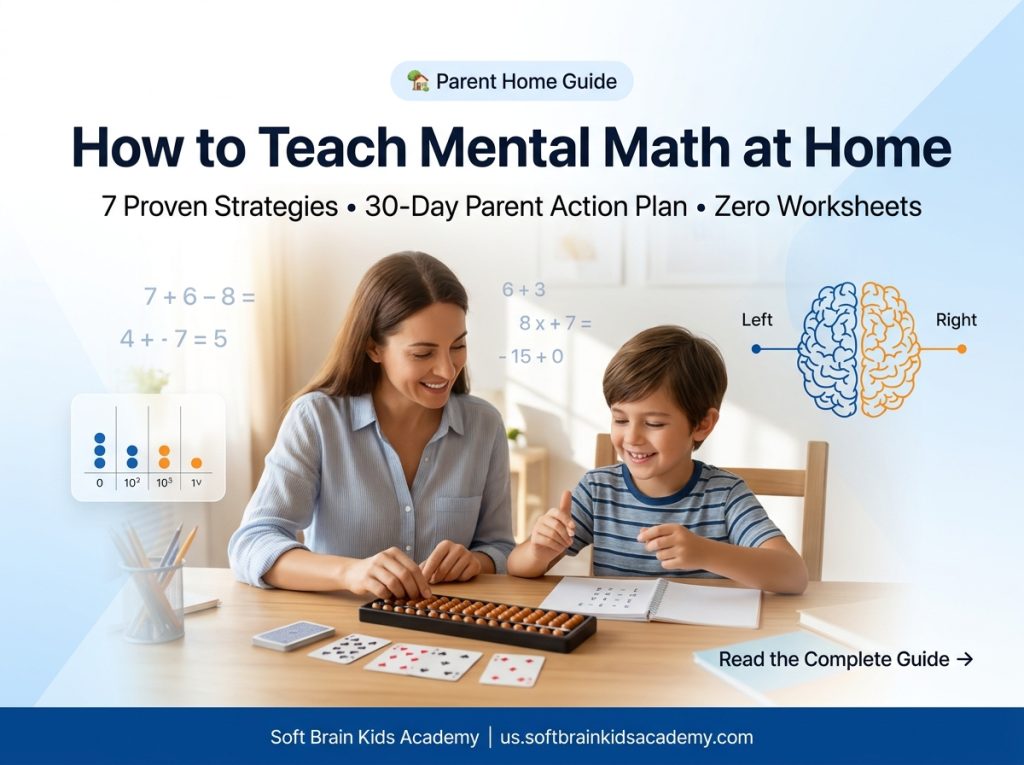

How to Teach Mental Math to Kids at Home: Parent’s Complete Guide (2026)
At a Glance: How to Teach Mental Math to Kids at Home
Learn exactly how to teach mental math to kids at home with 7 proven strategies, daily 10-minute routines, age-by-age progression, worked examples for each method, and a 30-day parent action plan. This guide covers number bonds, rounding & adjusting, making tens, left-to-right partitioning, doubles, Vedic shortcuts, and abacus Anzan visualization.
Every parent has watched their child reach for a calculator to solve 48 + 27 and wondered: “Shouldn’t they be able to do that in their head?” The truth is, most children can — they just haven’t been taught the right strategies. School math curricula focus heavily on written algorithms (stacking numbers, carrying digits), but rarely dedicate structured time to how to teach mental math to kids at home using the visualization and decomposition strategies that mathematically fluent adults use instinctively.
At SoftBrain Kids Academy, our mental math for kids program is built on a simple insight: mental math is not about memorizing answers — it’s about learning how to think about numbers flexibly. The Soroban abacus provides the physical scaffolding that makes abstract mental strategies visible and tactile, while Vedic math provides the algebraic shortcuts that accelerate computation speed. This guide combines both approaches into a comprehensive parent-friendly curriculum you can implement at your kitchen table starting tonight.
Whether your child struggles with basic addition or is preparing for competitive math exams, these 7 strategies will transform their mathematical thinking from slow, procedural step-counting into fast, intuitive mental processing. For foundational brain-building context, also read brain exercises for kids and how to improve concentration in kids.

Why Mental Math Matters More Than Written Math
Understanding how to teach mental math to kids at home is essential because mental math develops fundamentally different cognitive skills than written math. When a child solves 64 − 28 on paper using column subtraction with borrowing, they follow a fixed procedure. When they solve the same problem mentally, they must hold numbers in working memory, select the best strategy, decompose and recompose quantities, and monitor their own reasoning — all simultaneously.
Research published in the Journal of Experimental Psychology confirms that children who develop strong mental math skills by 3rd grade are 2.7 times more likely to perform in the top quartile on standardized math assessments by 5th grade. Mental math builds the executive function, working memory capacity, and mathematical flexibility that written algorithms alone cannot develop.
Perhaps most importantly, mental math builds mathematical confidence. When a child can quickly verify whether their written answer “makes sense” by performing a rough mental calculation, they develop the self-assurance that transforms math from a source of anxiety into a source of empowerment. This confidence is exactly what programs at SoftBrain Kids Academy systematically build through structured Soroban training and Vedic math tricks.
The 3-Phase Teaching Framework for Parents
Before diving into individual strategies, understand the 3-phase framework that structures effective mental math instruction at home. Each phase builds on the previous one — skipping phases leads to fragile understanding that collapses under pressure:
Phase 1: Concrete — Physical Manipulation (Weeks 1–2)
Every strategy starts with physical objects. Use Soroban abacus beads, snap cubes, ten-frame counters, or playing cards. Children must physically experience number relationships before they can mentally represent them. This is why abacus training for kids at home is so powerful — the beads provide the concrete foundation that mental visualization requires.
Phase 2: Representational — Visual Diagrams (Weeks 3–4)
Transition from physical objects to visual representations — number line drawings, ten-frame diagrams, part-whole circles, and number bond webs. The child draws or sketches the strategy they previously performed physically. This builds the visual mental model they will eventually internalize.
Phase 3: Abstract — Pure Mental Calculation (Weeks 5+)
Only after mastering the physical and visual phases should children attempt pure mental calculation. At this stage, they “see” the strategy happening in their mind’s eye — visualizing number bonds connecting, beads sliding on an imaginary abacus, or numbers rounding and adjusting on a mental number line.
Strategy 1: Number Bonds — The Foundation of Everything
Number bonds are the absolute foundation of learning how to teach mental math to kids at home. A number bond is the understanding that every number can be decomposed into two or more parts, and those parts can be recombined. Mastering number bonds to 10 is the single most impactful thing a parent can do for their child’s mathematical future.
The 5 Essential Number Bond Pairs to 10:
- 1 + 9 = 10 (and 9 + 1 = 10)
- 2 + 8 = 10 (and 8 + 2 = 10)
- 3 + 7 = 10 (and 7 + 3 = 10)
- 4 + 6 = 10 (and 6 + 4 = 10)
- 5 + 5 = 10
These are identical to the “Param Mitra” (complement pairs) taught in Vedic math subtraction tricks and the “Big Friends” system used in abacus addition and subtraction rules. When your child can instantly recall that the complement of 7 is 3 (because 7 + 3 = 10), they possess the key that unlocks all mental arithmetic speed.
Teaching Method: Start by giving your child 10 counters (buttons, coins, or abacus beads). Place 6 on the left side. Ask: “How many are on the right side without counting?” When they can instantly answer “4” for every possible split of 10, they have mastered number bonds and are ready for Strategy 2.
Strategy 2: Making Tens — The Bridge Strategy
The “Making Tens” strategy (also called “Bridging Through 10”) is the most powerful single addition strategy a child can learn. It uses number bond knowledge to convert any addition problem into a simpler one that crosses through 10.
Worked Example — Solving 8 + 7 Mentally:
- Identify how many are needed to make 10: 8 needs 2 more to reach 10 (number bond: 8 + 2 = 10)
- Decompose the second number: Break 7 into 2 and 5 (taking the 2 needed from step 1)
- Add through 10: 8 + 2 = 10, then 10 + 5 = 15
This is exactly how the Soroban abacus processes addition physically — when adding 7 to a rod that already shows 8, the child slides 2 beads up to complete the upper bead (making 10), then adds the remaining 5 on the tens rod. The physical bead movement IS the Making Tens strategy made visible. Learn more about this process in how abacus works step by step.
Want Expert Guidance for Your Child’s Mental Math Journey?
SoftBrain Kids Academy’s structured abacus + Vedic math program teaches all 7 strategies through live expert-led classes.
Book a Free Trial Class →Strategy 3: Rounding & Adjusting (Compensation)
Rounding and Adjusting is the strategy that makes children feel like mental math “magicians.” It works by temporarily changing one number to a friendly round number, performing the easy calculation, then compensating for the change.
Addition Example — Solving 47 + 28 Mentally:
- Round 28 up to 30: This is easier to add (you added 2 extra)
- Add the friendly number: 47 + 30 = 77
- Compensate: Subtract the 2 you added: 77 − 2 = 75
Subtraction Example — Solving 83 − 29 Mentally:
- Round 29 up to 30: You subtracted 1 too many
- Subtract the friendly number: 83 − 30 = 53
- Compensate: Add back the 1: 53 + 1 = 54
This strategy is particularly powerful for children preparing for timed tests and math competitions where speed on basic arithmetic frees up time for complex problem-solving sections.
Strategy 4: Left-to-Right Partitioning
Traditional written math processes digits right-to-left (ones first, then tens, then hundreds). Left-to-Right Partitioning reverses this — processing the biggest place values first — which is actually how the human brain naturally processes magnitude. This is the same approach used in Vedic math tricks.
Worked Example — Solving 64 + 53 Mentally:
- Partition both numbers: 64 = 60 + 4 and 53 = 50 + 3
- Add the tens first: 60 + 50 = 110
- Add the ones: 4 + 3 = 7
- Combine: 110 + 7 = 117
The Soroban abacus naturally processes left-to-right because children read numbers from the highest-value rod first. This physical habit transfers directly to mental partitioning, which is why abacus-trained children excel at this strategy without additional instruction.
Strategy 5: Doubles & Near-Doubles
Children naturally memorize doubles (6+6=12, 7+7=14, 8+8=16) faster than other addition facts because of their rhythmic, pattern-based nature. The “Near-Doubles” strategy leverages this to solve adjacent problems instantly.
Worked Example — Solving 7 + 8 Using Near-Doubles:
- Recognize that 7 + 8 is close to 7 + 7: These are “near-doubles”
- Start from the known double: 7 + 7 = 14
- Adjust by 1: Since 8 is one more than 7, add 1: 14 + 1 = 15
This strategy works for any near-double problem: 15 + 16 = (15 + 15) + 1 = 31; 24 + 25 = (24 + 24) + 1 = 49. Children who master doubles as a foundation find near-doubles intuitive and fast.
Strategy 6: Vedic Math Shortcuts for Speed
Vedic mathematics provides algebraic shortcuts that dramatically accelerate mental calculation for specific problem types. These are particularly valuable for children aged 9 to 12 who have mastered basic strategies and need speed for competitive exams. Explore the complete system in what is Vedic math.
Vedic Shortcut: Subtracting from Powers of 10 (All from 9, Last from 10)
- Problem: 1000 − 637
- Apply “All from 9, Last from 10”: Subtract each digit from 9, except the last digit which is subtracted from 10
- Calculate: 9−6 = 3, 9−3 = 6, 10−7 = 3
- Answer: 363 (solved in 2 seconds mentally)
Learn 7 complete Vedic math subtraction tricks, multiplication tricks, and division tricks in our dedicated guides.

Strategy 7: Abacus Anzan — The Ultimate Mental Math Tool
Anzan (mental abacus) represents the pinnacle of how to teach mental math to kids at home. After months of physical Soroban practice, children develop the ability to visualize an imaginary abacus in their mind’s eye and “slide” virtual beads to solve complex multi-digit problems — including addition, subtraction, multiplication, and division — entirely mentally.
Research published in Frontiers in Human Neuroscience shows that Anzan-trained children activate the right hemisphere’s visual-spatial cortex during calculation — the same brain region used for spatial navigation and architectural visualization. This is fundamentally different from traditional mental math, which primarily activates the left hemisphere’s language centers. The result is dramatically faster processing: abacus-trained children solve 3-digit addition problems 57% faster than peers using conventional mental strategies.
At SoftBrain Kids Academy, Anzan training is introduced at Level 4 of our structured curriculum, after children have built solid physical bead manipulation skills in Levels 1–3. The progression is natural: physical beads → finger movement without beads → purely visual mental calculation. Learn about the brain development benefits of abacus training and compare it to other approaches in abacus vs calculator for kids.
Age-by-Age Strategy Progression Table
Use this progression table to determine which strategies to teach your child based on their age and current skill level:
| Age | Strategies to Teach | Tools Needed | Daily Practice |
|---|---|---|---|
| Ages 5–6 | Number Bonds to 10, Making Tens, Doubles | Soroban abacus, ten-frame cards, dot cards | 10 minutes |
| Ages 7–8 | All above + Near-Doubles, Left-to-Right Partitioning | Abacus, playing cards, number line | 12 minutes |
| Ages 9–10 | All above + Rounding & Adjusting, Vedic Shortcuts | Abacus (mental Anzan intro), Vedic Math workbook | 15 minutes |
| Ages 11–12 | All above + Full Anzan Visualization, Multi-Digit Vedic Methods | Mental Anzan (no physical tools), competition prep | 20 minutes |
30-Day Parent Action Plan: Daily 10-Minute Routine
Here is the exact daily routine parents can follow to teach mental math at home effectively:
Days 1–7: Number Bond Mastery
Minutes 1–3: Flash number bond cards (complement pairs to 10). Minutes 4–7: Practice on Soroban abacus — call a number, child shows it on beads and states the complement. Minutes 8–10: Quick bond speed quiz — parent says a number, child instantly says the complement to 10.
Days 8–14: Making Tens + Doubles
Minutes 1–3: Review number bonds (warm-up). Minutes 4–7: Practice Making Tens with single-digit addition problems using abacus beads as the physical model. Minutes 8–10: Doubles challenge — time your child on all doubles from 1+1 to 12+12.
Days 15–21: Rounding & Partitioning
Minutes 1–3: Number bond + making tens warm-up. Minutes 4–7: Teach Rounding & Adjusting with 2-digit problems — start with adding/subtracting 9 (add/subtract 10, then compensate). Minutes 8–10: Left-to-Right Partitioning practice with 2-digit + 2-digit problems.
Days 22–30: Strategy Selection & Real-World Application
Minutes 1–3: Mixed strategy warm-up. Minutes 4–7: Present problems and ask your child to choose the BEST strategy before solving (e.g., “Is this a Making Tens, Rounding, or Partitioning problem?”). Minutes 8–10: Real-world mental math challenge (estimate grocery prices, calculate tip, divide pizza slices equally).
Mental Math Methods Comparison: Speed & Effectiveness
How do different mental math teaching methods compare in terms of speed outcomes and cognitive benefits?
| Method | 3-Digit Addition Speed | Working Memory Benefit | Best For |
|---|---|---|---|
| Written Algorithm Only | 15–25 seconds | Minimal | Paper-based computation |
| Conventional Mental Strategies | 8–12 seconds | Moderate | Daily estimation, school math |
| Vedic Math Sutras | 5–8 seconds | Moderate-High | Competitive exams, speed tests |
| Abacus Anzan (Mental Abacus) | 2–4 seconds | Very High | Maximum speed + brain development |
| Abacus + Vedic Combined (SoftBrain) | 2–3 seconds | Maximum | Complete cognitive + speed mastery |
Frequently Asked Questions
What is the best way to teach mental math to kids at home?
At what age should kids start learning mental math?
How long should daily mental math practice be for kids?
What mental math strategies should kids learn first?
Does the abacus help teach mental math at home?
How can I make mental math fun for kids who hate math?
Transform Your Child’s Mental Math Skills with Expert-Led Training
SoftBrain Kids Academy combines all 7 mental math strategies with structured Soroban abacus training in live online classes.
Book Your Free Trial →