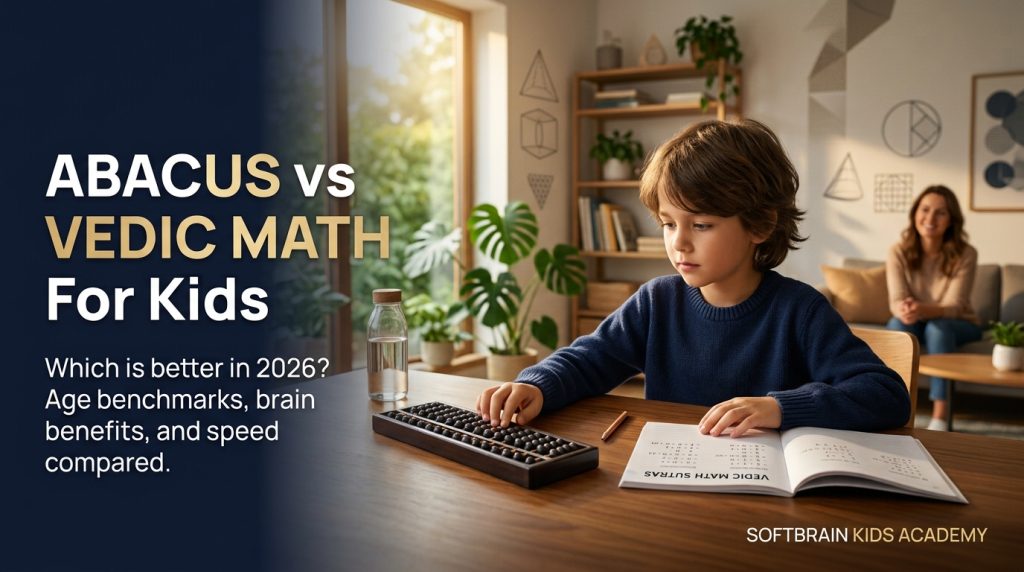

Abacus vs Vedic Math for Kids: Which Is Better in 2026?
At a Glance: Abacus vs Vedic Math for Kids
When evaluating abacus vs vedic math for kids, the decision comes down to your child’s age and mathematical goals. Abacus uses physical and visual bead manipulation (ideal for ages 4 to 9), while Vedic Math uses 16 word sutras for rapid mental calculation (best for ages 8 to 14).
Parents wanting to give their children a competitive edge in math often compare two world-renowned mental math systems: Abacus training and Vedic Mathematics. Deciding between abacus vs vedic math for kids requires understanding how each methodology functions, the cognitive benefits each develops, and how they align with your child’s grade school curriculum.
At SoftBrain Kids Academy, we specialize in live 1-on-1 online classes for both Abacus and Vedic Math. In this ultimate 2026 comparison guide, we break down methodology differences, present a 10-point side-by-side comparison table, analyze age benchmarks, and recommend the best learning pathway for your child.

1. Core Methodology: How Abacus and Vedic Math Differ
Understanding the fundamental difference in abacus vs vedic math for kids begins with their underlying operational mechanics. Read our introductory guides on benefits of abacus for kids and what is Vedic math.
Abacus Math (Soroban): A tactile, visual system originating in Asia. Children manipulate physical beads on a frame, representing place values (ones, tens, hundreds). As students advance, they project a virtual abacus in their mind’s eye (Anzan), achieving photographic mental calculation. Explore how abacus works step by step.
Vedic Mathematics: An ancient mental calculation system derived from 16 Indian math sutras (word formulas). Instead of physical beads, Vedic math uses algebraic number decomposition shortcuts to perform complex multiplication, division, squaring, and roots in seconds. Read 10 speed Vedic math shortcuts.
2. 10-Point Abacus vs. Vedic Math Comparison Table
| Feature | Abacus Math (Soroban) | Vedic Mathematics |
|---|---|---|
| Primary Tool | Physical & Mental Soroban Bead Frame | 16 Word Sutras (Mental Formulas) |
| Ideal Starting Age | Ages 4 to 9 (Early Elementary) | Ages 8 to 14 (Middle School+) |
| Prerequisite Knowledge | None (Learns 1-10 counting from scratch) | Basic single-digit multiplication tables |
| Brain Hemisphere Stimulation | Right Brain (Spatial visualization & Anzan) | Left Brain (Logic, pattern recognition) |
| Primary Mathematical Strength | Rapid Multi-Row Addition & Subtraction | Lightning Multiplication, Squaring & Division |
| Program Duration | 8 Levels (~2 to 2.5 Years) | 4 Modules (~10 to 12 Months) |
| Standardized Exam Impact | Zero calculation error rate on MAP tests | Saves 12+ minutes on SAT Math section |
3. Age Readiness: When to Start Each Program
Age is the most critical factor when choosing between abacus vs vedic math for kids:
- For Children Aged 4 to 7 (Pre-K to 2nd Grade): Choose online abacus classes for kids. Younger kids thrive on physical touch. Moving colorful beads makes numbers concrete and eliminates early math anxiety in kids. Read how to teach abacus to kindergarteners.
- For Children Aged 8 to 14 (3rd to 9th Grade): Choose best Vedic math classes for kids or vedic math online classes for beginners. At this stage, children have mastered basic tables and can leverage speed sutras for school exams.
Get a Free Math Skill Assessment for Your Child
Unsure whether Abacus or Vedic Math is right for your child? Book a free 1-on-1 evaluation with SoftBrain Kids Academy!
Book a Free Assessment Class →4. Brain Benefits: Right-Brain vs. Left-Brain Development
Neuroscientific research conducted by Harvard University Center on the Developing Child proves that Abacus training stimulates the right brain hemisphere through spatial visualization. Read about abacus for brain development and right brain training for kids.
Vedic Math activates the left brain’s logical pattern recognition centers. Combining both creates whole-brain synergy. Explore brain exercises for kids and brain development activities for children.
5. Impact on School Tests, SAT & Math Olympiads
Abacus students excel at elementary place value and long addition accuracy. Vedic math students dominate middle school algebra and timed competitive exams like SAT, AMC 8, and Math Kangaroo. Read is abacus useful for school math and how to improve math speed for kids.
6. Class Format & Tuition Fee Comparison
Review complete tuition price breakdowns in abacus class fees and course duration and Abacus vs Kumon vs Mathnasium.
7. Final Verdict: Which Program Should You Choose?
- Choose Abacus if: Your child is 4 to 8 years old, struggles with tactile counting, or needs visual right-brain development.
- Choose Vedic Math if: Your child is 8+ years old, wants to calculate 10x faster on school tests, or is preparing for SATs and Math Olympiads.
- The Ideal Pathway: Start with Abacus in Grades K–3, then transition to Vedic Math in Grades 4–8 for ultimate math mastery!
Claim Your Child’s Free Demo Class
SoftBrain Kids Academy offers live 1-on-1 private lessons for both Abacus and Vedic Math. Book a free trial today!
Try a Free Demo Class →