
Abacus Training for Kids at Home: Complete Parent Guide (2026)
At a Glance: Abacus Training for Kids at Home
Starting abacus training for kids at home requires a quality Soroban ($10–$25), structured live instruction, and 10 to 20 minutes of daily practice. This guide provides a complete setup checklist, tool comparison table, weekly practice schedules by level, and parent involvement strategies proven to accelerate results.
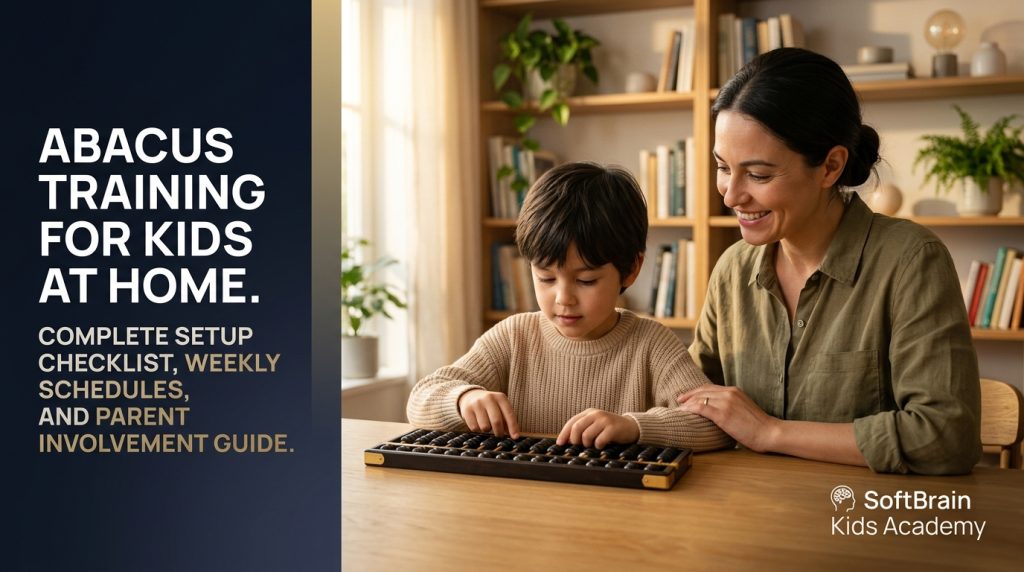
More parents than ever are searching for ways to start abacus training for kids at home. Whether you’re supplementing school math or building a complete mental math foundation, home-based practice is the key to rapid progress. This guide shows you exactly how to set up, structure, and sustain effective abacus practice at home.
At SoftBrain Kids Academy, our online abacus classes for kids deliver live 1-on-1 instruction directly to your home. Between sessions, children practice at home following the structured schedules outlined in this guide.

1. Home Setup Checklist for Abacus Training
Before starting abacus training for kids at home, gather these essentials:
- ✅ Physical Soroban: 13-rod or 17-rod Japanese abacus with reset button ($10–$25 on Amazon). See how abacus works step by step.
- ✅ Quiet practice space: Dedicated desk area, well-lit, minimal distractions
- ✅ Timer: Kitchen timer or phone stopwatch for timed drills
- ✅ Practice workbook: Level-appropriate worksheets with 20–30 problems per page
- ✅ Progress chart: Visual tracker (star chart for young children) to celebrate milestones
- ✅ Online class setup: Laptop/tablet with camera for live instruction sessions
- ✅ Pencil and notebook: For writing answers and tracking accuracy
2. Abacus Tool Comparison: Physical vs. Virtual vs. Hybrid
| Feature | Physical Soroban | Virtual Abacus App | Hybrid (Both) |
|---|---|---|---|
| Fine Motor Development | ★★★ Excellent | ★ Limited | ★★★ Excellent |
| Portability | ★★ Moderate | ★★★ Any device | ★★★ Flexible |
| Cost | $10–$25 one-time | Free to $5/month | $10–$30 total |
| Anzan Transition | ★★★ Best foundation | ★★ Good supplement | ★★★ Optimal |
| Our Recommendation | Levels 1–3 | Supplementary only | All Levels ✅ |
Read our detailed comparison in online abacus vs offline abacus classes.
3. Weekly Practice Schedule by Level
Use this schedule to structure your child’s abacus training for kids at home. See all levels in abacus math levels explained.
| Level | Mon–Fri Activity | Duration | Saturday | Sunday |
|---|---|---|---|---|
| Level 1 (Basics) | Bead counting, number recognition | 10 minutes | Fun math games | Rest day |
| Level 2 (Addition) | Small Friends + simple addition drills | 12 minutes | Review + 1 timed test | Rest day |
| Level 3 (Big Friends) | Big Friends + mixed operations | 15 minutes | Timed sprint (20 problems) | Rest day |
| Level 4–5 (Multiplication) | Multiplication + Anzan intro | 20 minutes | Full practice exam | Light Anzan practice |
| Level 6–8 (Advanced) | Division + mental Anzan sprints | 25 minutes | Competition prep | Mental math games |
4. Parent’s Role: What to Do (And What NOT to Do)
✅ DO These Things
- Create a consistent schedule: Same time, same place, every day builds habit
- Time the practice: Use a timer to create gentle urgency
- Celebrate small wins: Star charts, verbal praise, small rewards for milestones
- Watch accuracy, not just speed: 90%+ accuracy before increasing speed
- Attend parent-teacher updates: Stay informed about curriculum progress
❌ DON’T Do These Things
- Don’t teach bead techniques yourself unless you’re certified — wrong finger movements create hard-to-fix habits. Leave technique instruction to qualified tutors.
- Don’t compare with other children: Every child progresses at their own pace. Read math anxiety in kids to understand why comparison backfires.
- Don’t skip rest days: Mental fatigue reduces retention. 5 days on, 1–2 days off is optimal.
- Don’t rush through levels: Mastery at each level is critical for long-term success.
5. Online Training vs. Physical Learning Center
| Factor | Online 1-on-1 (SoftBrain) | Physical Center |
|---|---|---|
| Convenience | No commute, learn from home | 30–60 min commute |
| Class Size | 1-on-1 private | 10–20 students |
| Schedule Flexibility | Choose any time slot | Fixed batch timings |
| Cost per Month | Competitive pricing | Often 20–40% higher |
| Parent Involvement | Can observe classes | Drop-off only |
Read our full comparison: online abacus vs offline abacus classes. Also see abacus class fees and course duration and abacus learning center for kids.
6. Progress Milestones to Track
Use these milestones to gauge your child’s abacus training for kids at home progress:
- Month 1–2: Reads numbers 0–9 on Soroban. Adds single digits without formulas. See how to teach abacus to kindergarteners.
- Month 3–4: Masters Small Friends (+5) formula. Adds 2-digit numbers.
- Month 5–6: Masters Big Friends (+10) formula. Adds and subtracts 3-digit numbers. Read abacus addition and subtraction rules.
- Month 7–9: Begins multiplication. Read abacus multiplication for kids.
- Month 10–12: Starts Anzan (mental abacus) visualization. Read mental math for kids.
- Month 12+: Performs 3-digit mental addition in under 5 seconds. Competition readiness. Read benefits of abacus for kids.
7. 5 Common Mistakes Parents Make
- Buying the wrong abacus: Chinese-style (2 upper beads) ≠ Soroban (1 upper bead). Most curricula use Soroban.
- Skipping the physical abacus: Going straight to virtual apps weakens motor memory and Anzan transition. Read abacus for brain development.
- Inconsistent practice: 3 days on, 4 days off destroys retention. Aim for 5+ days per week.
- Teaching techniques from YouTube: Without proper training, children develop wrong finger positions that are extremely difficult to correct later.
- Pushing speed before accuracy: Speed without accuracy is meaningless. The target is 90%+ accuracy FIRST, then increase speed. Read how to improve math speed for kids.
Start Abacus Training at Home with Expert Guidance
SoftBrain Kids Academy offers live 1-on-1 online abacus classes. Your child learns from a certified tutor while practicing at home with structured worksheets and progress tracking. Book a free trial!
Book a Free Demo Class →