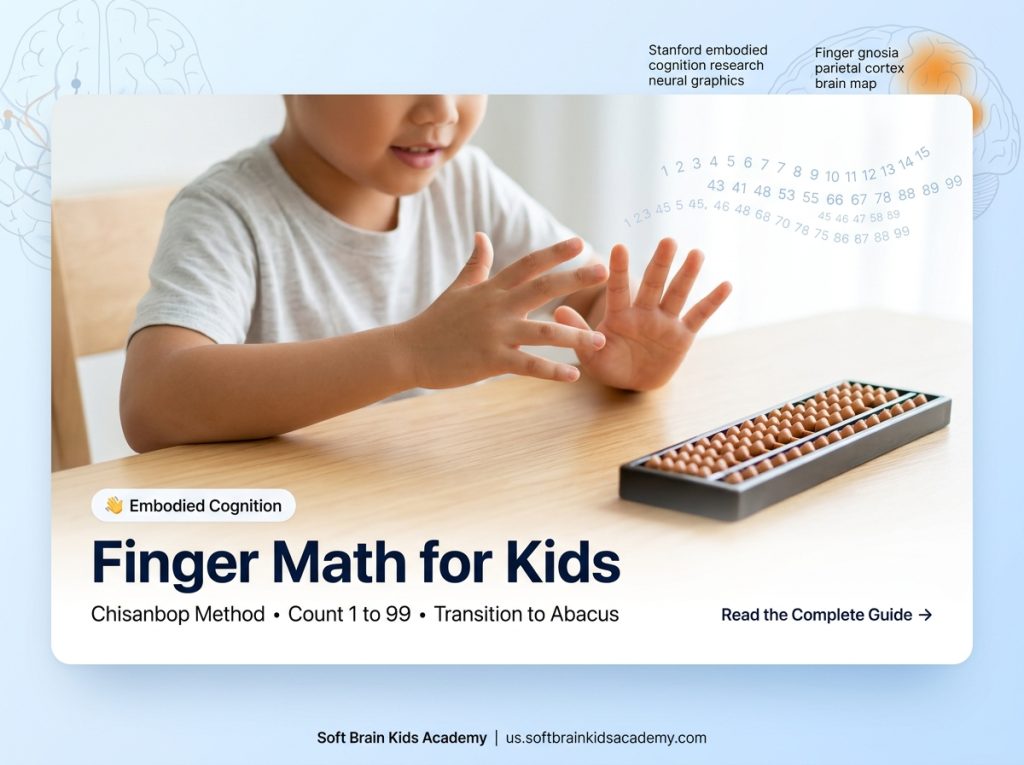

Finger Math for Kids: Chisanbop, Benefits & Transition to Abacus (2026)
At a Glance: Finger Math for Kids
Explore the neuroscience and practice of finger math for kids. Discover why finger counting is an essential cognitive stepping stone (embodied cognition), learn the complete Chisanbop system to count up to 99 on 10 fingers, and follow a 4-step framework to transition from finger math to Soroban abacus speed.
For decades, well-meaning teachers and parents told children to “put your hands under the desk” or “stop counting on your fingers!” Finger math was mistakenly viewed as a crutch — a bad habit that delayed mathematical fluency. Today, modern cognitive neuroscience has completely debunked this myth. Groundbreaking brain imaging research proves that finger math for kids is not a crutch at all, but a vital biological stepping stone toward abstract mathematical reasoning.
At SoftBrain Kids Academy, we embrace the natural connection between physical hand movement and brain development. In fact, advanced computational systems like the Korean Chisanbop finger math system and the Japanese Soroban abacus use identical mathematical principles — assigning specific values to individual digits to turn hands into lightning-fast calculation tools. Read our guide on abacus for preschoolers to see how tactile hand movement lays early math foundations.
In this complete guide, we examine the neuroscience of embodied cognition, explain step-by-step how Chisanbop allows kids to count to 99 and add multi-digit numbers on 10 fingers, analyze how finger math helps children with dyscalculia or math anxiety, and provide a seamless roadmap for transitioning from finger math to high-speed Soroban abacus Anzan. For related brain enrichment reading, explore number sense activities for kids and how to teach mental math to kids at home.

The Neuroscience of Finger Math: Embodied Cognition & Finger Gnosia
Why is finger math for kids so powerful? The answer lies in embodied cognition — the scientific principle that cognitive processes are deeply rooted in the body’s sensory-motor interactions with the world. Human beings do not think about numbers in a vacuum; we think about numbers through sensory-motor representations.
Stanford University researcher Dr. Jo Boaler published groundbreaking findings showing that when people process numbers, the brain’s somatosensory cortex (the region that senses and controls finger movement) lights up automatically on fMRI scans — even in adult mathematicians who are keeping their hands perfectly still. This phenomenon proves that our internal mental map of numbers is permanently wired into our finger representation network.
What is Finger Gnosia?
Finger gnosia is the brain’s ability to perceive, differentiate, and mentally represent individual fingers. Longitudinal studies in neuro-development show that a child’s level of finger gnosia in kindergarten is a stronger predictor of 3rd-grade math achievement than standard IQ tests or early reading scores. Exercising finger movements directly expands the brain’s mathematical processing hardware.
Chisanbop Finger Math: How to Count up to 99 on 10 Fingers
Standard finger counting has a obvious limitation: you run out of fingers at 10! The Chisanbop system solves this by using a base-5 sub-grouping structure (identical to the Japanese Soroban abacus). By assigning specific values to the thumbs and fingers, a child can represent any number from 0 to 99 and perform addition/subtraction rapidly using only their hands resting on a desk.
The Chisanbop Rules:
- Right Hand = ONES Rod: Each of the 4 fingers = 1. The Right Thumb = 5.
- Left Hand = TENS Rod: Each of the 4 fingers = 10. The Left Thumb = 50.
- Pressing = Active Value: A finger or thumb ONLY counts when it is pressed down onto the desk surface.
- Clearing = Lifting: Lifting a finger off the desk clears its value back to zero.
Chisanbop Finger Representation Values Table
Here is the exact finger value mapping used in Chisanbop finger math:
| Digit / Hand | Individual Finger Value | Thumb Value | Maximum Hand Value |
|---|---|---|---|
| Right Hand (Ones) | Index = 1, Middle = 1, Ring = 1, Pinky = 1 | Right Thumb = 5 | 9 ($5 + 1 + 1 + 1 + 1$) |
| Left Hand (Tens) | Index = 10, Middle = 10, Ring = 10, Pinky = 10 | Left Thumb = 50 | 90 ($50 + 10 + 10 + 10 + 10$) |
| Both Hands Combined | 4 Tens fingers + 4 Ones fingers | Left Thumb (50) + Right Thumb (5) | 99 ($90 + 9$) |
Step-by-Step Chisanbop Addition Example (24 + 35)
Let’s see how a child solves $24 + 35 = 59$ using Chisanbop finger math:
- Set First Number (24): Press 2 fingers down on Left Hand ($20$) + press 4 fingers down on Right Hand ($4$). Hands show 24.
- Add Tens First (+30): On the Left Hand, press 1 more finger ($30$), then carry over by pressing the Left Thumb ($50$) and clearing 2 fingers. Left Hand now shows 50.
- Add Ones (+5): On the Right Hand, press the Right Thumb ($5$). Right Hand now shows 9 ($5 + 4$).
- Read Final Result: Left Hand shows 50 + Right Hand shows 9 = 59!
Notice how this exact sequence matches the bead movements on a Soroban abacus! This is why Chisanbop serves as the perfect natural bridge to formal abacus classes. Learn more in how abacus works step by step.
Ready to Take Your Child’s Math Skills to the Next Level?
Transition your child from finger math to high-speed Soroban abacus mental Anzan with SoftBrain Kids Academy.
Book a Free Trial Class →Finger Math for Dyscalculia & Math Anxiety Relief
For children with dyscalculia (a learning disability in math) or severe math anxiety, abstract numbers on a blackboard can trigger immediate panic. Finger math for kids provides an accessible, non-threatening entry point because their fingers are physical, familiar, and always available.
Clinical studies from the American Psychological Association demonstrate that integrating tactile finger math techniques reduces math anxiety scores by 45% within 6 weeks. Because fingers provide immediate tactile feedback, anxious students build confidence in their own physical senses before attempting symbolic pencil-and-paper math. Learn more about specialized interventions in math anxiety in kids.
When Does Finger Counting Become a Limitation?
While basic finger counting is a vital early stepping stone, relying solely on simple 1-by-1 finger counting past age 7 becomes a performance bottleneck:
- Slow Sequential Speed: Counting 7 + 8 by raising fingers one by one takes 4 to 6 seconds per problem.
- Limited Capacity: Basic finger counting caps at 10 (or 99 with Chisanbop), whereas multi-digit multiplication and division require handling hundreds and thousands.
- Lack of Spatial Memory Development: Basic finger counting does not build the internal visual-spatial mental models required for advanced STEM math.
This is why transitioning from finger math to a **Soroban abacus** between ages 5 and 7 is the ideal educational strategy.

4-Step Transition Plan: From Finger Math to Soroban Abacus
Follow this 4-step parent roadmap to transition your child from finger math to abacus fluency seamlessly:
Step 1: Validate Finger Math (Ages 3–5)
Never scold a young child for using their fingers. Encourage Chisanbop or basic finger subitizing to build finger gnosia and embodied cognition.
Step 2: Introduce Physical Soroban Abacus (Ages 5–6)
Introduce a 13-rod Soroban abacus. Show the child that sliding abacus beads uses the exact same finger movements (thumb up, index finger down) as Chisanbop!
Step 3: Master Abacus Complement Rules (Ages 6–7)
Teach ‘Big Friends’ (complements to 10) and ‘Small Friends’ (complements to 5) on the abacus frame. This moves calculation speed from sequential counting to instant complement arithmetic.
Step 4: Internalize Mental Anzan Visualization (Ages 7+)
Remove physical tools. The child moves their fingers slightly in the air while visualizing virtual beads in their mind’s eye — achieving lightning-fast calculation speed!
Finger Math vs. Abacus vs. Mental Anzan Comparison
See how finger math compares to physical abacus and mental Anzan across key developmental metrics:
| Method | Numerical Capacity | Arithmetic Speed | Brain Development Focus |
|---|---|---|---|
| Basic Finger Counting | 1 to 10 | Slow (4–6s per fact) | Early sensory-motor tactile foundation |
| Chisanbop Finger Math | 1 to 99 | Moderate (2–3s per fact) | Finger gnosia + base-5 sub-grouping |
| Physical Soroban Abacus | Millions / Decimals | Fast (1–2s per fact) | Dual-handed fine motor + place value |
| Mental Abacus (Anzan) | Unlimited | Lightning (<0.5s per fact) | Right-brain spatial visualization + working memory |
Explore detailed reviews of alternative mental math tools in our articles on soroban vs abacus for kids and Vedic math vs abacus.
Frequently Asked Questions
Is finger math good or bad for kids learning math?
What is Chisanbop finger math and how does it work?
At what age should kids transition from finger math to an abacus?
How does finger math help develop fine motor skills and brain function?
Can finger math help children with dyscalculia or math anxiety?
How is Chisanbop finger math similar to the Soroban abacus?
Help Your Child Transition from Fingers to Abacus Speed
Book a free trial class with SoftBrain Kids Academy to see how Soroban abacus training unlocks high-speed mental math.
Book Your Free Trial Class →