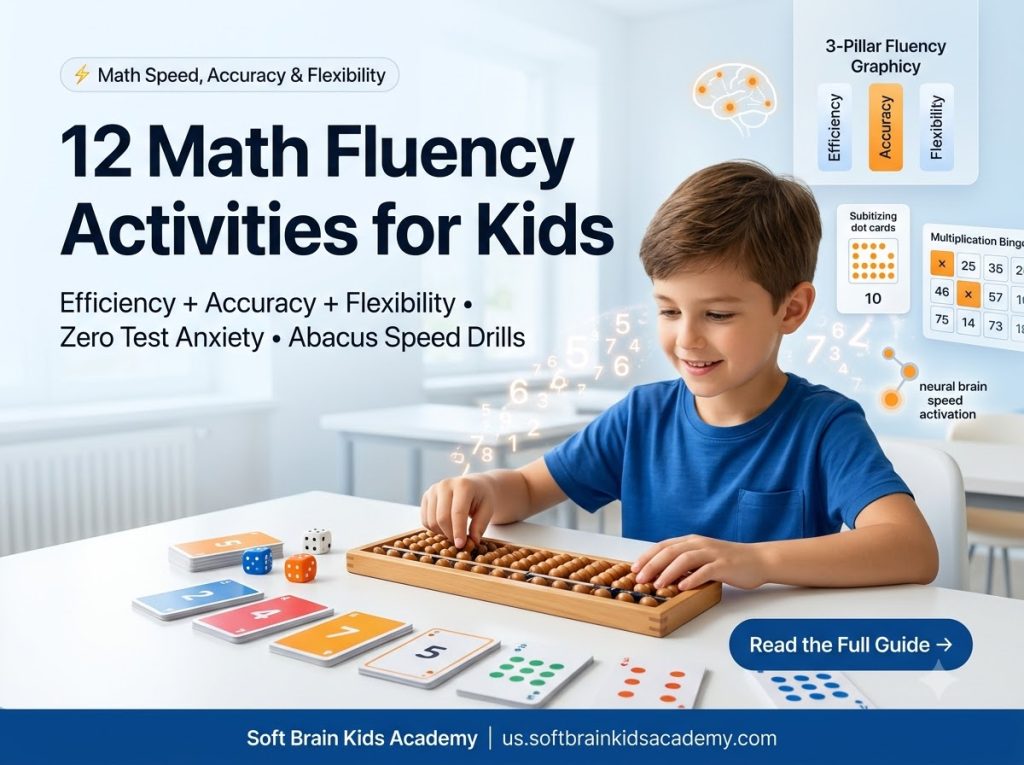

12 Math Fluency Activities for Kids: Build Speed & Accuracy (2026)
At a Glance: Math Fluency Activities for Kids
Discover 12 math fluency activities for kids that build efficiency, accuracy, and strategic flexibility. From tactile Soroban abacus bead drills and mental math games to array visualizers and card challenges, learn how to build automatic math fact recall without stress or timed test anxiety.
In modern mathematics education, few terms are more widely used — or more frequently misunderstood — than “math fluency.” Many parents and educators mistakenly equate math fluency with raw calculation speed on timed tests. However, the National Council of Teachers of Mathematics (NCTM) emphasizes that true math fluency requires three distinct pillars: Efficiency (using a clear, direct method), Accuracy (reliably reaching the correct answer), and Flexibility (knowing multiple strategies and choosing the most elegant one for specific numbers).
When children practice math fluency activities for kids that combine these three pillars, math ceases to be an anxious race against the clock. Instead, it becomes an engaging game of numerical strategy.
At SoftBrain Kids Academy, our specialized live programs integrate tactile Soroban abacus bead training with ancient Vedic math shortcuts to cultivate genuine mathematical fluency. Read our companion articles on how to improve math speed for kids, number sense activities for kids, and mental math for kids.

The 3 Pillars of Math Fluency: Efficiency, Accuracy & Flexibility
Understanding the three pillars of math fluency transforms how parents support their children at home:
⚡ Pillar 1: Efficiency
Carrying out a calculation without getting lost in unnecessary sub-steps. Example: knowing that 9 + 6 is 10 + 5 = 15 instantly instead of counting 6 individual fingers.
🎯 Pillar 2: Accuracy
Reliably reaching the correct result through sound number logic and careful execution.
🔄 Pillar 3: Flexibility
Knowing multiple strategies and choosing the best one. Example: solving 19 × 5 by doing (20 × 5) − 5 = 95 rather than long multiplication.
🧮 Build Unstoppable Math Fluency in Your Child
SoftBrain Kids Academy combines Soroban abacus and Vedic shortcuts for ultimate math speed and accuracy. Book a free trial class.
Book Free Trial Class →12 High-Impact Math Fluency Activities for Kids
1. Soroban Abacus Speed Bead Blitz
Practice rapid bead movement on a Soroban abacus frame. Call out number combinations and have your child enter them physically on rods. The tactile bead movement builds muscle memory and visual automaticity.
2. Make-a-Ten Card Game
Using a standard deck of cards (face cards removed), deal 5 cards face up. Players race to find pairs that sum to 10. Builds instant addition complement fluency.
3. Target Number 24 Challenge
Deal 4 numbers (e.g., 3, 8, 2, 1). Challenge your child to combine all four numbers using addition, subtraction, multiplication, or division to reach a target of 24. Develops extreme calculation flexibility.
4. Multi-Digit Multiplication Shortcuts (Vedic Cross)
Practice Vedic math sutras like Vertically and Crosswise. Read our guide on multiplication tricks for kids.
5. Ten-Frame Subitizing Flash
Flash ten-frame dot cards for 1 second. Have your child state the number without counting individual dots. Builds instant spatial subitizing visual fluency.
6. Multiplication War Card Game
Two players turn over a card simultaneously. The first player to multiply the two card values wins the cards. Low-stakes competitive fun.
7. Mental Anzan Bead Visualization
Transition from physical abacus to mental Anzan — calculating with imaginary beads in the mind’s eye. Expands visual working memory.
8. Compensation Addition Strategy
Teach kids to add by rounding up to tens: solve 48 + 27 as (50 + 27) − 2 = 75. Promotes mathematical flexibility.
9. Skip-Counting Rhythm Clapping
Chant skip-counting sequences (3, 6, 9, 12…) while clapping hands in rhythm. Connects auditory and motor cortical pathways.
10. Math Fact Bingo
Create Bingo cards with answer numbers. Call out equations (e.g., ‘7 × 8’). Kids mark the correct product. Great for group play.
11. Double & Half Strategy for Multiplication
To solve 14 × 5, halve 14 to get 7 and double 5 to get 10 → 7 × 10 = 70. Builds mental multiplication speed.
12. Daily 10-Minute Mental Math Sprint
A 10-minute un-timed daily mental math sprint. Celebrate individual personal best scores to build math confidence.
Why Timed Tests Destroy Fluency (and What to Do Instead)
Research from Stanford University’s Jo Boaler demonstrates that timed 1-minute math sheets trigger fight-or-flight stress responses in over one-third of elementary students, blocking working memory retrieval. Timed drills measure stress tolerance, not mathematical fluency! Replace timed sheets with game-based challenges and tactile abacus practice.
The Abacus Advantage: Tactile & Visual Anzan Automaticity
Abacus training builds superior math fluency because it bypasses language-based counting. Bead positions represent numbers spatially. When children move to mental Anzan, they manipulate bead images in their right parietal brain hemisphere, performing multi-digit calculations with effortless automaticity. Read our article on abacus math levels explained.
Fluency Milestones Table by Grade Level
| Grade | Target Fluency Milestone | Key Activity |
|---|---|---|
| K–1st | Addition & Subtraction within 10 | Make-a-Ten Card Game, Abacus counting |
| 2nd–3rd | Single-Digit Addition/Subtraction & 2s/5s/10s Times Tables | Abacus bead blitz, Finger 9s trick |
| 4th–6th | Multiplication & Division within 12×12, Multi-Digit Mental Math | Vedic cross multiplication, Mental Anzan |
🚀 Build Lightning-Fast Math Fluency Today
Book a free trial class at SoftBrain Kids Academy. Watch your child develop math speed, accuracy, and joy.
Book Free Trial Class →